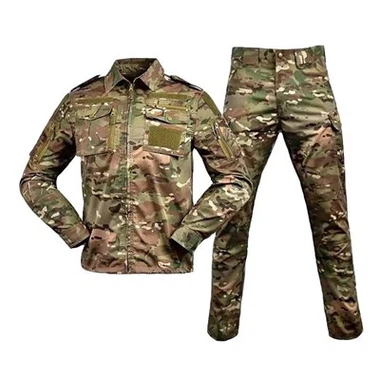

Infrared Camouflage of Camouflage Uniforms: Why Do Ordinary Camouflage Uniforms Show UP Under Thermal Imagers?
Nov 10, 2026


1. Introduction: Camouflage Uniforms Can Fool the Human Eye – Why Can't They Fool Thermal Imaging?
A common confusion is this: why does a camouflage uniform that is almost invisible to the naked eye in the jungle look like a glowing light bulb on a thermal imager screen?
The answer lies in the fact that the two ways of "seeing" are completely different. The human eye sees reflected light-camouflage uniforms simulate the environment through colours and patterns, deceiving the visual system. A thermal imager, by contrast, sees the thermal radiation emitted by the object itself-any object with a temperature above absolute zero emits infrared radiation, and thermal imaging equipment captures this radiation and converts it into a visible image.
This means that no matter how realistic the camouflage pattern is, a human body at 36–37℃ is naturally a "heat source" in a thermal imager. If a camouflage uniform has only addressed the problem of "looking like the environment" but has not addressed the problem of "radiating like the environment," then in front of thermal imaging, it is effectively "naked."
This is the fundamental reason why ordinary camouflage uniforms "show up" under thermal imaging.

2. First, Distinguish: Near-Infrared Camouflage vs. Thermal Infrared Camouflage
When discussing "infrared camouflage," many people conflate two concepts. In reality, near-infrared (NIR) and thermal infrared (TIR) target two different types of detection equipment, and their protection logics are completely different.
2.1 Near-Infrared (NIR): Protection Against "Night Vision Goggles"
Near-infrared camouflage targets equipment such as night vision goggles and low-light image intensifiers. These devices operate in the approximate 700–1400 nm or even wider near-infrared band, and are essentially imaging methods that "enhance reflected light."
The core threat in the near-infrared is this: if the reflection characteristics of a camouflage uniform in the near‑infrared band are inconsistent with the background such as vegetation and soil, it will "light up" or "go dark" on the night vision screen. What near‑infrared camouflage must do is spectral reflectance matching – making the reflectance curve of the fabric as close as possible to the natural background. A key indicator is the K value. When the near‑infrared reflectance matching K value is >5, the camouflage fabric can effectively "blend" into the vegetation background under night vision.
2.2 Thermal Infrared (TIR): Protection Against "Thermal Imagers"
Thermal infrared camouflage targets thermal imagers. Thermal imagers operate in the two atmospheric windows of 3–5 μm (mid‑infrared) and 8–14 μm (far‑infrared), capturing the object's own thermal radiation, not reflected light.
This determines that the technical path of thermal infrared camouflage is fundamentally different from near‑infrared: it is not "reflecting like the background," but "radiating like the background." Even if an ordinary camouflage uniform has excellent near‑infrared camouflage, if its surface temperature and emissivity cause the thermal signal it radiates to differ too much from the background, it will still be clearly visible under a thermal imager.
- One‑sentence distinction: NIR is "making night vision goggles unable to see reflected light"; TIR is "making thermal imagers unable to see thermal radiation." Two sets of standards, two types of materials, two testing dimensions – they cannot substitute for each other.

3. Core Physics: Emissivity and Temperature Jointly Determine "Thermal Brightness"
To understand thermal infrared camouflage, one must return to a basic physical formula – the Stefan‑Boltzmann Law: the infrared energy radiated by an object is proportional to its emissivity (ε) and the fourth power of its absolute temperature (T) .
The formula looks simple, but it directly gives two basic paths for thermal infrared camouflage:
Path One: Reduce emissivity (ε). The closer emissivity is to 1, the more the object behaves like a "perfect thermal radiator"; the lower the emissivity, the less infrared energy is radiated at the same temperature, and the "darker" it appears on a thermal imager.
Path Two: Control surface temperature (T). Even if emissivity remains unchanged, if the surface temperature of the fabric can be made close to the ambient background, the "contrast" in thermal imaging will drop significantly.
The problem with ordinary camouflage uniforms is precisely this: their fabric emissivity is typically around 0.8–0.9, close to "blackbody" behaviour; at the same time, body heat is continuously transferred outward, making the fabric surface temperature higher than the environment. High emissivity + high surface temperature – the two factors combine to make the wearer a high‑contrast target in a thermal imager.
Particular attention must be paid to the fact that emissivity is "band‑dependent." The same material may have different emissivity in the 8–14 μm and 3–5 μm bands. Therefore, thermal infrared camouflage must be designed for specific detection bands, and it cannot be said in general terms that "low emissivity" is sufficient.

4. Three Technical Paths for Thermal Infrared Camouflage
4.1 Low‑Emissivity Coatings: Making the Surface "Radiate Less"
The most direct approach is to build a low‑emissivity functional layer on the fabric surface to reduce its radiation capability in the thermal infrared band.
Common solutions in research and patents include electroless silver‑plated fabrics, metal‑filled coatings, and conductive material coatings such as MXene. For example, one study used electroless silver plating to reduce the fabric's emissivity to 0.687 in the 8–14 μm band and 0.655 in the 3–5 μm band, significantly lower than the 0.8–0.9 level of ordinary textiles. The logic of low‑emissivity materials is to make the target "darker" in thermal imaging, rather than to hide it by cooling.
The engineering difficulty of low‑emissivity coatings lies in durability: the coating must withstand washing, abrasion, and environmental ageing, while not excessively sacrificing the fabric's flexibility and breathability. This is also why military standards specifically test thermal cycle tolerance and heat resistance.
4.2 Phase‑Change Microcapsules: Making Temperature "Change More Slowly"
Another path is temperature regulation-not pursuing extremely low emissivity, but using phase-change materials (PCMs) to absorb or release heat, delaying the rise or fall of the fabric surface temperature, thereby reducing the temperature difference between the target and the environment.
When phase-change materials undergo solid–liquid phase change, they can absorb or release a large amount of latent heat within a certain temperature range while their own temperature changes very little. After microencapsulation, phase-change materials can be coated or combined onto textiles to "absorb" part of the heat when the human body generates heat, delaying the surface temperature rise of the fabric and blurring the "thermal outline" in thermal imaging.
Research data shows that coatings containing phase‑change microcapsules can make the surface temperature 2–3℃ lower than untreated samples on a 50℃ hot plate; more complex composite systems can achieve an actual temperature difference of up to 21.6℃ from untreated fabric on a simulated heat source, and maintain the surface temperature below 38℃ within 300 seconds. This "peak-shaving" effect is exactly what thermal infrared camouflage requires.
4.3 Temperature Matching and Structural Design: Making the Thermal Signal "Blend into the Background"
A more advanced approach is to make the target's thermal signal actively match the environment. Multi-band camouflage technical materials show that, through the combination of low-emissivity coatings and micro-temperature-control structures, it is possible to achieve a thermal radiation temperature difference of <5 K from the environment for 80% of the daily cycle, thereby preventing equipment from "showing up" on thermal imagers due to heat dissipation or cooling.
Here, "5 K" is a valuable reference magnitude: it means that the thermal contrast between the target and the background is controlled at a relatively low level, rather than pursuing "absolutely zero radiation." The goal of thermal infrared camouflage has never been "no radiation at all," but making the radiation signature indistinguishable from the background.

5. How Do Military Standards View This: Emissivity Is Not a "Label," but "Testable Data"
Thermal infrared camouflage performance cannot rely on "claims"; it must be grounded in standardised testing.
China's military testing system has a series of clear standards for thermal infrared stealth coatings and camouflage materials, centred on emissivity in the two atmospheric windows of mid-infrared (3–5 μm) and far-infrared (8–14 μm) .
Relevant standards include:
- GJB 6083-2007 "General specification for thermal infrared stealth coatings": sets specific requirements and test methods for infrared emissivity, solar absorptance, temperature resistance, etc.
- GJB 7928-2012 "General requirements for camouflage coatings": the thermal infrared part specifies evaluation methods for emissivity.
- GJB 2502 series "Test methods for emissivity of infrared radiation coatings": provides the methodological basis for emissivity testing.
The core test items include normal infrared emissivity, hemispherical infrared emissivity, solar absorptance, thermal cycle tolerance, etc. Emissivity measurement usually uses a Fourier transform infrared spectrometer with an integrating sphere or reflectance accessory, calculating the band‑averaged emissivity by comparison with high‑reflectance standard samples and a blackbody furnace.
This means that judging whether an "infrared camouflage uniform" meets the standard cannot rely only on whether it has a camouflage pattern; it depends on whether it has emissivity data for the corresponding band, corresponding standard number, and corresponding test value.

6. Frequently Asked Questions (FAQ)
Q: Why are ordinary camouflage uniforms so bright under thermal imagers?
A: Because thermal imagers see thermal radiation, not reflected light. The fabric emissivity of ordinary camouflage uniforms is typically 0.8–0.9, close to a blackbody; at the same time, body heat makes the fabric surface temperature higher than the environment. High emissivity + relatively high surface temperature – the two factors combine to make the wearer a high‑contrast target in thermal imaging.
Q: If near‑infrared camouflage is done well, can it replace thermal infrared camouflage?
A: No. Near‑infrared camouflage targets night vision goggles (reflected‑light enhancement), while thermal infrared camouflage targets thermal imagers (self‑emitted thermal radiation). Two sets of equipment, two physical mechanisms, two testing standards – they do not replace each other. A fabric with a qualified near‑infrared K value may have no thermal infrared camouflage capability at all under a thermal imager.
Q: For low‑emissivity coatings, is lower emissivity always better?
A: Within a specific detection band, reducing emissivity does reduce thermal radiation and lower thermal imaging contrast. But engineering must also consider durability, flexibility, breathability, and multi‑band compatibility. Military standards test not only emissivity but also thermal cycle tolerance and heat resistance. Simply pursuing the "lowest numerical value" at the expense of practical performance is not a qualified product logic.
Q: Can phase‑change materials "eliminate" thermal signals?
A: No. The role of phase‑change materials is to delay temperature changes and reduce peak temperature differences, making the "thermal outline" in thermal imaging blurry and lower in contrast, rather than making the target completely disappear. Its effect depends on whether the phase‑change temperature matches the use environment, whether the phase‑change enthalpy is sufficient, and its stability under repeated use.

Conclusion
Ordinary camouflage uniforms "show up" under thermal imagers not because the camouflage pattern is poorly drawn, but because they have only solved the problem of "looking like the environment" and have not solved the problem of "radiating like the environment." The human eye sees reflected light; a thermal imager sees the object's own thermal radiation. The rules of the two "worlds" are completely different.
The two core paths of thermal infrared camouflage – reducing emissivity and controlling surface temperature – correspond to low‑emissivity coatings and phase‑change temperature‑control materials, respectively. The ultimate hard yardstick for judging whether a camouflage uniform truly has thermal infrared camouflage capability is not the four words "infrared stealth" on the label, but emissivity test reports for the corresponding band, corresponding standards (GJB 6083 / GJB 7928), and corresponding values. Understanding emissivity is the key to understanding what "stealth" really means in the thermal imaging world.