
The Hardcore Indicators of Camouflage Fabric: How to Understand Weight, Yarn Count, and Abrasion Resistance
Aug 28, 2026
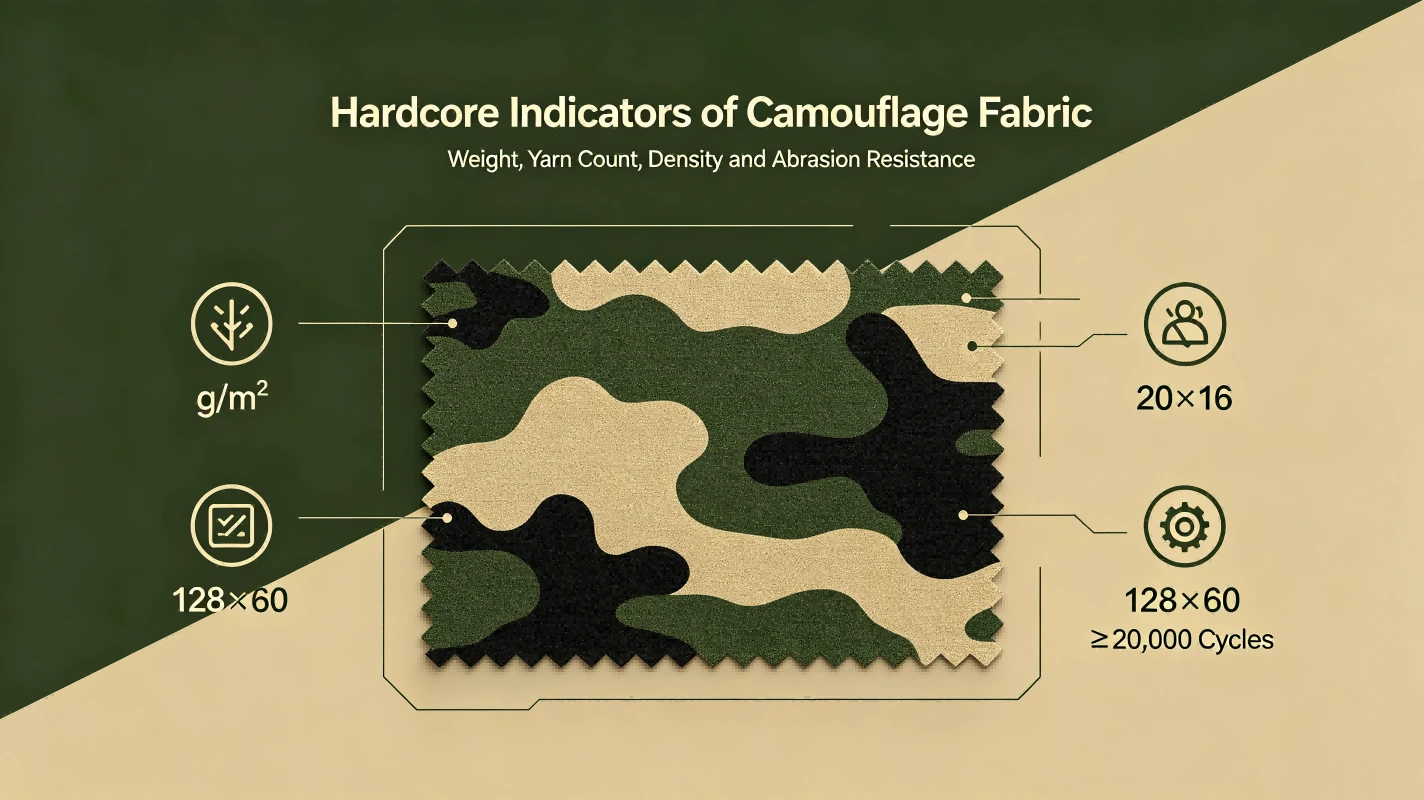
When buying camouflage uniforms or tactical pants, product pages often list a string of numbers like "20×16 128×60," "weight 220g," or "abrasion resistance ≥20,000 cycles." These numbers may look like a secret code, but they're actually not mysterious at all. Once you understand them, you can tell at a glance whether a camouflage uniform is "just for show" or "built to take a beating."
1. Fabric Weight (g/m²): The "Thickness Gauge" of Fabric
Fabric weight refers to the weight of one square metre of fabric, measured in g/m² (grams per square metre). It is the most direct indicator of a fabric's thickness and durability.
Higher weight: the fabric is thicker, more abrasion‑resistant, and crisper, but breathability decreases and it becomes heavier
Lower weight: the fabric is lighter and more breathable, but durability is relatively weaker
The weight of camouflage uniforms varies greatly depending on their intended use:
| Weight range | Best for | Characteristics |
| 150‑180 g/m² | Lightweight summer training uniforms, tropical combat uniforms | Good breathability, but average abrasion resistance |
| 180‑220 g/m² | Spring/autumn general‑purpose camouflage uniforms | Balanced thickness and breathability – the most common specification |
| 220‑260 g/m² | Autumn/winter training uniforms, work‑wear camouflage | Thick, abrasion‑resistant, and reasonably warm |
| 260+ g/m² | Heavy‑duty tactical uniforms, polar training uniforms | Extremely durable, but heavy |
Real procurement examples: Northeast Petroleum University's 2024 military training uniforms required Air Force blue camouflage fabric with weight ≥220 g/m²; another procurement required a weight of 260‑300 g/m². Different weights directly correspond to different usage intensities and seasons.
2. Yarn Count: The "Thickness Code" of Yarn
Yarn count indicates how fine or coarse the yarn is. In camouflage fabric specifications, it is usually written in a format like "20×16."
How to read it:
The number before the multiplication sign (20) represents the warp count – the thickness of the vertical yarns
The number after the multiplication sign (16) represents the weft count – the thickness of the horizontal yarns
The larger the number, the finer the yarn; the smaller the number, the coarser the yarn. Coarser yarns produce thicker, more abrasion‑resistant fabrics, but the hand feel is stiffer. Finer yarns produce lighter, softer fabrics.
Common camouflage fabric yarn count specifications:
| Yarn count | Characteristics | Typical uses |
| 21×21 | Warp and weft yarns have the same thickness – fabric is uniform | Standard training uniforms, spring/autumn training uniforms |
| 20×16 | Warp is finer, weft is coarser – fabric has directional texture | The most common specification for polyester‑cotton twill camouflage |
| 16×16 | Both warp and weft are coarse yarns – fabric is thick and sturdy | Autumn/winter training uniforms, work‑wear camouflage |
One procurement requirement for international students' camouflage uniforms explicitly stated: yarn linear density (tex) warp 21, weft 60. Another training uniform project required yarn count 21×21, density 108×58. Once you understand yarn count, you can assess the fabric's thickness orientation.

3. Fabric Density: The "Weave Density"
Density is the number of yarns per unit length, usually written in a format like "128×60."
How to read it:
The number before the multiplication sign (128) represents the warp density – the number of warp yarns per inch
The number after the multiplication sign (60) represents the weft density – the number of weft yarns per inch
The higher the density, the tighter, more abrasion‑resistant, and more tear‑resistant the fabric – but breathability decreases. For polyester‑cotton twill camouflage, a common specification is 20×16 120×60 – warp yarn count 20, weft yarn count 16, warp density 120 ends per inch, weft density 60 picks per inch.
One procurement notice required: yarn count 20×14, density 108×56, weight 220g. Another required warp density >430 ends/10cm, weft density >220 picks/10cm, and mass per unit area ≥195 g/m².
Quick rule of thumb: smaller yarn‑count numbers = coarser yarns (more abrasion‑resistant); larger density numbers = tighter weave (more tear‑resistant).

4. Abrasion Resistance Grade: The "Real‑World Performance" Indicator
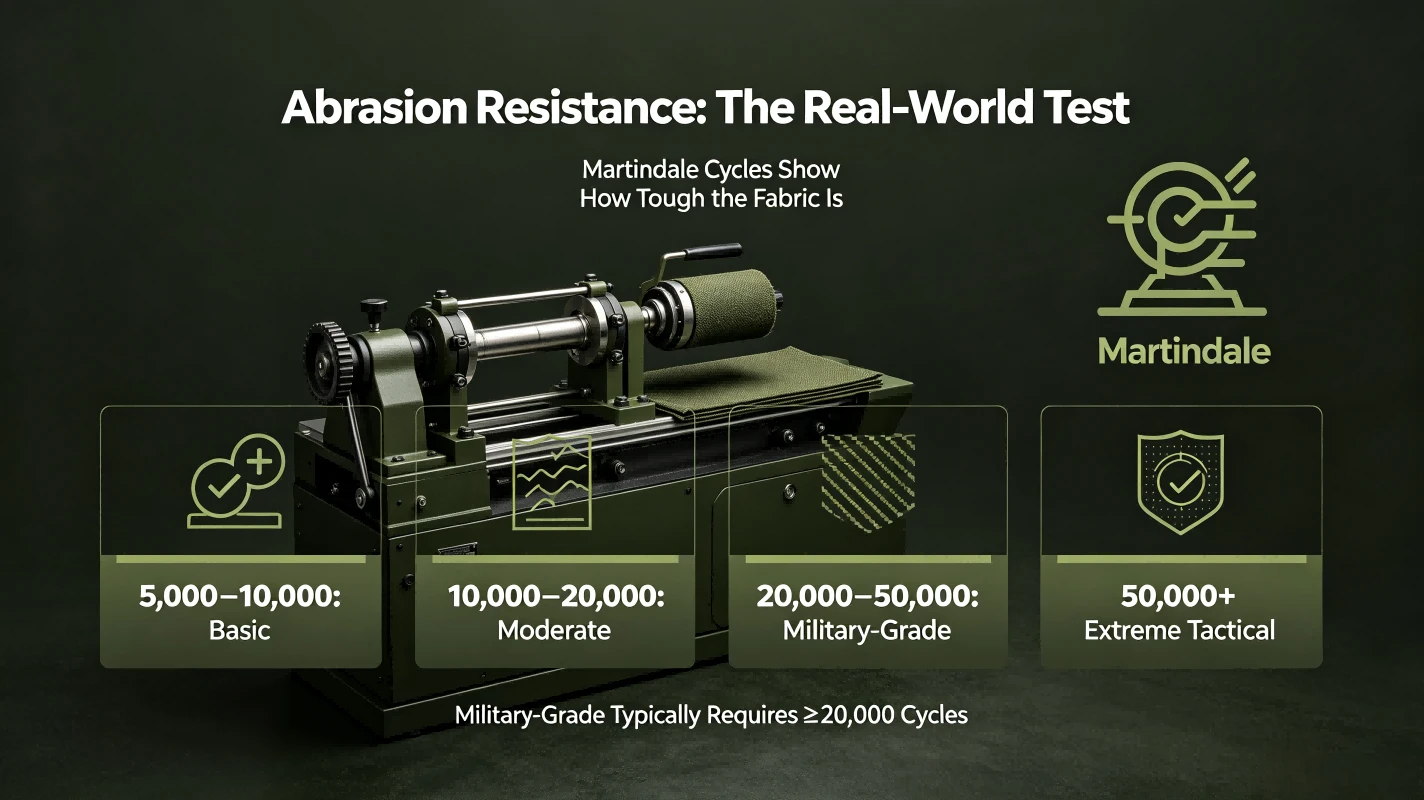
Abrasion resistance is one of the most critical performance indicators for camouflage uniforms. The current mainstream test method is the Martindale method – the fabric is rubbed repeatedly against a standard abrasive under specified pressure, and the number of cycles until damage appears is recorded.
| Abrasion cycles | Grade evaluation | Best for |
| 5,000‑10,000 | Basic abrasion resistance | Everyday casual wear, light use |
| 10,000‑20,000 | Moderate abrasion resistance | Standard training uniforms, general‑purpose training uniforms |
| 20,000‑50,000 | High abrasion resistance | Military training uniforms, tactical gear |
| 50,000+ | Extreme abrasion resistance | Premium tactical gear (Cordura 500D can reach 220,000 cycles) |
Military‑grade camouflage fabric typically requires 20,000+ cycles. One procurement requirement for international students' camouflage uniforms specified abrasion resistance ≥1500 (note: different test methods use different units; the key is to check the test method and standard reference). Always remember: values from different test standards cannot be compared directly – you must verify the test method and standard.
Other relevant indicators:
Breaking strength: warp ≥800 N/5cm, weft ≥700 N/5cm
Tear strength (trapezoid method): ≥50 N
Colourfastness: dry rubbing ≥ grade 4, wet rubbing ≥ grade 3
5. Putting It All Together: Reading a Camouflage Fabric Specification
Take a real procurement specification as an example:
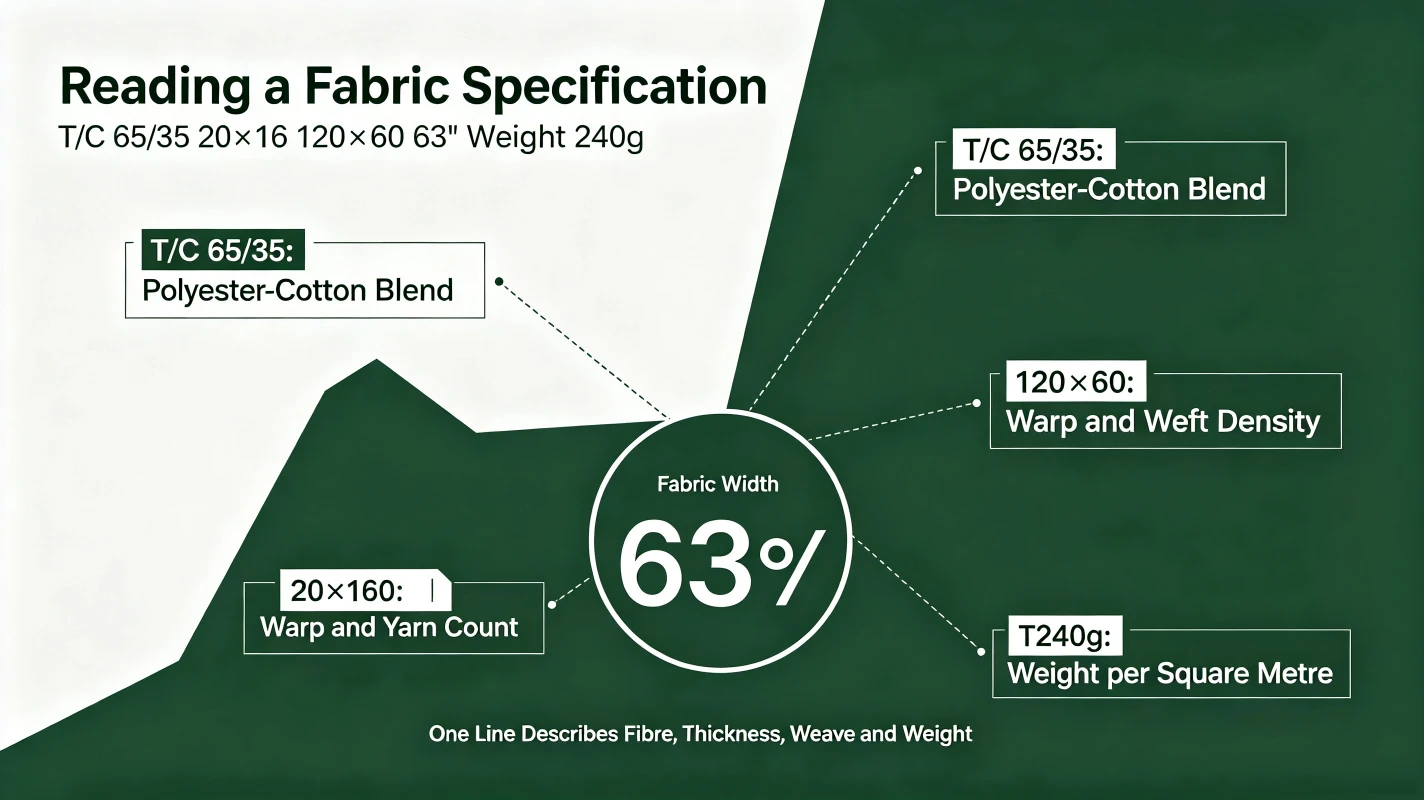
Polyester‑cotton twill T/C 65/35 20×16 120×60 63″ Weight 240g
In plain language:
T/C 65/35: 65% polyester + 35% cotton blend
20×16: warp yarn count 20 (finer), weft yarn count 16 (coarser)
120×60: warp density 120 ends/inch, weft density 60 picks/inch
63″: fabric width 63 inches (approximately 160 cm)
Weight 240g: 240 grams per square metre – a sturdy, abrasion‑resistant fabric
6. Buying Tips
Check the weight first: choose 180‑200 g/m² for summer, 200‑230 g/m² for spring/autumn, and 230+ g/m² for winter or high‑intensity use.
Look at yarn count and density: 20×16 120×60** is the "standard configuration" for polyester‑cotton twill camouflage. Smaller yarn‑count numbers (coarser yarns) + larger density numbers (tighter weave) = better abrasion resistance.
Check the abrasion grade: military‑grade camouflage uniforms typically require Martindale abrasion ≥20,000 cycles.
Check the fibre composition: in a polyester‑cotton blend, polyester provides the abrasion‑resistant skeleton, while cotton provides breathability and comfort. The classic 65/35 ratio balances durability with comfort.

Conclusion
The "hardcore" indicators of camouflage fabric are essentially a precise language for describing "just how tough this fabric really is." Fabric weight tells you how thick it is; yarn count tells you how coarse the yarns are; density tells you how tight the weave is; and abrasion resistance tells you how long it will last. Together, these four indicators give you a complete picture of the fabric.
The next time you see specifications like "20×16 128×60 weight 220g," you'll immediately know: this is a well‑balanced camouflage fabric with reasonable warp/weft thickness, a tight weave, and moderate weight** – you'll have a clear sense of whether it's "built for action" or "only good for photos."


