


Types of Hook‑and‑Loop Fasteners on Tactical Uniforms: Differences Between Hook Side, Loop Side, Adhesive‑Backed, and Flame‑Retardant Variants
Oct 20, 2026

1. Introduction: The Most Inconspicuous Yet Most Critical Trim on Tactical Uniforms
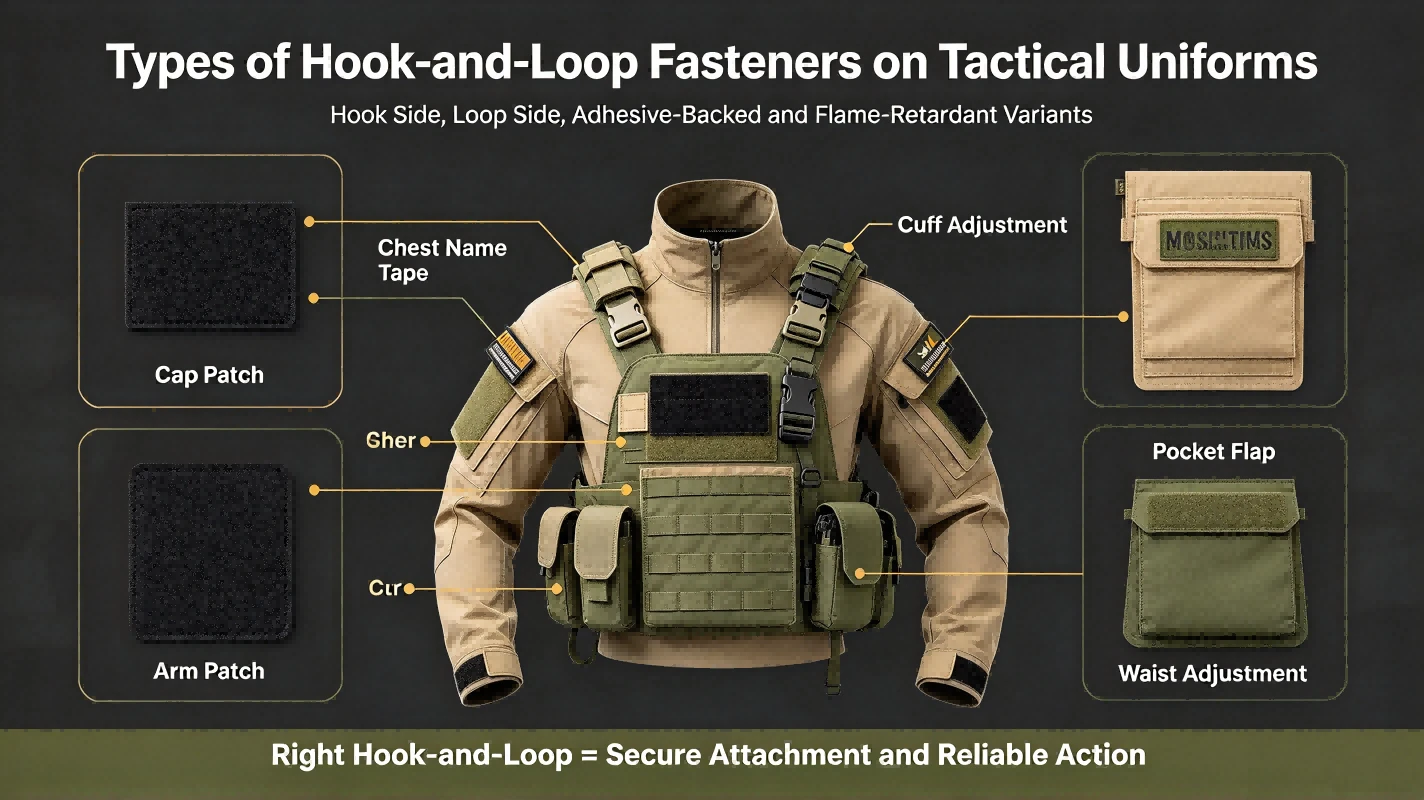
Hook-and-loop fasteners are found everywhere on tactical uniforms – patch positions on the top of caps, name tapes on the chest, arm patch attachment points, cuff adjustment tabs, pocket flap closures, and waist adjustment. It may look like just a "piece of fuzzy fabric," but in tactical scenarios, the performance of hook‑and‑loop directly affects whether equipment can be securely attached, whether actions can be completed quickly, and whether it can work reliably in extreme environments.
Many people assume hook-and-loop is just hook-and-loop, with no difference. In reality, the hook-and-loop used on tactical uniforms comes in multiple types: hook side, loop side, adhesive-backed, sewn-on, flame-retardant, and heavy-duty-each with different structures, performance, and suitable locations. Using the wrong type can result in weak adhesion and easy detachment at best, or failure during high-intensity missions and compromised equipment use at worst.
This article explains the types and differences of hook-and-loop fasteners on tactical uniforms clearly.
2. Basic Structure of Hook‑and‑Loop: Hook Side and Loop Side
2.1 How Hook‑and‑Loop Works
A hook‑and‑loop fastener consists of two parts:
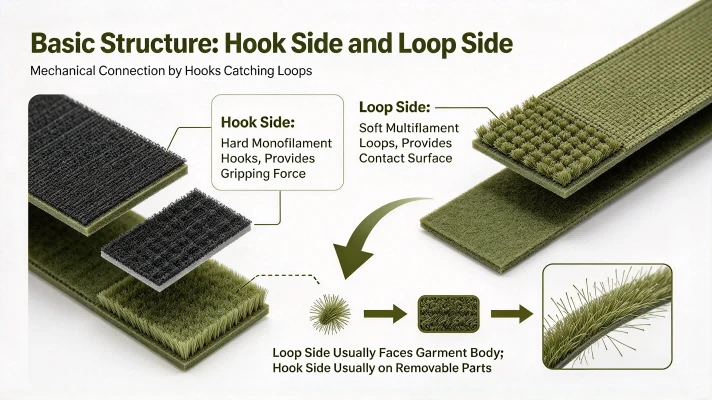
- Hook side: the surface is covered with fine, hard hooked fibres, like countless tiny hooks
- Loop side: the surface is covered with soft looped fibres, like a dense layer of fuzz
When the hook side is pressed against the loop side, the hooks catch the loops, forming a reopenable mechanical connection. When pulled apart, the hooks release from the loops with a "ripping" sound.
2.2 Differences Between Hook Side and Loop Side
|
Comparison dimension |
Hook side |
Loop side |
|
Surface characteristics |
Hard, scratchy, granular |
Soft, fuzzy, smooth |
|
Fibre form |
Monofilament bent into hooks |
Multifilament bent into loops |
|
Material |
Nylon monofilament (common), polyester monofilament |
Nylon multifilament (common), polyester multifilament |
|
Durability |
Hooks wear and deform easily |
Loops break and pill easily |
|
Contribution to adhesion |
Provides "gripping force" |
Provides the "contact surface to be gripped" |
|
Hand feel |
Rough, stiff |
Soft, lofty |
2.3 Hook/Loop Configuration on Tactical Uniforms
On tactical uniforms, the configuration of hook and loop sides is deliberate:
- Patches, name tapes, arm patches: usually the back of the patch is hook side, and the corresponding position on the garment is loop side. This allows patches to be swapped freely, while the loop side on the garment does not scratch the skin.
- Pocket flaps, cuff adjustment: usually the inside of the flap is hook side, and the corresponding position on the pocket body is loop side. This way, when closed, the hook side faces inward and is less likely to snag other items.
- Waist adjustment: usually the adjustment strap is hook side, and the corresponding position on the waist is loop side, enabling stepless adjustment.
Key principle: On tactical uniforms, the loop side is usually sewn onto the main body of the garment, while the hook side is usually sewn onto removable patches or adjustment straps.
There are three reasons for this design:
① the loop side is soft and does not scratch the skin when worn against the body;
② the hook side is on removable components, so replacement cost is lower when worn;
③ the loop side faces outward and is less likely to snag equipment and fabrics.
3. Adhesive‑Backed vs. Sewn‑On Hook‑and‑Loop: Two Fixing Methods
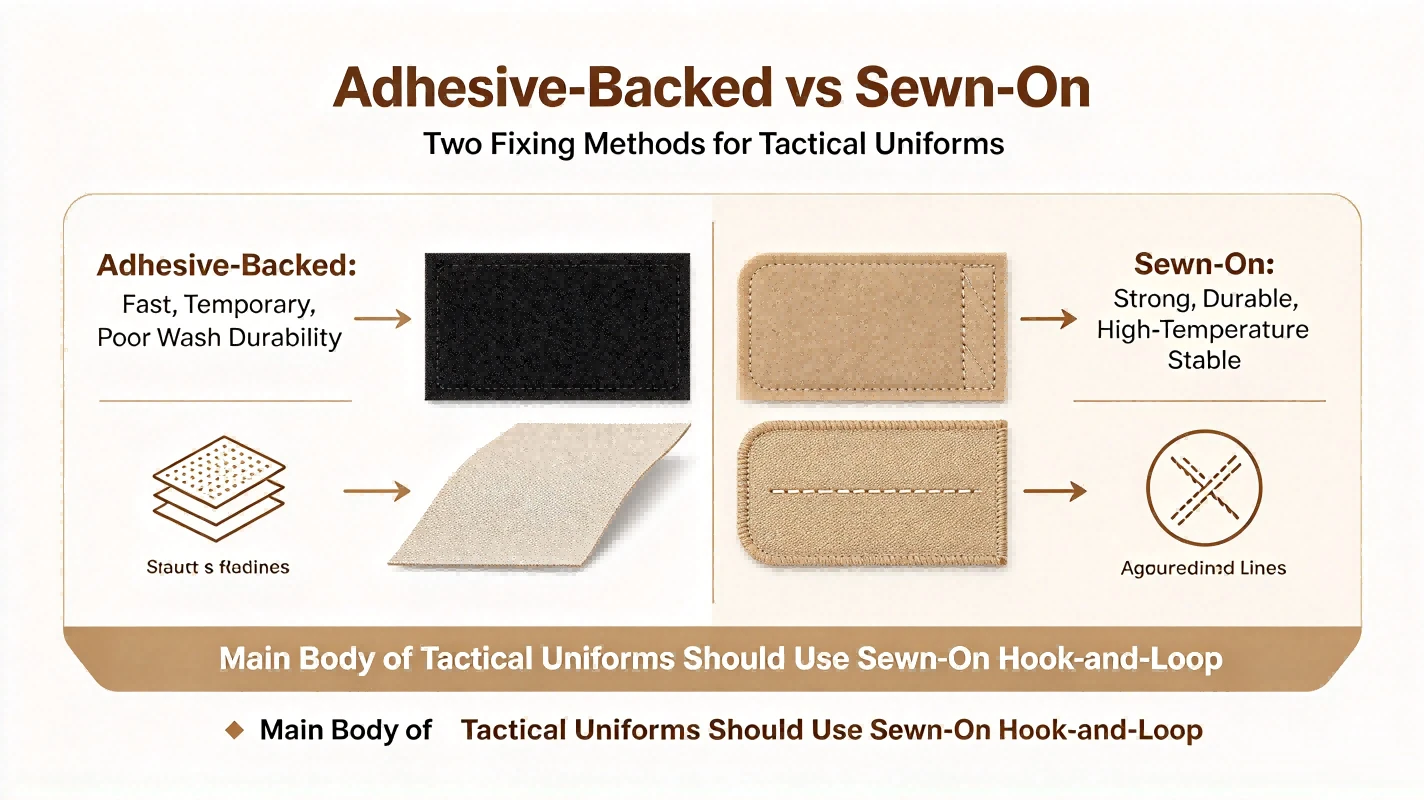
There are two ways to fix hook‑and‑loop to garments: adhesive‑backed and sewn‑on. On tactical uniforms, sewn‑on is dominant; adhesive‑backed is mainly used for temporary fixing or small‑area applications.
3.1 Adhesive‑Backed Hook‑and‑Loop
Structure: The back of the hook‑and‑loop is coated with a layer of hot‑melt adhesive or pressure‑sensitive adhesive. After peeling off the release paper, it can be stuck directly onto the fabric.
Advantages:
- Convenient to use, no sewing required
- Suitable for small‑area, temporary fixing
- Can be used in positions where sewing is inconvenient
Disadvantages:
- Poor wash durability: the adhesive layer ages after repeated washing and easily detaches
- Poor temperature resistance: the adhesive layer softens at high temperatures, and adhesion decreases
- Not suitable for the main body of tactical uniforms: tactical uniforms require repeated washing and high‑intensity use, and adhesive‑backed hook‑and‑loop cannot meet durability requirements
Suitable scenarios on tactical uniforms: temporary identification patches, small‑area fixing at non‑load‑bearing positions, sample prototyping stages.
3.2 Sewn‑On Hook‑and‑Loop
Structure: The hook‑and‑loop is fixed to the fabric with sewing thread, with stitching around the perimeter or edges for reinforcement.
Advantages:
- Strong durability: can withstand repeated washing and high‑intensity pulling
- Good temperature resistance: does not rely on an adhesive layer; stable performance at high temperatures
- Suitable for the main body of tactical uniforms: meets military‑grade durability requirements
Disadvantages:
- Requires sewing operations; production efficiency is lower than adhesive‑backed
- Stitch lines may become stress concentration points and require reinforcement
Suitable scenarios on tactical uniforms: all load‑bearing positions and long‑term fixing points – patch positions, pocket flaps, cuff adjustment, waist adjustment, MOLLE accessory fixing, etc.
Key sewing process points:
- Stitch around the perimeter of the hook‑and‑loop with double stitching or bartacks to prevent edge unravelling
- Use high‑strength polyester thread or bonded nylon thread, in the same colour as the hook‑and‑loopAvoid excessively dense stitching (≤12 SPI) to prevent damage to hook/loop fibres
- Hot‑cut or bind the edges of the hook‑and‑loop to prevent fraying
4. Flame‑Retardant Hook‑and‑Loop: Military‑Grade Special Requirements
4.1 Why Do Tactical Uniforms Need Flame‑Retardant Hook‑and‑Loop?
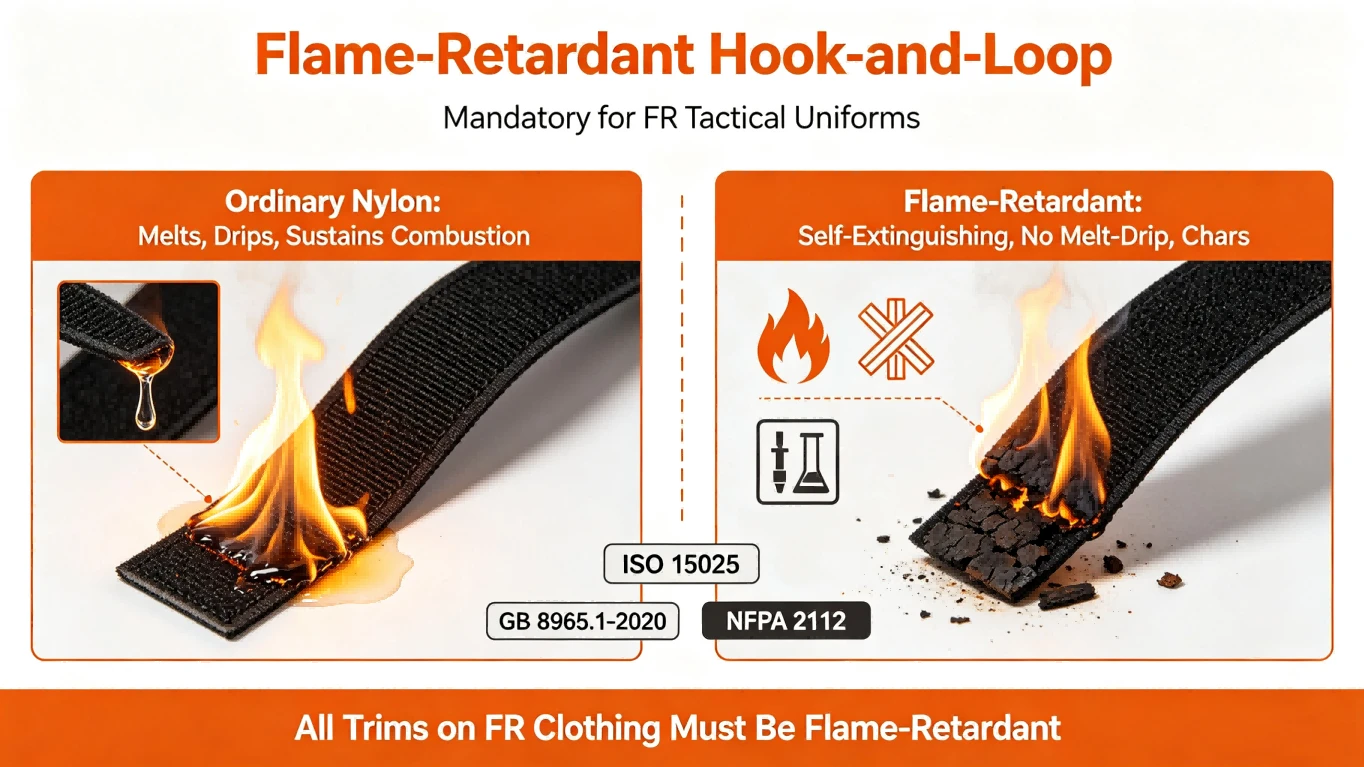
On flame‑retardant tactical uniforms (such as Nomex®/aramid FR clothing), all trims must be flame‑retardant-including sewing thread, zippers, webbing, and hook‑and‑loop. If ordinary nylon or polyester hook-and-loop is used, it will melt and drip when exposed to fire, not only losing its fixing function but also potentially causing secondary burns.
Therefore, flame-retardant tactical uniforms must use flame-retardant hook-and-loop.
4.2 Materials and Standards for Flame-Retardant Hook-and-Loop
Material types:
- Aramid hook-and-loop: inherently flame-retardant, high-temperature resistant, no melt-drip-the highest grade of flame-retardant hook-and-loop
- Modified nylon/polyester flame-retardant hook-and-loop: achieves flame retardancy through FR finishing or copolymer modification, lower cost than aramid
- Nomex® blend hook-and-loop: balances flame retardancy and cost
Test standards:
- ISO 15025: limited flame spread test – requires afterflame time ≤2 s, afterglow time ≤2 s, no melt-drip
- GB 8965.1‑2020: Chinese flame‑retardant clothing standard, with clear requirements for trim flame retardancy
- NFPA 2112: industrial flash-fire protection standard, with thermal stability requirements for trims
4.3 Flame-Retardant vs. Ordinary Hook-and-Loop
|
Comparison dimension |
Ordinary nylon hook-and-loop |
Flame-retardant hook-and-loop |
|
Material |
Nylon 6/66, polyester |
Aramid, modified FR nylon, Nomex blend |
|
Behaviour in fire |
Melts, drips, sustains combustion |
Self-extinguishing, no melt-drip, chars |
|
Temperature resistance |
Softens at about 150–180℃ |
Above 200–300℃ |
|
Cost |
Low |
High (aramid type can be 5–10 times ordinary) |
|
Suitable for |
Ordinary tactical uniforms, training uniforms |
FR tactical uniforms, firefighting suits, flight suits |
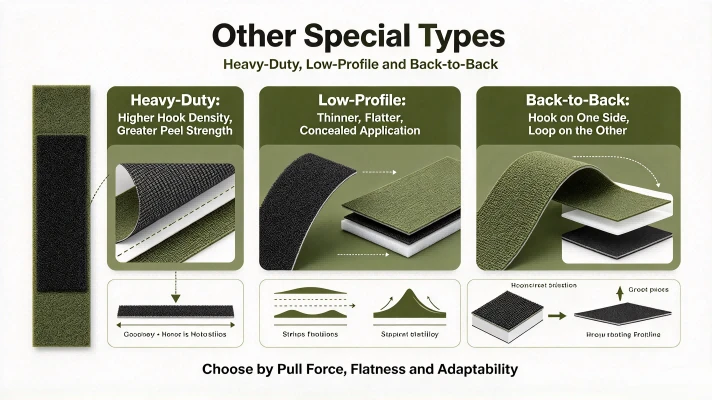
5. Other Special Types of Hook‑and‑Loop
5.1 Heavy‑Duty Hook‑and‑Loop
Characteristics: higher hook density, thicker hook shape, denser loop surface – significantly higher adhesion than ordinary hook‑and‑loop.
Suitable for: positions that need to withstand greater pulling force – waist adjustment, tactical vest cummerbund, equipment fixing straps.
5.2 Low-Profile Hook-and-Loop
Characteristics: thinner, adds almost no thickness after bonding, and provides a flatter appearance.
Suitable for: positions requiring concealment and flatness – hidden pockets, lining fixing, low‑visibility identification positions.
5.3 Back‑to‑Back Hook‑and‑Loop (Hook and Loop Integrated)
Characteristics: one side is hook, the other side is loop; it can self-adhere or serve as an adapter layer.
Suitable for: positions requiring flexible adaptation – equipment module adapters, temporary fixing straps.
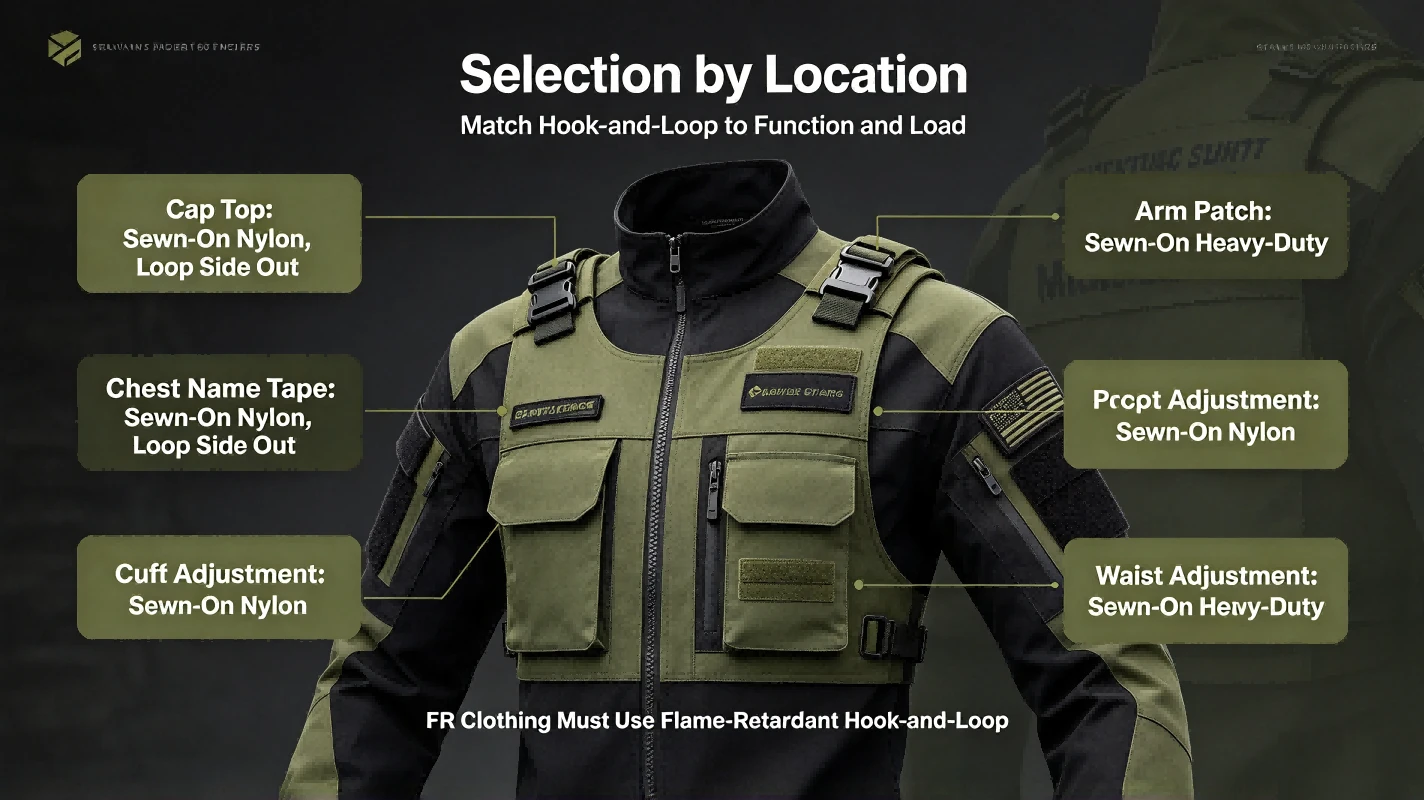
6. Hook-and-Loop Selection by Location on Tactical Uniforms
|
Location |
Recommended type |
Reason |
|
Cap top patch position |
Sewn-on nylon hook-and-loop (loop side facing out) |
Patches need frequent swapping; loop side facing out does not scratch hands |
|
Chest name tape position |
Sewn-on nylon hook-and-loop (loop side facing out) |
Same as above, and must withstand washing |
|
Arm patch fixing position |
Sewn-on heavy-duty hook-and-loop |
Arm patches have some weight and require high adhesion |
|
Cuff adjustment |
Sewn-on nylon hook-and-loop (hook side on adjustment strap) |
Frequent opening/closing; durability priority |
|
Pocket flap closure |
Sewn-on low-profile hook-and-loop |
Needs to be flat and not press against the hand |
|
Waist adjustment |
Sewn-on heavy-duty hook-and-loop |
Withstands pulling force; requires high adhesion strength |
|
All positions on FR clothing |
Flame-retardant hook-and-loop |
Mandatory military requirement; prevents melt-drip |
|
MOLLE accessory fixing |
Sewn-on heavy-duty hook-and-loop or buckles |
Choose according to accessory weight |
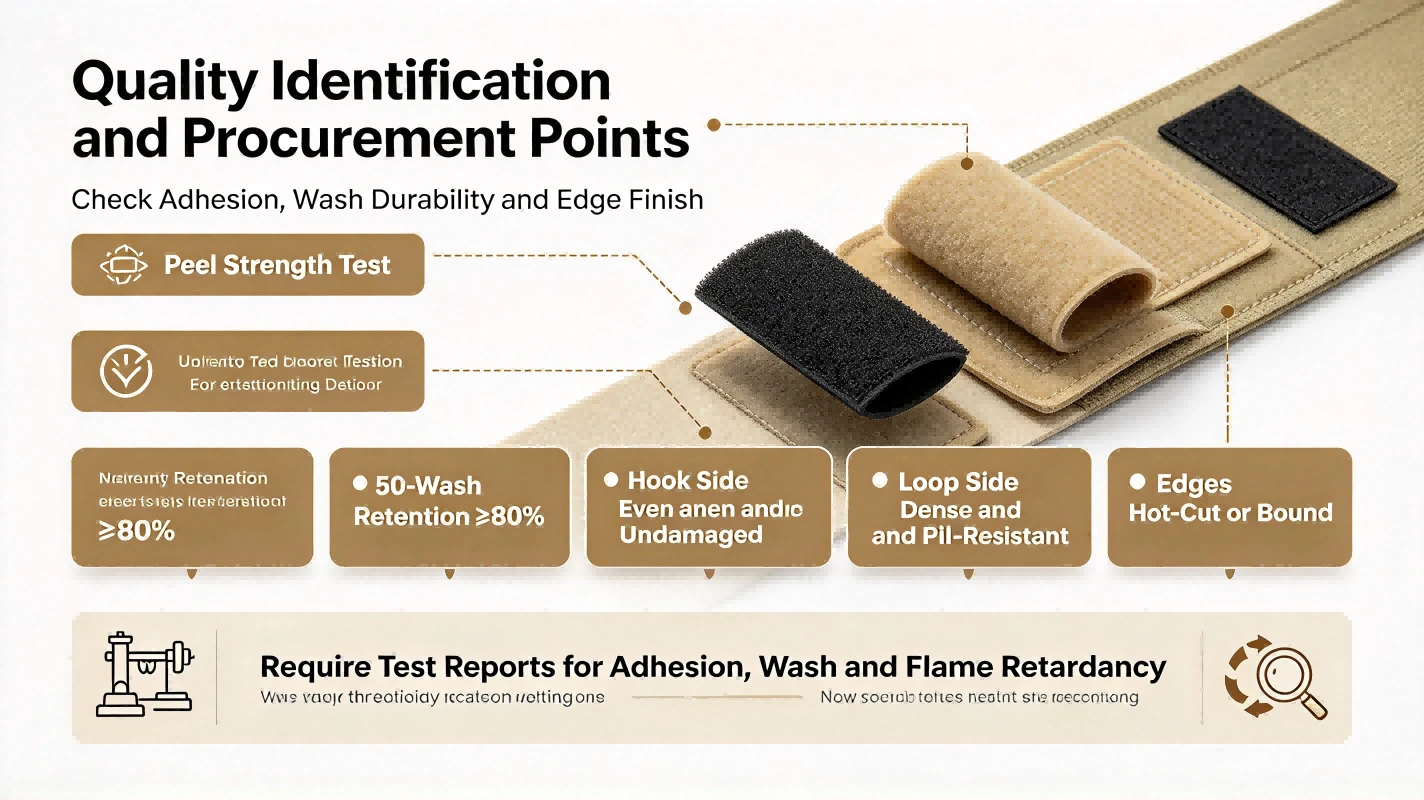
7. Quality Identification and Procurement Points for Hook‑and‑Loop
7.1 Quality Identification Methods
- Adhesion test: press the hook and loop sides together, then use a tensile tester to measure peel strength. Ordinary type ≥2 N/cm², heavy‑duty type ≥5 N/cm².
- Wash test: after 50 washes, adhesion retention should be ≥80%.
- Hook side inspection: hooks should be evenly arranged, not flattened, and not broken.
- Loop side inspection: loops should be dense, without large areas of flattened loops or fibre shedding.
- Edge inspection: edges should be hot‑cut or bound, with no fraying or loose threads.
7.2 Procurement Points
- Confirm material: nylon or polyester? Nylon has better abrasion resistance; polyester is lower cost
- Confirm type: sewn‑on or adhesive‑backed? The main body of tactical uniforms must use sewn‑on
- Confirm flame‑retardant requirements: FR clothing must use flame‑retardant hook‑and‑loop; require ISO 15025 test reports
- Confirm adhesion grade: ordinary or heavy‑duty? Choose according to the location
- Confirm width specifications: common widths include 20 mm, 25 mm, 38 mm, 50 mm; procure according to design requirements
- Confirm colour: black, coyote brown, olive green, grey, etc.; must match the fabric
- Require test reports: adhesion, wash durability, flame retardancy (if applicable)
8. Frequently Asked Questions (FAQ)
Q: Why does the loop side face outward and the hook side face inward on tactical uniforms?
A: There are three reasons for the loop side facing outward: ① the loop side is soft and does not scratch hands or skin; ② the loop side on the outside is less likely to snag other equipment and fabrics; ③ the hook side is on removable patches or adjustment straps, so replacement cost is lower when worn.
Q: Can adhesive‑backed hook‑and‑loop be used on tactical uniforms?
A: Not recommended for load‑bearing or long‑term use positions. Adhesive‑backed hook‑and‑loop has poor wash durability and the adhesive layer ages and detaches after repeated washing. The main body of tactical uniforms should use sewn‑on hook‑and‑loop.
Q: Can flame‑retardant and ordinary hook‑and‑loop be distinguished by appearance?
A: It is very difficult to distinguish by appearance. The identification method is a burn test: ordinary nylon hook‑and‑loop melts and drips when exposed to fire, while flame‑retardant hook‑and‑loop self‑extinguishes without melt‑drip. During procurement, suppliers should be required to provide flame‑retardant test reports.
Q: What should I do if the hook‑and‑loop no longer sticks well?
A: If the hooks on the hook side are flattened or worn, a stiff brush can be used to gently comb the hook surface to restore some grip. If the loop side is severely pilled or shedding, replacement is recommended. In daily use, avoid letting the hook‑and‑loop pick up hair, threads, and other debris.
Q: Can hook‑and‑loop be ironed?
A: Not recommended. High temperatures deform the hooks and melt the loops, reducing adhesion. If ironing is necessary, use a pressing cloth and low temperature, avoiding direct contact with the hook‑and‑loop.
Conclusion
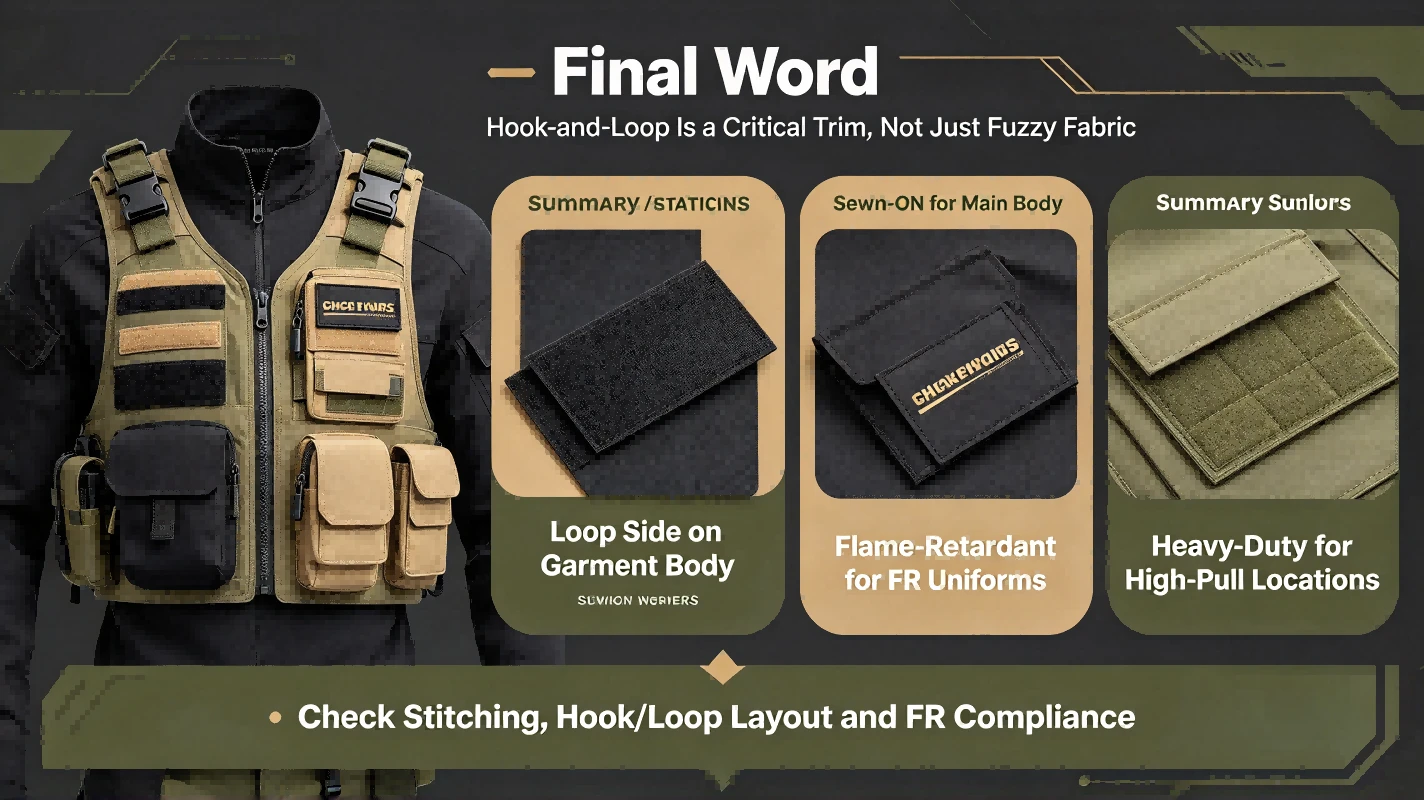
The hook‑and‑loop on tactical uniforms may look like just a "piece of fuzzy fabric," but it actually involves structural differences between hook and loop sides, the process choice between adhesive‑backed and sewn‑on, and the performance grading between ordinary and flame‑retardant. Using the right hook‑and‑loop means equipment is securely fixed and actions are fast and reliable; using the wrong type means weak adhesion and easy detachment at best, or failure in extreme environments at worst.
When buying tactical uniforms, you can check whether the hook‑and‑loop stitching is secure, whether the hook/loop configuration is reasonable, and whether flame‑retardant uniforms use flame‑retardant hook‑and‑loop. These three details often reflect the trim quality and craftsmanship level of a tactical uniform.


