


Analysis of Clothing Comfort and Functionality Comparisons
Jun 07, 2024
Experimental Subjects
Experimental Subjects
Five male university students from Inner Mongolia University of Technology, aged around 23 years old, with similar body shapes, numbered 1 to 5. The average height is 1.72 meters, and the average weight is 62 kilograms.
Experimental Environment
The experiments were conducted in the Clothing Comfort Laboratory of Inner Mongolia University of Technology. The indoor temperature averaged 20°C, the air pressure was 88.93 kPa, the relative humidity was 22%, and the wind force level was O.
Experimental Method
The experiment consists of three stages, with a total duration of 18 minutes.
Rest Stage
Subjects rest for 3 minutes each while wearing desert-style camouflage clothing and winter-style camouflage clothing in a stationary state.
Exercise Stage
Subjects wear the test clothing and perform running exercises on a treadmill at the prescribed speed for 12 minutes.
Recovery Stage
Subjects gradually stop the running exercise until they come to a complete stop, with the process lasting 3 minutes.

The experimental arrangement is as shown in Figure 1.

Comparison Analysis
The experimental data were organized, compared, and analyzed, involving key data such as oxygen consumption (VO2), carbon dioxide exhalation (VCO2), minute ventilation, and respiratory exchange ratio.
The experimentally obtained data are summarized in Table 3.

From Table3, it is evident that wearing winter-style military camouflage uniforms results in slightly higher oxygen consumption compared to wearing desert-style military camouflage uniforms. This suggests that wearing winter-style uniforms imposes more constraints on movement during exercise, requiring more energy expenditure to perform running activities. Additionally, the VCO2 emission while wearing winter-style camouflage uniforms is also higher. An increase in CO2 emission inevitably leads to greater oxygen consumption. Therefore, wearing desert-style military camouflage uniforms should result in increased oxygen consumption. The increase in both oxygen intake (VO2) and carbon dioxide exhalation (VCO2) indicates an increase in minute ventilation, which is consistent with the experimental data results, providing mutual validation.
The human body releases heat by reacting oxygen with stored energy substances to produce CO2. This process provides the necessary energy for the body. According to the law of conservation of energy and the relative proportions of protein, fat, and carbohydrates consumed by the body during energy expenditure, the heat generated by the human body during this process can be approximately calculated when the oxygen intake and CO2 emission are known.
The specific calculation formula is as follows:
Heat Production (Q) = Oxygen Heat Equivalent (20.20 kJ/L) × Oxygen Consumption
The calculation results are shown in Table 3.

By comparing the data, it's evident that wearing desert-style military camouflage uniforms results in significantly less heat production compared to winter-style military camouflage uniforms. Heat production is the result of chemical processes where the human body consumes stored energy substances (such as glycogen and fat) by reacting with oxygen (O2) and releasing carbon dioxide (CO2). More heat production indicates a greater consumption of stored energy substances. Therefore, higher heat production is not conducive to energy conservation. From this, it can be inferred that desert-style military camouflage uniforms are more conducive to energy conservation and result in less energy expenditure compared to winter-style military camouflage uniforms.
Subjective Comfort Experiment
After the completion of the cardiopulmonary function tests, participants filled out a subjective comfort evaluation form based on their actual feelings towards the clothing comfort.
The statistical results of the subjective comfort evaluation form are presented in Table 3.
From the experimental data in Table 3, it's evident that desert-style military camouflage uniforms offer greater flexibility compared to winter-style military camouflage uniforms. Increased flexibility implies less constraint on the body, allowing for more agile and efficient movement, thus conserving energy. For soldiers whose duties often involve high-intensity training or even combat, desert-style military camouflage uniforms are more conducive to leveraging their abilities and enhancing combat effectiveness.
During winter dressing, while ensuring clothing warmth, poor moisture permeability may lead to dampness inside the clothing, causing discomfort to the wearer. Analyzing the data reveals that desert-style military camouflage uniforms exhibit better warmth and moisture permeability than winter-style military camouflage uniforms. Additionally, desert-style military camouflage uniforms perform better in terms of thickness perception, implying reduced weight, which can make soldiers feel lighter and enable them to carry more weapons and equipment.
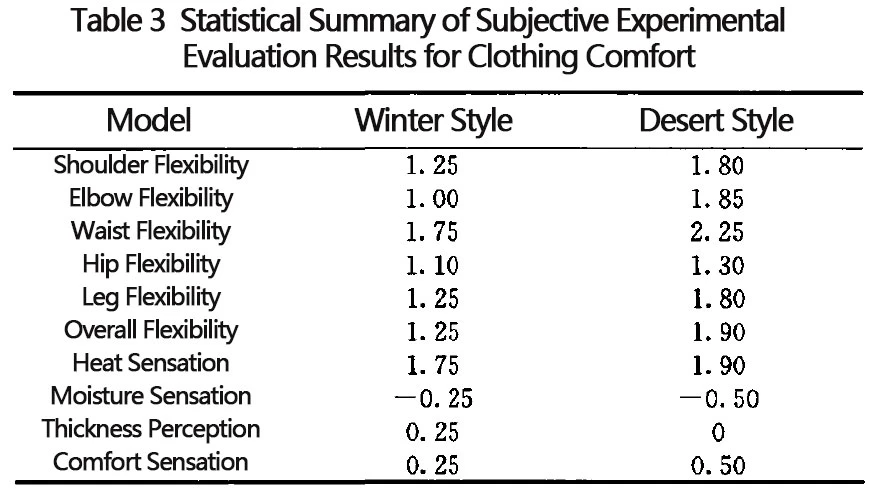
Overall, the subjective comfort experiment indicates that desert-style military camouflage uniforms are more comfortable than winter-style military camouflage uniforms.


