
Analysis of Infrared Camouflage Fabric Patent Technologies
Jun 25, 2024
The textile industry is a traditional sector in China that has been transitioning from labor-intensive to innovative and technology-driven in recent years, influenced by cheaper labor markets in Southeast Asia and elsewhere. In particular, infrared camouflage fabrics represent innovative textiles rich in technological content, garnering significant attention from militaries worldwide.
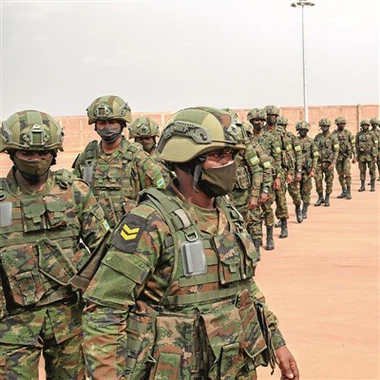
Camouflage printed fabrics are widely used in military applications such as combat uniforms, sleeping bags, and tents, designed to blend into surrounding environments like desert, forest, or grasslands. However, conventional camouflage fabrics are effective only in visible light and provide no camouflage under advanced surveillance technologies such as infrared detection. Therefore, the development of infrared camouflage printed fabrics has become a new essential requirement for modern military camouflage textiles. High-performance infrared camouflage fabrics not only enhance the survival, security, and combat capabilities of military forces but also require capabilities for near-infrared and thermal infrared camouflage, reflecting advancements in detection technologies.
Principle of Infrared Camouflage
Infrared radiation is an electromagnetic wave with wavelengths ranging from 0.76 to 1000 micrometers (μm). Any object with a temperature above absolute zero emits infrared radiation. In military contexts, infrared detection focuses on collecting signals in the 3-5 μm and 8-14 μm wavelength bands, utilizing thermal imaging technology for all-weather target reconnaissance.
The theoretical basis of thermal imaging is Stefan-Boltzmann law. Thermal imaging works by exploiting differences in infrared radiation between targets and backgrounds, which stem from variations in temperature and emissivity. These differences in distribution are crucial factors determining the efficiency of infrared detection. Therefore, the aim of infrared camouflage is to align the infrared radiation characteristics of a target with those of its background. This alignment serves to minimize or eliminate the infrared radiation contrast between the target and its surroundings, thereby achieving camouflage and evasion from infrared detection.