
How to distinguish the Box Cannon, Big Mirror, Big Red 9, and Fast-Slow Machine — these four types of Mauser pistols
Mar 24, 2026
It is widely known that the Mauser series of pistols from Germany were extremely popular in China during the Republican period. They were used not only by the military and police, but even by guards employed by wealthy households.
German Mauser pistols were produced continuously from 1896 until the late 1930s. Over several decades of development, many variants emerged, and virtually all of them were imported or copied in China.

Moreover, based on the distinctive features of each model, they were given various nicknames, such as "Box Cannon," "Big Mirror," "Big Red 9," and "Fast-Slow Machine."
So what exactly are the Mauser pistol models corresponding to these four nicknames? And what do they look like?
In this article, let's take a brief look.
Ⅰ. "Box Cannon" corresponds to the Mauser M1896 pistol.

The Mauser M1896, abbreviated as Mauser C96, was the pioneering work of the Mauser series of pistols and the very first model in the entire line.
Originally, this pistol was designed by the three Feederle brothers at the Mauser factory in their spare time, just for fun. Unexpectedly, it caught the attention of the Mauser owner, who then patented it. In 1896, it was standardized as the M1896 pistol.

The M1896 was available in a standard model and a short-barreled model. The standard model had an overall length of about 312 mm and weighed 1160 g, while the short-barreled model had a total length of 288 mm and weighed 1130 g. Both were chambered in 7.63 mm, firing the 7.63×25 mm Mauser pistol cartridge.
However, unlike pistols from other countries, the Mauser M1896 featured a fixed magazine rather than a detachable one. It had a capacity of 10 rounds, which could be loaded from the top using a 10-round stripper clip.

In terms of appearance, the M1896 pistol has a strong mechanical look. Multiple parts of the gun feature lightening grooves, and the wooden grip panels are engraved with dense, striped anti-slip textures.
Another characteristic of the Mauser M1896 pistol is its hard-shell holster. This holster is made of wood, with a hinged lid at the back that can be opened, making it look like a small box when in use.

Additionally, the front end of the holster features a connector that can attach to a slot on the back of the pistol grip. In combat, this holster could be mounted to the rear of the gun and used as a shoulder stock-a design that was quite distinctive and practical for its time.
This is precisely why the Mauser M1896 earned the nickname "Box Cannon."
After this initial model was introduced to China, it was copied by several arsenals and became the most commonly issued sidearm for military and police forces during the Republican era.
Ⅱ. "Big Mirror" corresponds to the Mauser M1899 pistol.

The Mauser M1899 was introduced in 1899 as a custom model for the Italian Navy, also known as the "Italian Navy Version Mauser C96 Pistol."
This model emphasized simple craftsmanship, low cost, and ease of mass production.
In terms of performance, the Mauser M1899 was essentially the same as the original first-generation C96. It was also chambered in 7.63×25 mm Mauser pistol cartridge and featured a 10-round fixed magazine.

Like the earlier model, it could also be fitted with a dual-purpose hard-shell wooden holster that served as both a carrying case and a shoulder stock.
The difference, however, was that the production process of the Mauser M1899 was simplified. In pursuit of faster manufacturing, features such as the lightening grooves, trademarks, and factory stamps were removed from the gun's body, leaving the entire surface polished very smooth. Because the lightening grooves were omitted, the M1899 also became heavier, with a total weight of approximately 1200 grams.
It was precisely due to the M1899's smooth, mirror-like surface that it earned the nicknames "Big Mirror" or "Mirror Magazine" at the time.

Later, a variant of this pistol appeared with a 20-round capacity. However, it still did not use a detachable magazine; instead, the fixed magazine was simply extended downward to accommodate 20 rounds.
As a result, this variant was nicknamed the "Big-Belly Mirror Magazine" at the time.
During the Warlord Era, the Dagu Arsenal of the Fengtian clique also copied this pistol, referring to it by the same nicknames-"Big Mirror" and "Mirror Magazine."
Ⅲ. "Big Red 9" corresponds to the Mauser M1916 pistol.

The Mauser M1916 was the first Mauser pistol model to become a standard-issue weapon for the German military, entering service with the German Army in 1916. Initially, however, the German military was not particularly interested in the Mauser series of pistols and had consistently favored the Luger P08. But in 1916, during the middle of World War I, the German military faced a shortage of standard-issue pistols and was forced to place an order with Mauser, commissioning a batch of Mauser pistols for frontline service.
Since these were to serve as German military sidearms, they had to use the military's standard ammunition. Therefore, the Mauser pistols issued to the German Army during World War I were all in 9 mm caliber, chambered for the same 9×19 mm cartridge used by the Luger P08.

Because this model was finalized in 1916, it became known as the Mauser M1916 pistol.
Compared to the original Mauser C96, the M1916 retained essentially the same outline and appearance. It also featured lightening grooves on the frame, along with Mauser trademarks and factory stamps. The most noticeable change in appearance was the grip panel area.
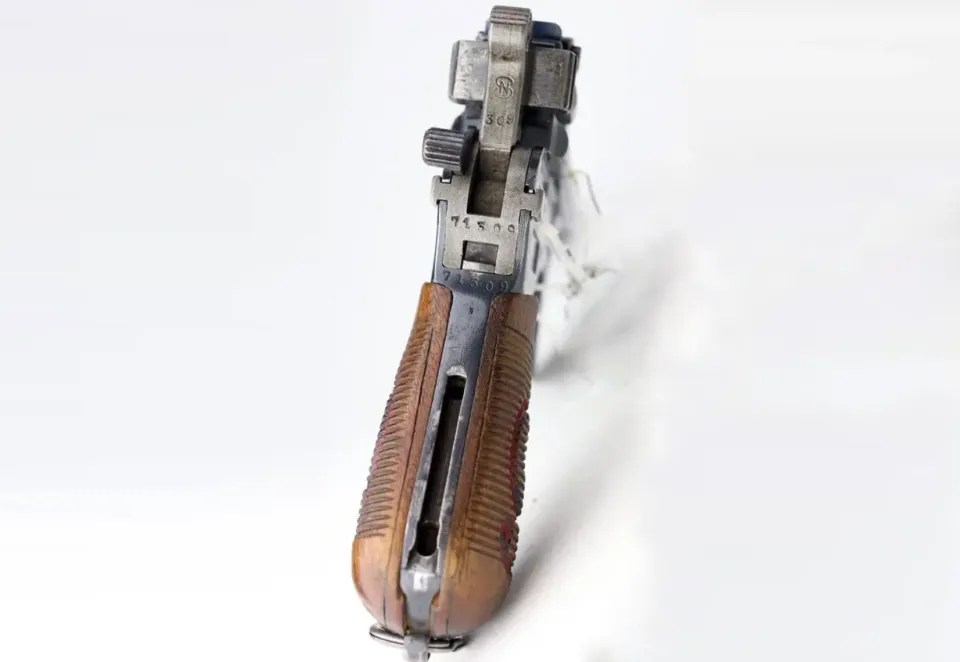
First, the anti-slip grooves on the grip became more numerous, denser, and finer. Additionally, the grip panel was engraved with the Arabic numeral "9," which was painted with red lacquer. This indicated that the pistol was a 9 mm Mauser.
It was precisely because of this distinctive feature that the gun came to be known at the time as the "Big Red 9."

During World War I, approximately 137,000 Mauser M1916 pistols were produced. After Germany's defeat, in order to comply with the restrictions imposed by the Treaty of Versailles, these pistols had to be withdrawn from military service. A large portion of the decommissioned pistols were sold to China during the Republican era, while some were modified with shorter barrels and issued to police forces.
Ⅳ. "Fast-Slow Machine" corresponds to the Mauser M1932 pistol.

The Mauser M1932 was the ultimate model in the Mauser pistol series. Its most notable feature was the addition of a selector switch (the "fast-slow machine"), which enabled full-automatic fire in addition to standard semi-automatic operation. In effect, it functioned as a modern full-automatic pistol-and it was also the first full-automatic pistol to be adopted into military service worldwide. Because its factory designation was 712, it was also known as the Mauser M712 Schnellfeuer (rapid-fire) pistol.
The M1932 was developed from the Mauser M1930 model. In addition to gaining full-automatic capability, its feeding system was also redesigned. It no longer used a fixed magazine; instead, it featured a detachable box magazine, with options for a standard 10-round magazine or a 20-round magazine.

In terms of caliber, it remained 7.63 mm, firing the 7.63×25 mm Mauser pistol cartridge. In full-automatic fire, its theoretical rate of fire reached 900 rounds per minute, with an effective range of 100 meters. In terms of firepower, it essentially matched the standard of submachine guns, and even had a higher rate of fire than many submachine guns of the same period.
This is precisely why the Mauser M1932 was called the "Fast-Slow Machine."

The M1932 also featured some minor changes in appearance. For example, the lightening grooves on the receiver were retained only on the middle section on both sides, while the lightening strips on the upper left and right sides were removed, giving the surface a smoother, more rounded contour.
Additionally, the anti-slip grooves on the grip panels were reduced in number compared to earlier models-approximately 12 grooves-and each groove became wider, with greater spacing between them.

As a full-automatic pistol, this model had an even greater need for the dual-purpose hard-shell holster that served as both a carrying case and a shoulder stock. During sustained fire, the shoulder stock effectively helped counteract recoil and improved accuracy.
The Mauser M1932 was also very popular in China at the time, though its numbers were not as great as the early Mauser C96 model. Most of the M1932s imported back then were issued to the German-trained divisions of the Central Army.
The above covers the four different Mauser pistol models corresponding to the nicknames "Box Cannon," "Big Mirror," "Big Red 9," and "Fast-Slow Machine."