
Why Digital Camouflage Is More “Invisible” Than Traditional Camouflage: The Military Science Behind Pixelated Design
Sep 02, 2026
Have you noticed that the PLA's Type-07 training uniform camouflage pattern looks different from the traditional camouflage you might remember? Instead of large patches of green and brown, it's made up of tiny little squares-like a "mosaic" layer on the fabric. This pattern, known as "digital camouflage," is supposed to be more "invisible" than traditional camouflage. Why is that?


1. The Limitation of Traditional Camouflage: Boundaries Are Too Sharp
Traditional camouflage (such as the Type-87 pattern) consists of irregular spots or stripes with smooth, rounded edges and clear boundaries between different colours. The idea is to use large colour patches to break up the human silhouette and achieve concealment.
But the problem is also here: the transitions between colour blocks are unnatural. Green is green, brown is brown-with a clearly distinguishable line in between. When viewed up close, these sharp boundaries make the camouflage uniform look "unnatural," like a piece of fabric that has been deliberately painted, making it easier to spot.
Senior Engineer Zhang Xudong of the PLA General Logistics Department's Military Equipment Research Institute once summarised: traditional camouflage often only works at specific observation distances. Too far away and it becomes indistinct; too close and it's too obvious-the effective distance window is narrow.
2. The Core of Digital Camouflage: Pixel Matrix and Computer-Generated Patterns
The solution offered by digital camouflage is to use computers to break the pattern down into countless small squares-much like the pixels on a TV or computer screen-and then use computers to arrange and combine these squares to simulate the textures, colours, and layers found in natural environments.
You can think of it this way: traditional camouflage is "painted" by an artist with a brush, while digital camouflage is "computed" by a computer using "pixels."
From a distance, it looks like a large pattern; up close, it looks like gravel. Zhang Xudong's ten-word summary perfectly captures the deceptive effect of digital camouflage.


3. Why Is Digital Camouflage More "Invisible"?
Reason One: Blurring Boundaries, Disrupting Outline Recognition
The problem with traditional camouflage is that colour boundaries are too clear. Digital camouflage uses the visual principle of the pixel matrix to make the edges between different colours blurred, fragmented, and discontinuous.
This blurring effect exploits a characteristic of human cognition-the "law of simplicity" from Gestalt psychology-the human brain naturally tends to simplify complex information into regular shapes. The scattered distribution of the pixel matrix disrupts this cognitive inertia, making it harder to separate the target from the background.
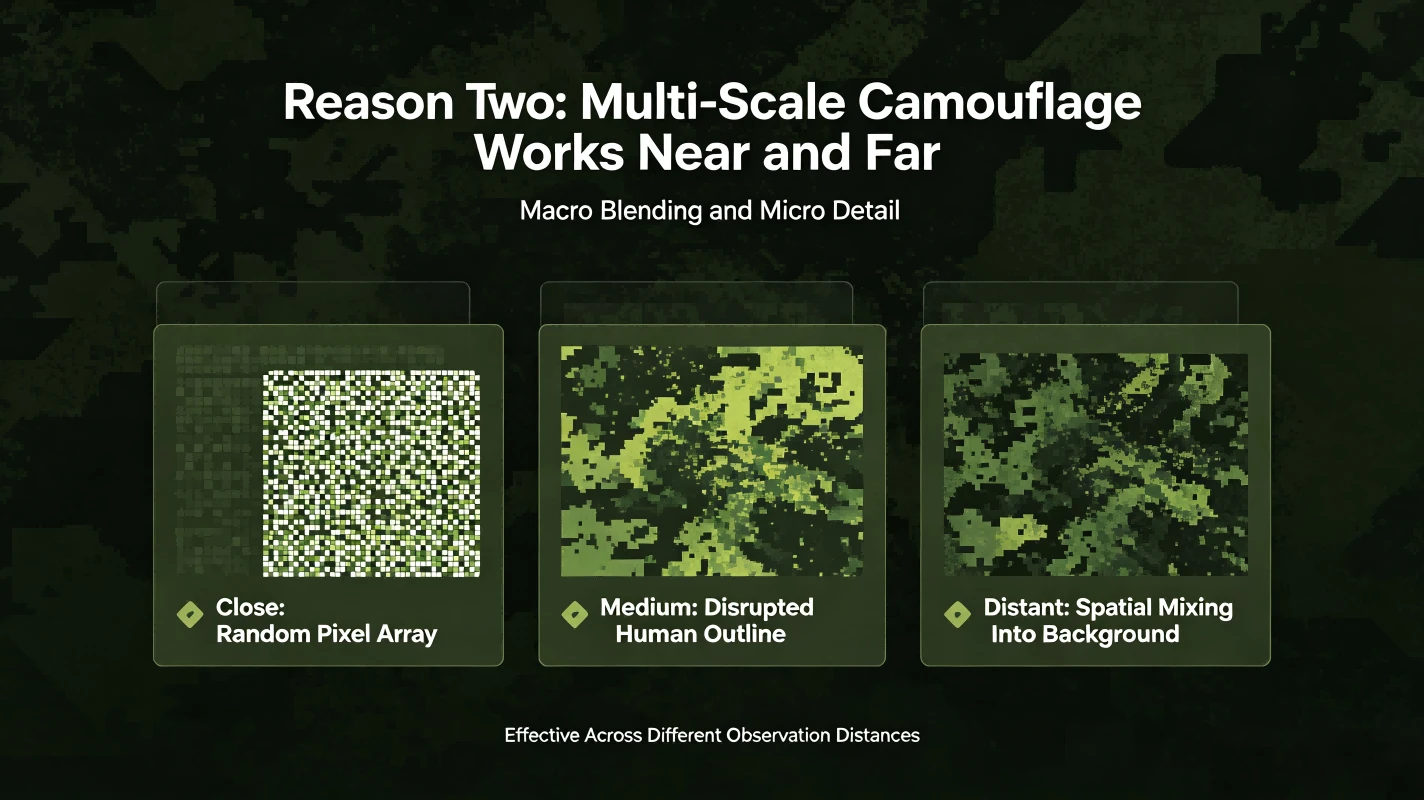
Up close, digital camouflage appears as a random array of small square colour blocks, simulating the dappled effect of tree shadows or the speckled texture of leaves and gravel in forests or deserts. From a distance, the different coloured dots blend through spatial mixing, creating the effect of larger patches that mimic the surface characteristics of forests, mountains, and other background landscapes.
"It looks like one pattern from afar, and another up close" – this is the core of digital camouflage's "multi‑distance adaptability."
Reason Two: Multi‑Scale Camouflage – Effective at All Distances
The fatal weakness of traditional camouflage is its single‑distance effectiveness. Digital camouflage, on the other hand, is a "multi‑scale camouflage technique" – it remains effective at different observation distances.
At the macro scale, the overall colour distribution determines tonal blending at long range; at the micro scale, the fine pixel matrix simulates natural details up close. No matter what distance the observer is at, the target is difficult to separate from the background.
Reason Three: Countering Night-Vision and Other Modern Detection Devices

Traditional camouflage only fools the naked eye. Digital camouflage adds an extra layer of defence-it uses special dye treatments that give it excellent infrared reflectance properties.
The digital camouflage pattern on the Type-07 training uniform not only evades visual detection but also provides protection against detection in low-light and certain infrared bands. Under infrared and night‑vision devices, digital camouflage offers significantly greater concealment advantages than traditional camouflage. Because modern electro-optical observation equipment relies on digital imaging, and digital camouflage itself is artificially created "mosaic" patterns, it actually becomes more "compatible" under electronic detection.
4. From Pixels to "Starry Sky": The Evolution of Digital Camouflage
The early forms of digital camouflage can be traced back to the 1970s, when the U.S. military experimented with "Dual‑tex" pixelated patterns on vehicle paint.
What truly brought digital camouflage to the battlefield was CADPAT (Canadian Disruptive Pattern), first introduced by Canada in 1997. In NATO tests in 2001, CADPAT outperformed traditional camouflage. Test data showed that soldiers wearing digital camouflage had a discovery rate reduced by more than 50% compared to those wearing traditional green uniforms.
China introduced Type-07 digital camouflage in 2007, with variants for woodland, desert, and marine environments. The abrasion resistance of Type-07 training uniforms increased significantly from 140+ cycles (Type-87) to over 700 cycles.
In 2019, China further upgraded to "Starry Sky Camouflage"-with a finer micro-grid design and five colour variants (tropical woodland, desert, temperate woodland, urban, and desert), achieving adaptive concealment across multiple terrains.


5. Conclusion
Traditional camouflage relies on large colour patches to "break up" outlines; digital camouflage relies on pixel matrices to "blur" boundaries. The former is the accumulation of experience from the pre-digital era; the latter is precise computation from the computer age.
The U.S. military once stated: "Once the human eye sees a digitally pixelated camouflage uniform at a distance, the brain involuntarily mistakes it for vegetation or soil." This one sentence captures the essence of digital camouflage: it doesn't hide a person-it deceives the observer's cognitive system.
From traditional spot-based camouflage, to computer-generated pixel matrices, to terrain-adaptive Starry Sky camouflage-the evolution of camouflage uniforms is essentially a history of camouflage technology transitioning from "art" to "science."