Zipper Selection for Tactical Uniforms: Performance Comparison of YKK, SBS, and Flame‑Retardant Zippers
Nov 17, 2026

1. Introduction: The Zipper Is the Component on a Tactical Uniform That "Should Never Fail"
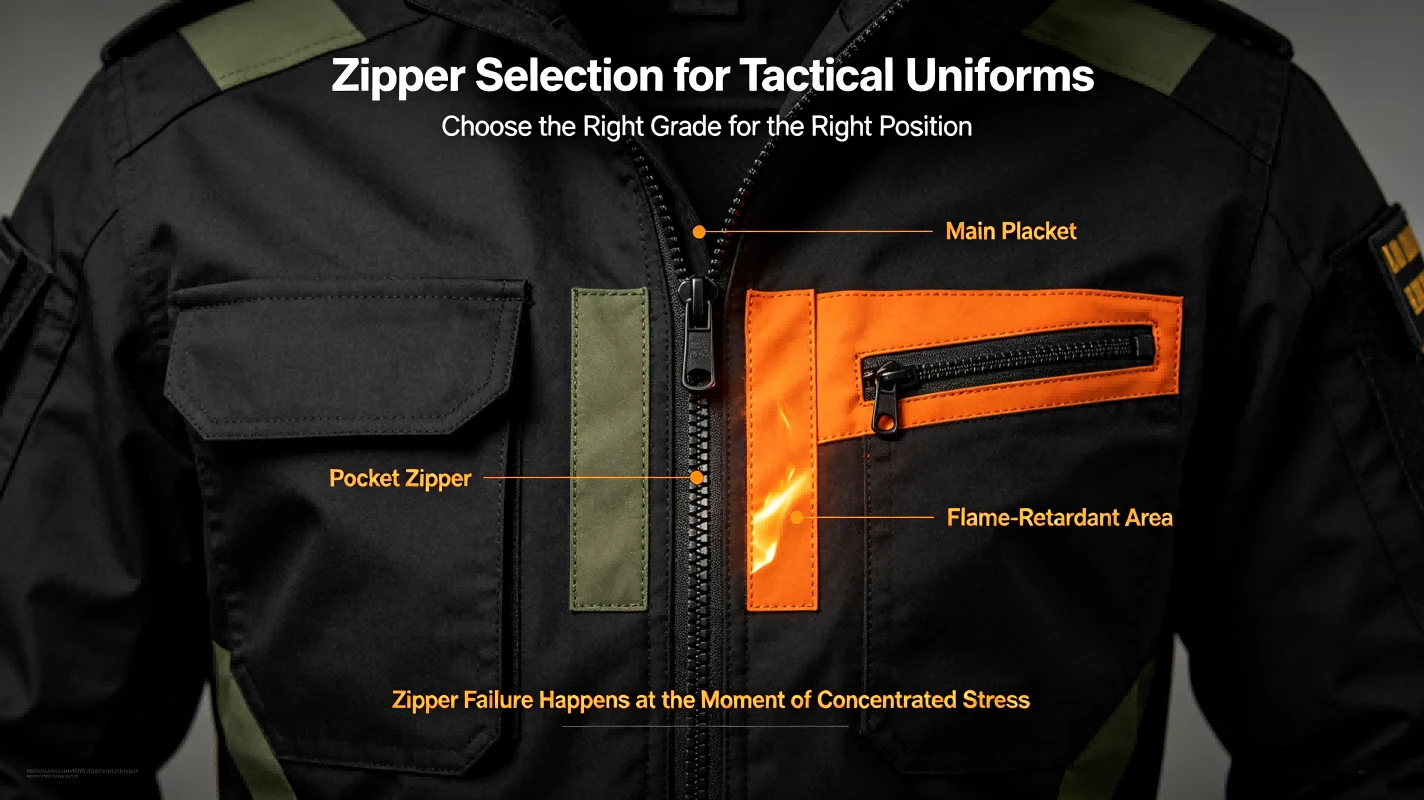
Zippers on tactical uniforms have a cruel characteristic: they do not fail in normal use-when they fail, it is catastrophic. The main zipper jams halfway, and a stab-resistant vest cannot be quickly donned or doffed; a pocket zipper bursts open in mud, scattering magazines or documents; an ordinary zipper on flame-retardant clothing melts in a flame, tearing a gap in the protective system.
Zipper failure is not a matter of "gradually getting worse"-it happens at the moment of concentrated stress. The zipper parameters in a procurement specification determine whether, at that moment, it "holds" or "bursts open."
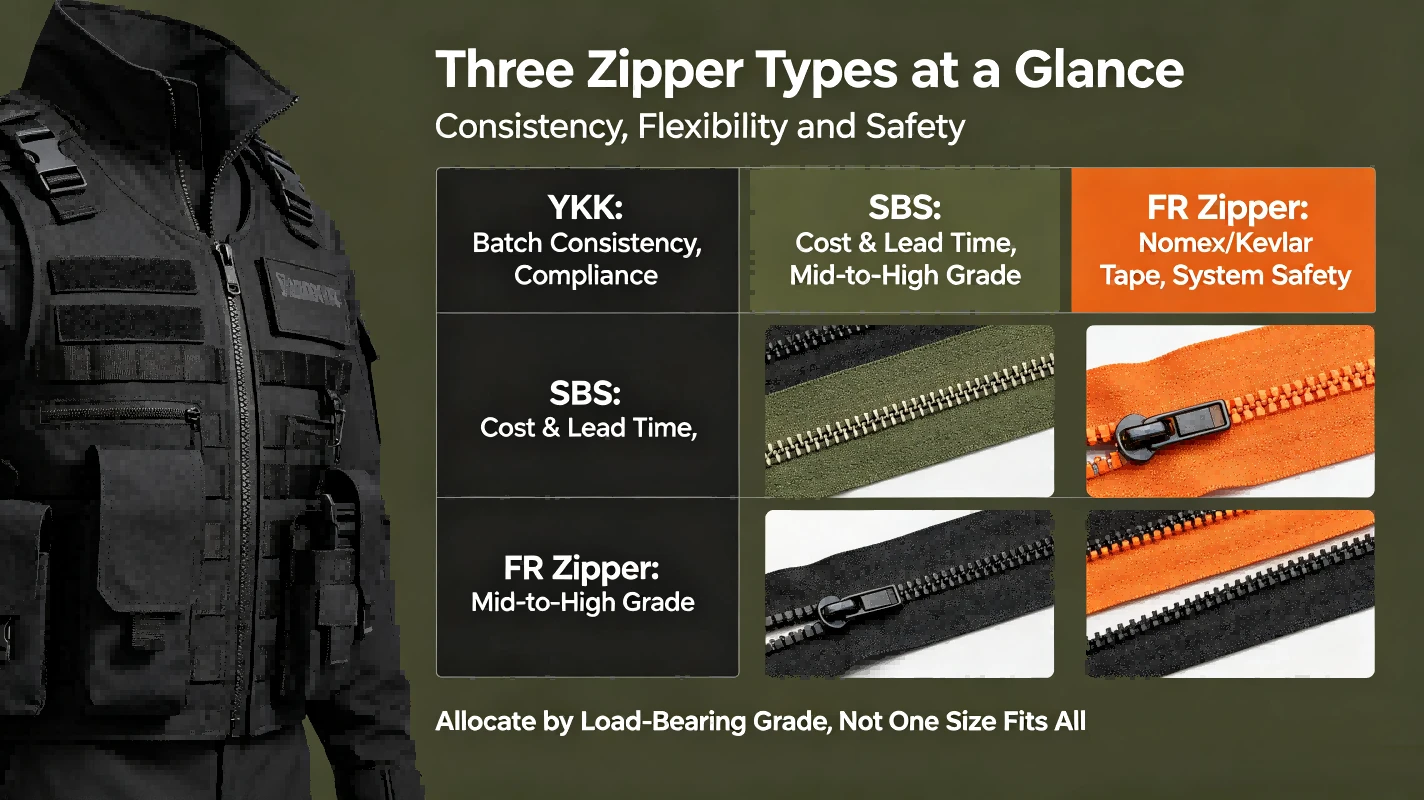
The zipper solutions commonly used in tactical uniforms fall into three tiers: YKK (Japanese, with the most mature consistency and service system), SBS (a leading domestic brand, with outstanding supply‑chain flexibility and cost advantages), and flame‑retardant zippers (Nomex®/Kevlar® tape, serving flame‑protective scenarios). This article explains the performance boundaries and selection logic of the three.
2. YKK: The "Baseline" for Batch Consistency
2.1 Core Advantage: Not "the Highest Peak," but "the Smallest Dispersion"
YKK's industry position, most accurately stated in the context of tactical uniforms, is this: it is the baseline for batch consistency.
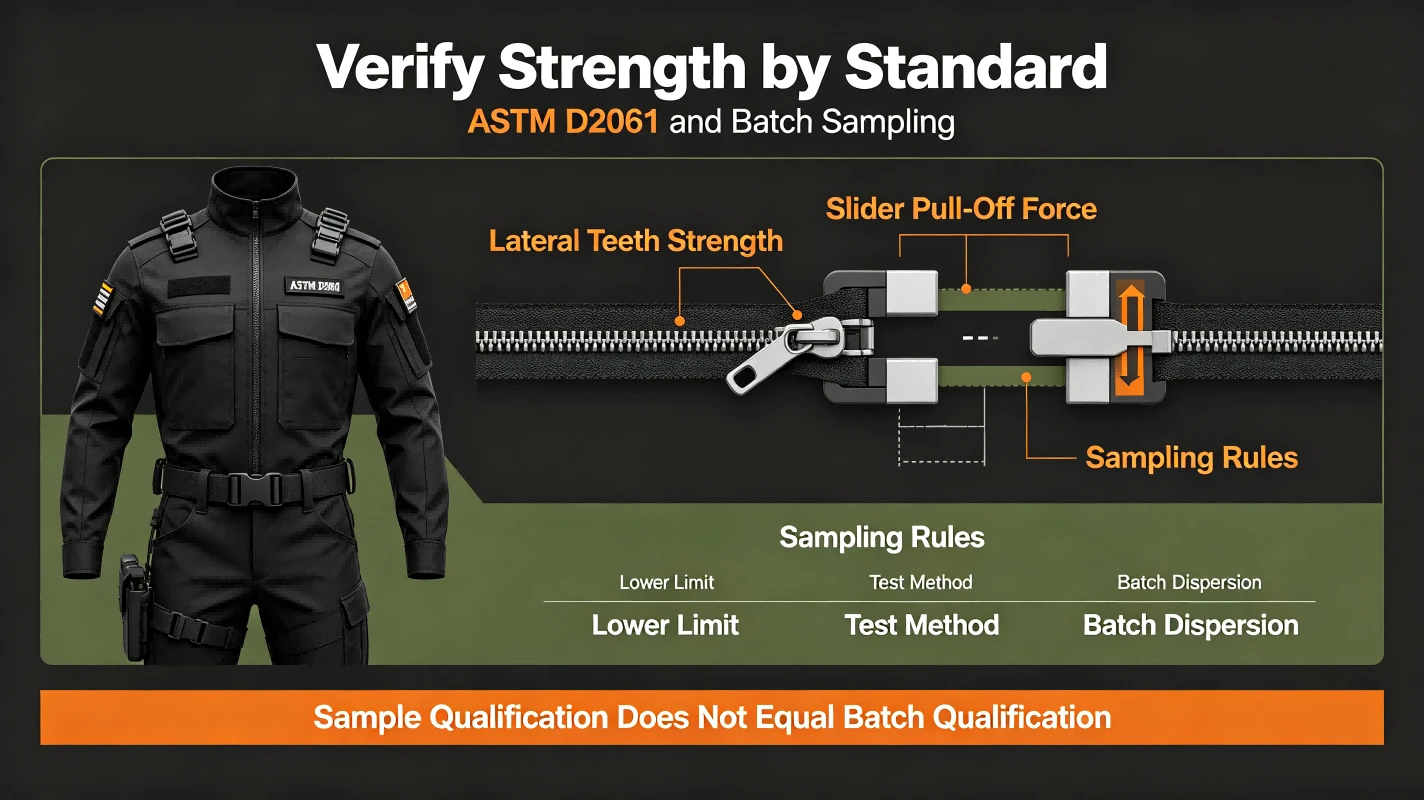
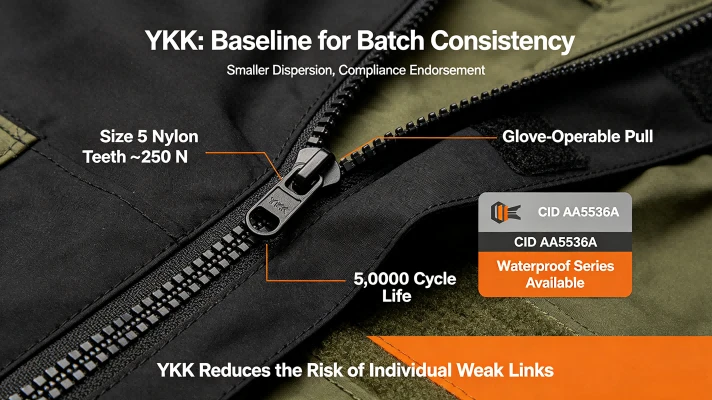
Zipper failure is often not because "average strength is insufficient," but because a few outliers are mixed into a batch. The lateral teeth strength of a main zipper is typically accepted at around 250 N (size 5 nylon teeth) in the industry, and both YKK and SBS can usually meet this at the sample stage. The real difference lies in this: a production line with good yield control keeps the test values of the entire batch within a narrow range; a loosely controlled line produces individual weak links that "pass inspection but fail six months later."
Another implicit value of YKK in tactical uniform procurement is compliance endorsement. YKK zippers comply with the CID AA5536A military procurement specification, which is often directly cited in tender documents for military and police orders. At the same time, YKK offers waterproof, water‑repellent, watertight, and other series of closures, covering different needs from routine training uniforms to waterborne missions.
2.2 Typical Applications on Tactical Uniforms
In procurement specifications, the designation of YKK zippers is often functional rather than decorative. For example, the main body of a police stab‑resistant vest specifies a size 15 YKK zipper, and explicitly requires the zipper pull to be treated with heat‑shrink tubing so that it can be operated while wearing gloves. This detail points to the real constraints of tactical scenarios: wearing gloves, under pressure, one‑handed operation – the zipper must "engage fully in a single pull."
YKK's brass zippers also maintain tooth‑tip edge retention better than ordinary products after long‑term use, and the repeated cycling life of its nylon zippers can reach the order of 5,000 cycles in workshop testing. On high‑frequency pockets and main plackets that require frequent opening and closing, this difference directly affects user experience and repair rates.
3. SBS: Supply‑Chain Flexibility and the Balance of "Adequately Reliable"
3.1 Positioning: Not a "Cheap Substitute for YKK," but a "Reasonable Choice Under Different Constraints"
Simply understanding SBS as a "cheaper version of YKK" is a misreading. In the field of tactical uniforms and equipment, SBS's true positioning is this: when procurement constraints shift from "ultimate consistency" to "cost, lead time, and customization flexibility," it is an engineering‑reasonable choice.
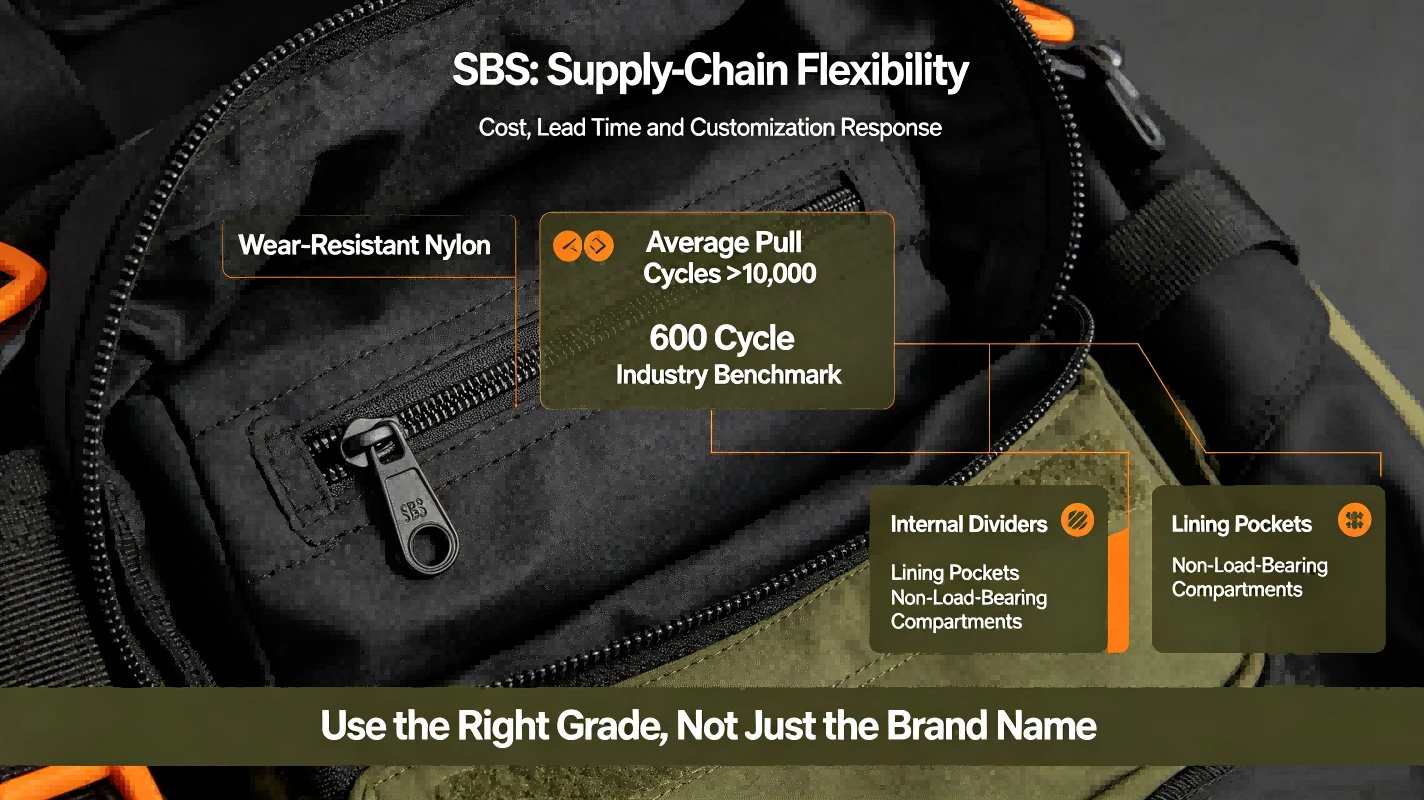
SBS's wear‑resistant nylon zippers are specifically optimized in stitching, teeth structure, and slider cavity: high‑strength thread prevents teeth from falling off due to thread abrasion; the groove design on the tooth surface locks the thread into the groove; and adjustments to the slider cavity reduce direct friction between the slider body and the thread during zipping. In testing, its average pull cycles exceeded 10,000, far above the industry benchmark of 600 cycles. This means that in non‑primary load‑bearing, medium‑to‑low‑frequency opening and closing positions (internal dividers, lining pockets, storage compartments), SBS's durability is sufficient to cover the actual service life of tactical uniforms.
3.2 Cost and Response Advantages
At the cost level, YKK's metal zippers are RMB 2–3 per meter more expensive than SBS, and nylon zippers about RMB 1 more; at the same quality tier, YKK's end‑price difference can reach 30%–50%. For tactical uniform orders in the thousands of units, this price difference is enough to affect the hardware cost structure of the entire order.
SBS's supply‑chain response speed is another tactical‑level advantage: flexibility such as three‑day delivery of custom fluorescent zippers and on‑demand addition of anti‑scratch coatings falls in a range that YKK's standard service system finds difficult to cover in urgent replenishment orders or special colour tasks.
3.3 Applicable Boundaries for SBS
SBS has a very wide grade range, covering everything from basic volume products to high‑configuration/functional types (waterproof, windproof, outdoor‑specific). In tactical uniform selection, the key is not "whether to use SBS," but which grade of SBS to specify. Using SBS for internal non‑load‑bearing areas, low‑frequency pockets, and auxiliary compartments is reasonable; using basic SBS for the main placket, the main body closure of a stab‑resistant vest, or high‑load equipment attachment points exceeds its design constraints.
A more pragmatic strategy is mixed use: use YKK for externally visible, primary load-bearing, high-frequency operation zippers; use SBS for internal dividers, linings, and non-load-bearing zippers. In benchmarking backpack-type products, the hardware cost difference of this strategy is about GBP 0.45–1.10 per unit, while the differences in teeth strength and slider life are concentrated precisely at the main opening-the position users perceive most.
4. Flame-Retardant Zippers: Not "Better Zippers," but "A Different Safety Grade"
4.1 Essential Difference: The Tape Determines Flame Retardancy, Not the Teeth
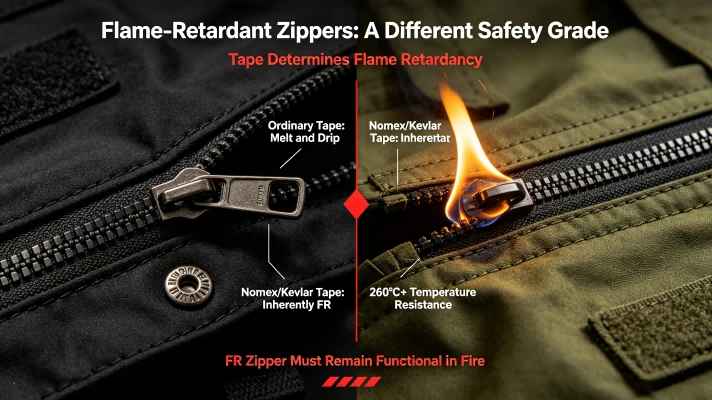
The fundamental divide between flame‑retardant zippers and ordinary zippers is not the teeth, but the tape (zipper cloth tape) . Ordinary zipper tape is polyester or nylon, which melts and drips in fire-itself a source of ignition and secondary burns. Flame-retardant zipper tape uses Nomex® (meta-aramid) or Kevlar® (para-aramid) fibres, which are inherently flame-retardant, do not rely on finishing treatments, and do not lose flame-retardant performance after washing.
Metal flame-retardant zippers use permanently flame-retardant fibre tape with high-temperature resistance up to 260°C. They are permanent flame-retardant zippers, mainly used in flight combat suits, firefighter suits, and similar scenarios. Nomex® tape maintains tensile strength at temperatures above 400°F, ensuring that the zipper remains functional in fire or high-heat conditions, rather than merely "not burning."
4.2 Compliance Threshold: The "Entry Ticket" for Flame-Retardant Zippers Is a Test Report
Flame-retardant zippers cannot rely on "claims"; they must be grounded in standardized test data. The core standards involved in tactical uniform flame-retardant zippers include:
- ASTM D6413: vertical flame test, evaluating afterflame time, afterglow time, and char length.
- NFPA 2112: industrial flash-fire protection standard, with clear requirements for the thermal stability and flame retardancy of trims such as zippers.
- BS 3084: zipper strength testing, ensuring that flame-retardant performance does not come at the expense of mechanical strength.
- EN 469 / ISO 11612: firefighting and high-heat protective clothing standards; Level 2 typically requires aramid or meta-aramid (Nomex®-equivalent) tape as standard configuration.
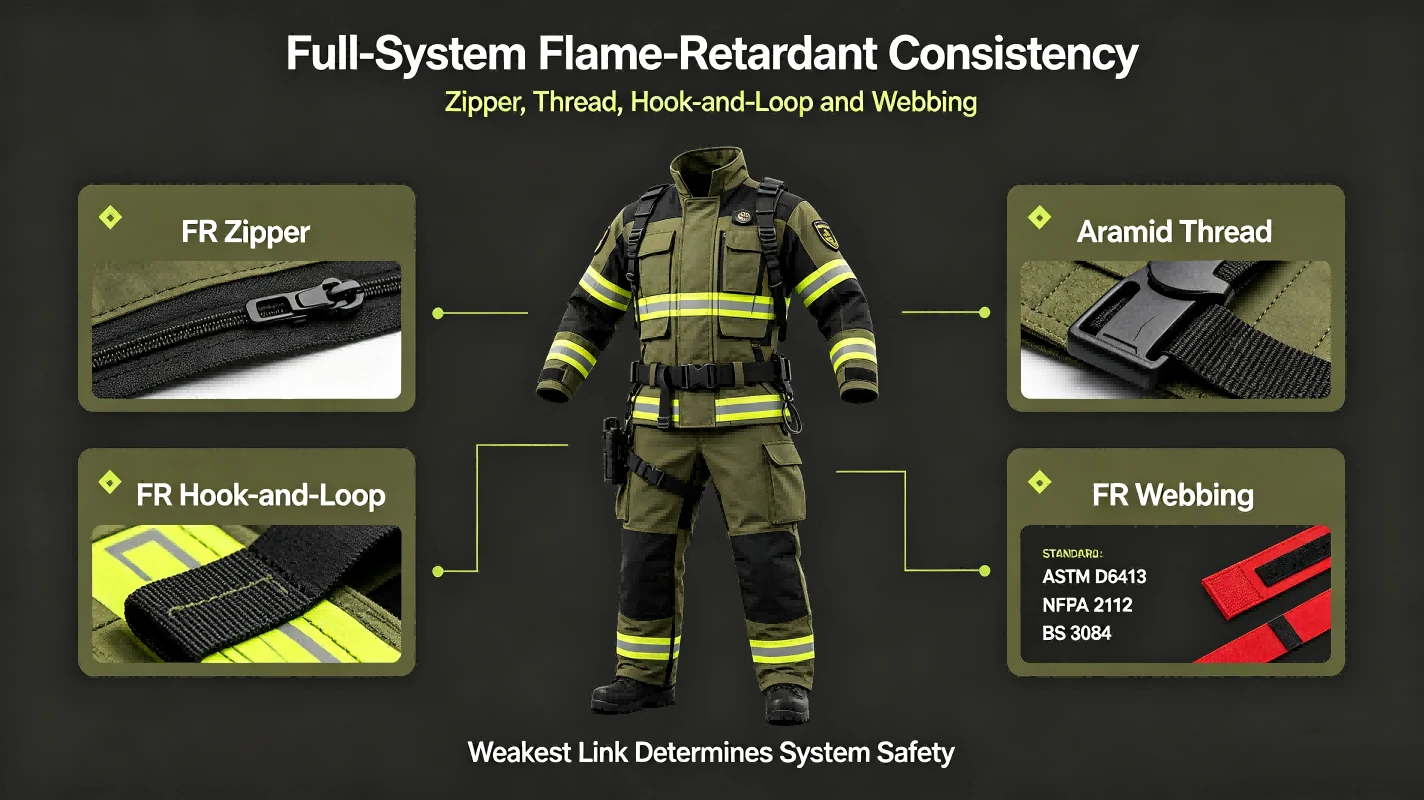
A common procurement error is this: the fabric passes flame-retardant certification, but the zipper, thread, and hook-and-loop do not pass simultaneously. Flame-retardant protection is a matter of system integrity-ordinary polyester thread melts and breaks first at high temperatures, and the zipper falls apart; ordinary nylon zipper tape melts and drips, opening a gap in the protective layer. All components of flame-retardant tactical uniforms must be of the same flame-retardant grade; otherwise, the weakest link becomes the failure point.
5. Selection Comparison of the Three Zipper Types
|
Comparison dimension |
YKK (standard) |
SBS (standard) |
Flame-retardant zipper (Nomex/Kevlar tape) |
|
Core value |
Batch consistency, compliance endorsement, service system |
Cost flexibility, lead-time flexibility, customization response |
Inherent flame retardancy, no melt-drip, functionality maintained at high temperature |
|
Lateral teeth strength (size 5 nylon, reference) |
~250 N order, small batch dispersion |
Can reach an equivalent level at the sample stage; dispersion depends on grade |
Depends on substrate; flame retardancy does not sacrifice mechanical strength |
|
Slider/teeth cycle life |
Nylon zippers begin to fuzz after ~5,000 repeated cycles |
Wear-resistant version exceeds 10,000 pull cycles (far above the 600-cycle industry benchmark) |
Must meet both flame-retardant and strength requirements |
|
Flame-retardant performance |
Standard versions not flame-retardant |
Standard versions are not flame-retardant; some functional types can be FR-treated |
Inherently flame-retardant, Nomex/Kevlar tape, temperature resistance 260°C+ |
|
Cost |
Higher baseline; metal is RMB 2–3/m more than SBS |
Significantly lower than YKK; end-price difference up to 30%–50% |
Highest; aramid tape far more costly than standard |
|
Best position |
Main placket, externally visible zippers, stab-resistant vest main body |
Internal dividers, lining pockets, non-load-bearing auxiliary compartments |
All zippers on flame-retardant tactical uniforms |
6. Selection Logic for Tactical Clothing Factories
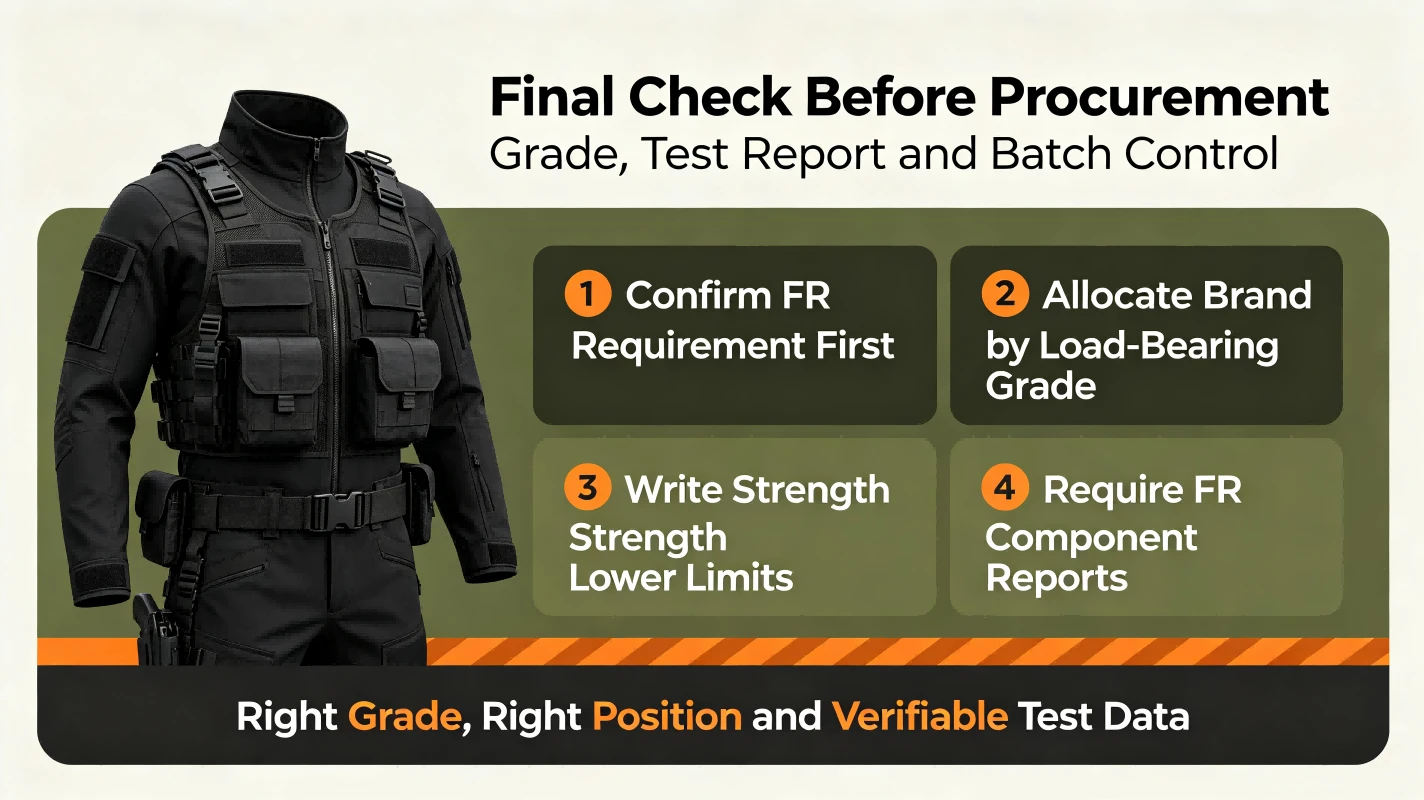
Step One: Determine "whether flame‑retardant is required" before discussing brand. If the product is a flame‑retardant tactical uniform (Nomex/aramid fabric, firefighting, flight, EOD, and similar scenarios), the zipper must be a flame‑retardant zipper; brand choice is meaningful only on the premise of flame‑retardant compliance. The flame‑retardant versions of ordinary YKK or SBS require confirmation of tape material and corresponding standard test reports, not just the brand name.
Step Two: Allocate brands by "load‑bearing grade," not "one size fits all." For primary load‑bearing and high‑frequency operation positions such as the main placket, stab‑resistant vest main body closure, and external equipment attachment points, prioritise the corresponding grade of YKK products; for internal dividers, linings, and non‑load‑bearing storage positions, mid‑to‑high‑grade SBS can be specified to control costs while leveraging its lead time and customisation flexibility.
Step Three: Write "batch consistency" into the procurement specification. Do not simply write "YKK size 5" or "SBS size 5"; specify lower limits for lateral teeth strength, lower limits for slider pull‑off force, test methods (ASTM D2061), and sampling rules. Sample qualification does not equal batch qualification; the real risk lies in the dispersion around the mean.
Step Four: Confirm "full‑system flame‑retardant consistency." In the procurement list for flame‑retardant tactical uniforms, zippers, sewing thread (aramid thread), hook‑and‑loop, and webbing must all provide flame‑retardant test reports simultaneously. Any non‑flame‑retardant item is a system failure point.
7. Frequently Asked Questions (FAQ)
Q: Is YKK always more durable than SBS?
A: It depends on the position of use and the grade of SBS. On primary load‑bearing, high‑frequency external zippers, YKK's batch consistency and long‑term feel retention are usually more reliable; in internal non‑load‑bearing positions, mid‑to‑high‑grade SBS durability is sufficient to cover the actual life cycle of tactical uniforms, with a clear cost advantage. SBS has a very wide grade range – basic SBS cannot be directly compared with YKK's main series.
Q: Can ordinary YKK zippers be used on flame‑retardant tactical uniforms?
A: No. Flame‑retardant protection is systemic. Ordinary zipper tape (polyester/nylon) melts and drips in fire, creating a failure point in the protective layer. Flame‑retardant tactical uniforms must use flame‑retardant zippers with Nomex or Kevlar tape, and require test reports for corresponding standards such as ASTM D6413 and NFPA 2112.
Q: What does SBS's "10,000 cycles" wear‑resistant zipper mean?
A: SBS's test data for its nylon wear-resistant version shows average pull cycles exceeding 10,000, far above the 600-cycle industry benchmark. This indicates ample life redundancy in medium-to-low-frequency opening and closing scenarios, suitable for internal dividers and storage positions; but "high wear cycles" does not equal "sufficient primary load-bearing strength." Lateral teeth strength and slider pull‑off force remain the primary indicators for main placket selection.
Q: How can genuine YKK be distinguished from counterfeit?
A: Genuine YKK sliders usually have laser engraving on the inside, with clear lettering; the surface has a subtle matte texture. Counterfeits often have blurry engraving and rough edges. For tactical uniform procurement, a more reliable approach is to require the supplier to provide YKK shipment documents or authorization proof, rather than judging by appearance alone.
Conclusion
Zipper selection for tactical uniforms is ultimately a matter of risk allocation. What you buy with YKK is batch consistency and compliance endorsement, reducing the risk of "an individual weak link failing at a critical moment"; what you buy with SBS is supply‑chain flexibility and cost space, a reasonable engineering choice in internal non‑load‑bearing positions; what you buy with flame‑retardant zippers is not a brand, but a safety grade – in flame‑retardant scenarios, it is a necessary condition for system integrity, not an optional item.
There is no "best zipper," only a zipper in the right position, of the right grade, with the right test report. Writing strength lower limits, test methods, and flame-retardant compliance requirements clearly in the procurement specification protects the reliability of tactical uniforms under real stress more effectively than writing a brand name.