Abrasion Resistance of Military Training Camouflage Uniforms: Martindale Testing and Common Wear Areas
Sep 29, 2026

1. Introduction: Whether a Training Uniform Is "Durable Enough" Depends on Abrasion Resistance
During military training, students stand at attention, march in drills, and do physical training on the playground every day. Their clothing rubs repeatedly against the ground, equipment, and their own bodies. A pair of training trousers worn for less than two weeks shows white abrasion marks at the knees; a training jacket worn for a month develops fuzz at the elbows-these are all signs of insufficient abrasion resistance.
Abrasion resistance is one of the most important durability indicators of a training uniform. It determines how long the garment can be worn and whether it can withstand high-intensity use. The core method for measuring abrasion resistance is the Martindale test. This article explains the abrasion resistance of training uniforms clearly.

2. Martindale Test: The "Standard Ruler" for Abrasion Resistance
2.1 What Is the Martindale Test?
The Martindale Abrasion Test is currently the most commonly used international method for testing fabric abrasion resistance. It corresponds to standards such as ISO 12947, GB/T 21196, and ASTM D4966.
The test principle is as follows:
1. A circular fabric specimen is fixed onto the test table.
2. A standard wool abrasive or sandpaper is used to apply planar reciprocating friction to the specimen under a specified pressure (usually 9 kPa or 12 kPa).
3. The number of friction cycles is recorded when yarn breakage or holes appear in the fabric.
4. The higher the number of cycles, the better the abrasion resistance.
2.2 Martindale Test Grading
|
Abrasion cycles |
Grade evaluation |
Best for |
|
5,000-10,000 |
Basic abrasion resistance |
Everyday casual wear, light use |
|
10,000-20,000 |
Moderate abrasion resistance |
Standard training uniforms, general workwear |
|
20,000-50,000 |
High abrasion resistance |
Military training uniforms, high-intensity training uniforms |
|
50,000+ |
Extreme abrasion resistance |
Premium tactical gear (e.g., Cordura 500D can reach 220,000 cycles) |
The abrasion resistance requirement for military training camouflage uniforms is typically between 10,000 and 20,000 cycles. Some high‑intensity training uniform procurement specifications require Martindale abrasion ≥20,000 cycles.
2.3 Factors Affecting Martindale Test Results
- Fibre type: polyester has better abrasion resistance than cotton; nylon is better than polyester
- Yarn twist: higher twist yarns are more abrasion‑resistant
- Fabric density: higher density gives better abrasion resistance
- Fabric weight: higher weight generally gives better abrasion resistance
- Finishing: coatings or special finishes can improve abrasion resistance

3. Common Wear Areas on Training Uniforms and Their Causes
Wear on training uniforms is not evenly distributed – certain areas experience much faster wear due to frequent friction.
3.1 Knees
Cause of wear: During standing at attention, the knees come into repeated contact with the ground; when squatting and standing up, the knee area is repeatedly bent and rubbed. This is the fastest-wearing area on training trousers.
Typical signs: whitening, fuzzing, and thinning at the knees; holes in severe cases.
Influencing factors: trouser fit (loose or tight), fabric abrasion grade, training intensity.
3.2 Elbows
Cause of wear: Training movements such as crawling and push-ups cause the elbows to rub frequently against the ground. Training uniforms usually do not have reinforced elbows, making this a high-wear area.
Typical signs: fuzzing, whitening at the elbows; fabric damage in severe cases.
3.3 Seat
Cause of wear: Sitting on the ground to rest, and repeated friction against the ground or seating when sitting down and standing up. Seat wear is often overlooked but is noticeable in actual use.
Typical signs: thinning, pilling at the seat; holes in severe cases.
3.4 Shoulders
Cause of wear: Wearing a backpack or carrying a training rifle (model gun) causes repeated friction between the shoulders and straps. Shoulder wear usually occurs in the areas where backpack straps make contact.
Typical signs: fuzzing, fading at the shoulders; worn-through fabric in severe cases.
3.5 Trouser Hems
Cause of wear: The trouser hems rub repeatedly against the ground and shoe uppers. Wear is more severe when the hems are too long and drag on the ground.
Typical signs: frayed edges, damage at the hems.
3.6 Summary Table of Wear Areas
|
Wear area |
Cause of wear |
Wear rate |
Common signs |
|
Knees |
Repeated bending, ground friction |
Fastest |
Whitening, fuzzing, holes |
|
Elbows |
Crawling, push-up friction |
Fast |
Fuzzing, whitening, damage |
|
Seat |
Sitting on the ground, standing up friction |
Moderate |
Thinning, pilling, holes |
|
Shoulders |
Backpack strap, rifle sling friction |
Moderate |
Fuzzing, fading, worn-through |
|
Trouser hems |
Dragging, shoe upper friction |
Slower |
Fraying, damage |

4. Comparison of Abrasion Resistance Among Different Fabrics
Common fabrics for military training camouflage uniforms include polyester-cotton blends, pure cotton, and pure polyester. Their abrasion resistance differs significantly.
|
Fabric type |
Abrasion resistance |
Cause |
Suitability for training uniforms |
|
Pure cotton |
★★ |
Cotton fibres have lower strength; wet strength is even lower |
Comfortable but poor abrasion resistance; not durable |
|
Polyester-cotton blend (T/C 65/35) |
★★★★ |
Polyester provides the abrasion-resistant skeleton; cotton provides comfort |
Balances abrasion resistance and comfort – the most common |
|
Pure polyester |
★★★★★ |
Polyester has high strength and good abrasion resistance |
Abrasion-resistant but stuffy and not breathable |
|
Nylon/Cordura |
★★★★★ |
Nylon has the best abrasion resistance |
Used in high-end tactical gear |
Conclusion: Military training camouflage uniforms generally use polyester‑cotton blends because polyester's abrasion resistance is significantly better than cotton. The higher the polyester content, the better the abrasion resistance – but breathability and comfort decrease. 65% polyester + 35% cotton is the balance point between abrasion resistance and comfort.

5. How to Improve the Abrasion Resistance of Training Uniforms?
5.1 Improvements at the Fabric Level
- Increase polyester content: the higher the polyester proportion, the better the abrasion resistance. Summer training uniforms can use 80% polyester + 20% cotton.
- Increase fabric weight: higher weight means thicker fabric and better abrasion resistance. Choose 180 g/m² for summer, 220 g/m² or above for spring/autumn.
- Increase density: higher warp/weft density means a tighter fabric and better abrasion resistance.
- Use high‑strength yarns: high‑twist yarns or high‑strength polyester yarns can improve abrasion resistance.
5.2 Improvements at the Structural Level
- Knee reinforcement: add double‑layer fabric or abrasion‑resistant patches at the knees.
- Elbow reinforcement: add abrasion-resistant fabric at the elbows.
- Seat reinforcement: add abrasion-resistant lining at the seat.
5.3 Advice at the Usage Level
- Avoid dragging: do not let trouser hems become too long and drag on the ground.
- Reduce kneeling movements: minimise movements that put the knees in direct contact with the ground during training.
- Rotate garments: if conditions allow, rotate between two sets of training uniforms to reduce wear on a single set.
- Repair promptly: repair signs of wear promptly to prevent damage from spreading.

6. Abrasion Resistance Checklist for Buying Training Uniforms
- Check the composition: prefer polyester-cotton blends (65/35 or 80/20); higher polyester content means better abrasion resistance
- Check the weight: choose 180 g/m² or above for summer, 220 g/m² or above for spring/autumn
- Check the density: higher warp/weft density means better abrasion resistance
- Check for reinforcement: whether the knees, elbows, and seat have reinforcement designs
- Check the standard: confirm Martindale abrasion ≥10,000 cycles; military-grade requirements are ≥20,000 cycles
- Check reviews: refer to other buyers' feedback on abrasion resistance

7. Frequently Asked Questions (FAQ)
Q: How long does it take for a training uniform to wear through?
A: It depends on the fabric s abrasion resistance and the training intensity. Under normal training intensity, a polyester-cotton blend training uniform can usually last the entire training period. If the fabric has poor abrasion resistance or the training intensity is high, the knees and elbows may show noticeable wear within 1–2 weeks.
Q: How can I judge whether a training uniform has good abrasion resistance?
A: Check the Martindale abrasion cycles on the label. ≥10,000 cycles is moderate abrasion resistance; ≥20,000 cycles is high abrasion resistance. If there is no marking, observe whether the fabric is thick and whether the density is tight.
Q: Pure cotton training uniforms are more comfortable than polyester-cotton blends-why are they not durable?
A: Cotton fibres have lower strength, and their wet strength is even lower. After sweating, cotton fibres swell and their strength decreases further, significantly reducing abrasion resistance. Polyester has high strength and significantly better abrasion resistance than cotton.
Q: Can I still wear a training uniform if the knees have turned white from abrasion?
A: If it is only surface whitening and fuzzing without holes, it can still be worn. If the fabric is noticeably thin or has holes, it is recommended to repair or replace it to prevent the damage from spreading.

Conclusion
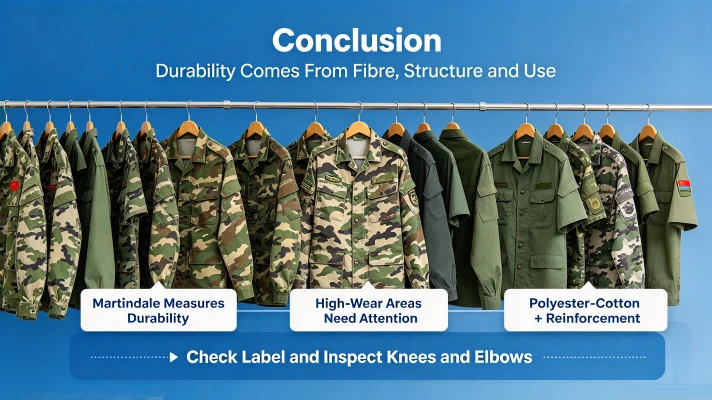
The abrasion resistance of military training camouflage uniforms depends on the combined effects of fibre type, yarn twist, fabric density, weight, and finishing. The Martindale test is the standard method for measuring abrasion resistance, and 10,000‑20,000 cycles is the common abrasion grade for training uniforms. Knees, elbows, seat, and shoulders are the most prone to wear – when buying, pay attention to whether these areas have reinforcement designs.
A training uniform with good abrasion resistance is not simply "the thicker the better" – it is about maximising fabric abrasion resistance through reasonable fibre proportions and structural design while maintaining basic breathability. The next time you buy a training uniform, check the label and inspect the knees and elbows – you will be able to judge whether the garment is "durable enough to wear."