
Bulletproof mechanism
Apr 20, 2024
Steel helmets rely on the hardness of the steel itself to resist impacts, but the steel material is inherently heavy. Bulletproof helmets made of steel are therefore bulky, imposing significant burden on the wearer's head and neck.
The bulletproof mechanism of fiber-reinforced resin-based composite materials is completely different. Essentially, it converts the kinetic energy of high-speed projectiles into the potential energy of the composite material and absorbs or dissipates it.
From the perspective of composite material structure, after being subjected to ballistic impact, the energy absorption forms of composite materials mainly include three types: fiber reinforcement fracture, resin matrix fracture, and interfacial delamination. When high-speed bullets impact the material, the fibers on the impact surface undergo compression shear failure, while the fibers on the opposite surface undergo tensile failure. The impact energy propagates in the composite material in the form of stress waves (including transverse waves and longitudinal waves), with the longitudinal waves propagating along the axis of the fibers. Research has found that when longitudinal waves reach the boundary position (i.e., the intersection of the warp and weft yarns of the fabric), some of the impact energy will be reflected and superimposed with the original longitudinal waves, causing an increase in the impact energy at that position, thereby initiating fiber fracture, as shown in Figure 2.

Uni-directional (UD) fabric is a composite fabric containing a large number of high-performance fibers only in a single direction. Its structure is shown in Figure 3.
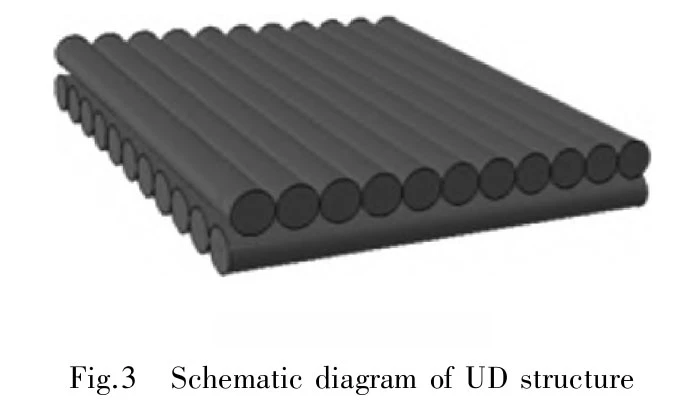
In this type of fabric structure, there are no intersection points between warp and weft yarns, allowing longitudinal waves to propagate further without reflection. Therefore, the ballistic performance of unidirectional (UD) fabrics is generally superior to that of woven fabrics with intersection points. Three-dimensional (3D) fabrics, due to their structural characteristics with more fiber bending and wrinkling, exhibit poorer stress wave propagation capabilities and consequently lower ballistic performance. However, some researchers argue that the presence of Z-twist yarns in 3D fabrics provides good structural integrity, excellent penetration resistance, and delamination resistance, resulting in superior ballistic performance compared to other fabric types. Research on the ballistic performance of 3D fabric composite materials is still ongoing.
Apart from the reinforcement structure, the performance of the reinforcing fibers themselves also significantly influences the properties of composite materials. Fibers with higher tensile strength, modulus, and density enable faster propagation of longitudinal waves, facilitating quicker absorption and dissipation of impact energy. Therefore, high-performance fibers such as aramid and UHMWPE fibers are commonly selected as reinforcing fibers for bulletproof composite materials.
The issue of resin matrix fracture is primarily related to the characteristics of the matrix itself. For instance, thermosetting resins have high stiffness and brittleness, making them prone to fracture upon impact, while thermoplastic resins exhibit good toughness and impact resistance but are more susceptible to deformation.
In composite material structures, the presence of interfaces allows reinforcing fibers and resin matrix to form a complete composite material, thereby exhibiting good mechanical properties. Additionally, interfaces also play a role in transmitting transverse stress waves. Interfacial delamination is another important form of energy absorption in composite materials, but the bonding strength of interfaces needs to be moderate. Low bonding strength can lead to severe delamination and fiber slippage, affecting the performance of composite materials, while excessive bonding strength can limit the effective utilization of the high strength and modulus of the fibers and decrease the ballistic performance of the composite material by restricting the wrapping angle of the projectiles.