
Buttons and Snaps on Tactical Uniforms: Pros and Cons of Metal, Plastic, and Magnetic Closures
Nov 20, 2026
1. Introduction: The Failure of a Single Button Can Render an Entire Equipment System Meaningless
Buttons and snaps on tactical uniforms are the smallest yet most underestimated components on the entire garment.
A main-placket snap bursts open at a critical moment, the front of a stab-resistant vest loses its closure, and the protective layer is exposed; a metal button corrodes and jams after water immersion and cannot be undone while wearing gloves; a magnetic closure accidentally releases in a strong magnetic field, scattering equipment on the ground. These scenarios are not alarmist-they are the inevitable result of incorrect closure selection under real stress.
Closures commonly used on tactical uniforms fall into three categories: metal buttons (including metal sew‑through buttons and metal snaps), plastic buttons (including resin buttons and plastic snaps), and magnetic closures (including fabric‑covered magnetic snaps and magnetic‑mechanical buckles). The three may look similar in appearance, but their differences in strength, corrosion resistance, temperature adaptability, accidental-opening risk, and detectability determine where each is suitable-and where it is not.
This article explains the performance boundaries and selection logic of the three closure types clearly.
2. Metal Buttons: The "Baseline" for Strength and Durability
2.1 Core Advantages: Tensile Strength and Temperature Resistance
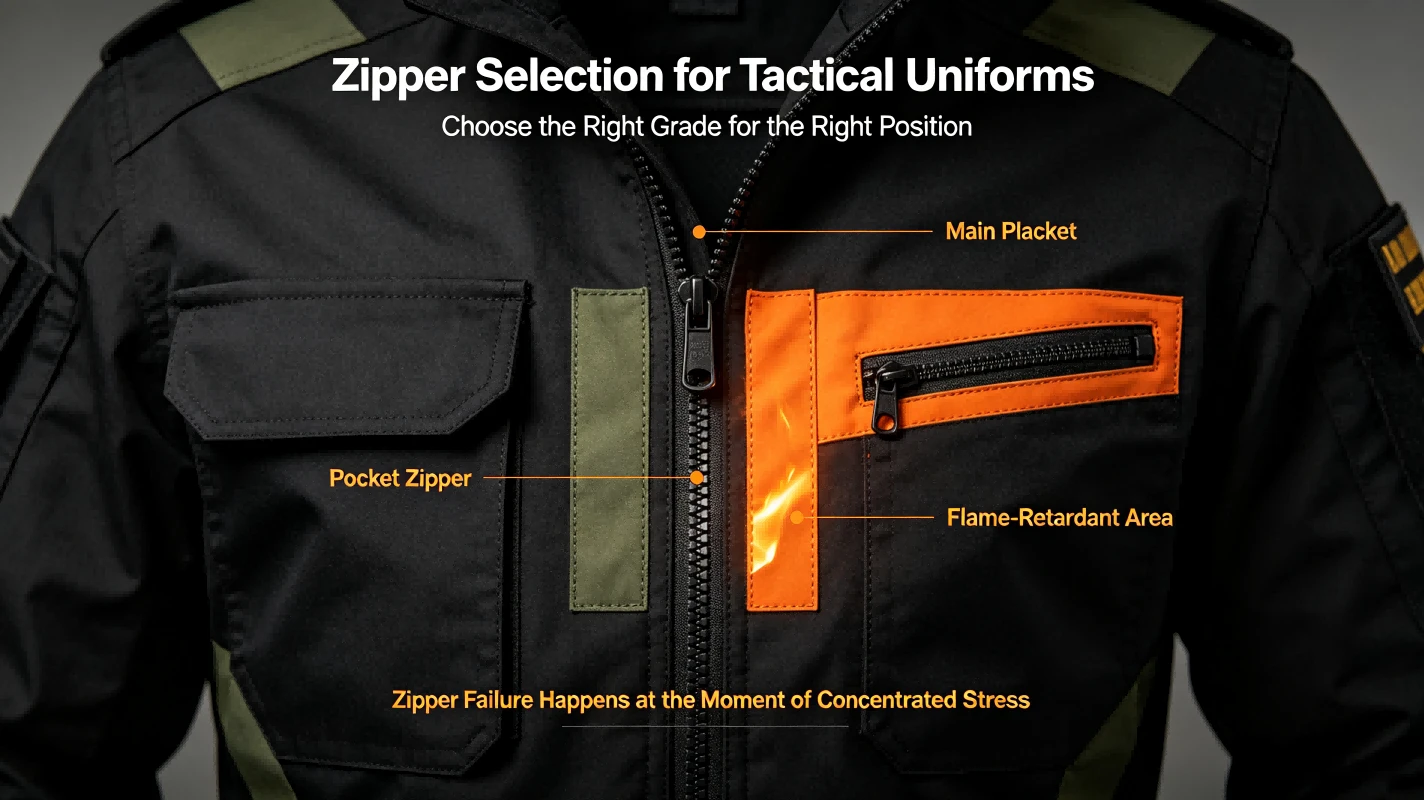
The core value of metal buttons (especially metal snaps and metal shank buttons) on tactical uniforms is tensile strength and temperature resistance. The tensile strength of metal snaps is typically far higher than that of plastic snaps, enabling them to withstand repeated pulling at high-load closure points such as the main placket, waistband, and equipment attachment points.
In terms of temperature resistance, metal buttons also have a clear advantage. Metal buttons do not soften or deform at high temperatures, making them suitable for high‑temperature environments such as flame‑retardant tactical uniforms, flight suits, and firefighter suits. Plastic buttons, by contrast, lose their elasticity as they approach their softening temperature (typically 120–150℃), and the "click" locking force of the snap drops sharply.
Key parameter reference:
- Metal snap tensile strength: quality products can reach ≥150 N (separation force between cap and socket)
- Metal shank button tensile strength: ≥200 N
- Temperature range: metal buttons can operate stably above 200℃, far higher than plastic buttons
2.2 Core Risks: Corrosion and Detectability
The primary risk of metal buttons in tactical scenarios is corrosion. Salt spray, sweat, and seawater environments accelerate the rusting of metal buttons – especially iron‑based buttons (commonly used in cheap products), which develop rust spots within days in humid environments. Corrosion not only damages appearance but also causes snaps to seize and become impossible to open or close.
Corrosion resistance ranking (best to worst):
1. Stainless steel buttons (304/316): best – suitable for waterborne and marine environments
2. Brass/copper alloy buttons: good, but may still oxidize in long‑term salt spray environments
3. Nickel‑plated/zinc‑plated iron buttons: average – the base metal corrodes rapidly once the plating is damaged
4. Ordinary iron buttons: worst – should not be used on tactical uniforms
Battlefield detectability is the second hidden risk of metal buttons. Metal buttons trigger alarms under metal detectors and security gates, and may become an exposure source in special missions requiring low detectability. Some military procurement specifications require non‑metallic closures to avoid this issue.
2.3 Suitable Positions on Tactical Uniforms
Metal buttons are suitable for positions with high requirements for strength and temperature resistance, such as the main placket, waistband closure, equipment attachment points, and flame‑retardant uniforms. In waterborne or marine environments, stainless steel should be prioritised; in scenarios requiring low detectability, metal buttons should be avoided.
3. Plastic Buttons: The "Pragmatic Choice" of Lightweighting and Cost Advantage
3.1 Core Advantages: Lightweight, Corrosion‑Resistant, Low Cost
The core value of plastic buttons (resin buttons, nylon snaps, POM snaps) on tactical uniforms is lightweighting and corrosion resistance.
Weight advantage: plastic snaps typically weigh only 1/3–1/2 of metal snaps. For tactical equipment requiring weight control (such as lightweight assault uniforms and summer training uniforms), this difference accumulates into a considerable weight saving across the entire garment.
Corrosion resistance advantage: plastic buttons do not rust and perform stably in humid, salt‑spray, and sweaty environments. This is their natural advantage in waterborne missions and marine environments – metal buttons corrode and seize, plastic buttons do not.
Cost advantage: the unit price of plastic buttons is typically only 1/3–1/5 of metal buttons. In large‑volume tactical uniform orders, this price difference has a noticeable impact on the overall order cost structure.
3.2 Core Risks: Insufficient Strength and Low‑Temperature Embrittlement
The primary risk of plastic buttons is insufficient tensile strength. The tensile strength of ordinary plastic snaps may be only 1/3–1/2 that of metal snaps. Under repeated pulling at high‑load closure points (main placket, waistband), snap prong deformation and cap detachment may occur.
Low‑temperature embrittlement is the second risk of plastic buttons. In extreme cold environments below ‑20℃, some plastic materials (especially ordinary PP and PS) become brittle and may crack or fracture under impact. This is a selection constraint that must be evaluated for cold‑region combat uniforms and high‑altitude equipment. POM (polyoxymethylene) and nylon materials have better low‑temperature performance than ordinary plastics, but still not as good as metal.
Temperature ceiling: the long‑term service temperature of plastic buttons typically does not exceed 80–100℃, making them unsuitable for high‑temperature scenarios such as flame‑retardant uniforms, flight suits, and firefighter suits.
3.3 Suitable Positions on Tactical Uniforms
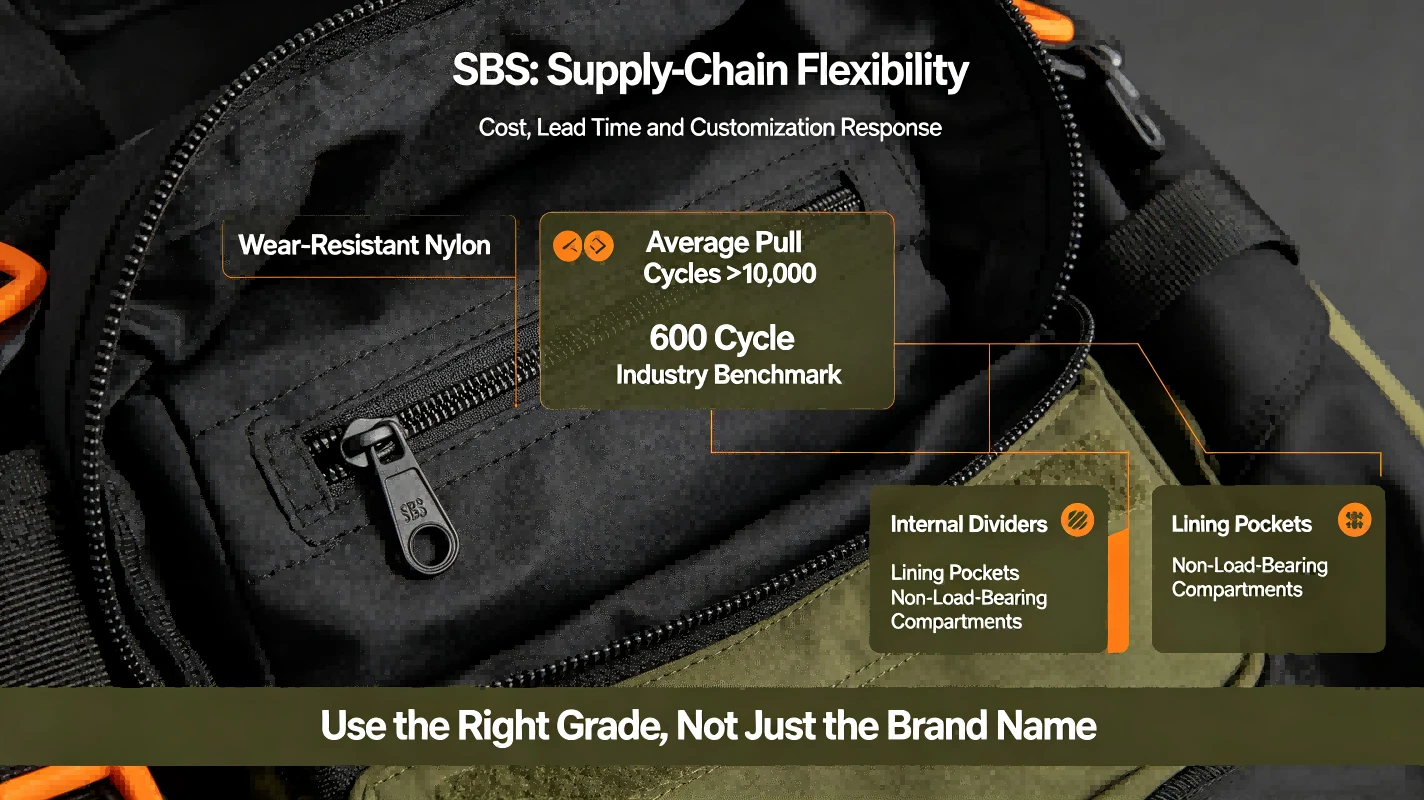
Plastic buttons are suitable for positions sensitive to weight and with less extreme strength requirements, such as internal dividers, linings, non-load-bearing pockets, and lightweight summer training uniforms. In cold-region equipment, POM or nylon materials should be prioritised, with low-temperature impact test data confirmed; in flame-retardant uniforms, ordinary plastic buttons are not suitable.
4. Magnetic Closures: The "Efficiency Tool" for Rapid Opening/Closing and One‑Handed Operation
4.1 Core Advantages: One‑Handed Blind Operation and Rapid Release
The core value of magnetic closures on tactical uniforms is rapid opening/closing and one-handed operation.
Magnetic closures rely on magnetic self-alignment: they automatically align and attract when brought close, requiring no visual alignment and no two-handed coordination. In tactical scenarios involving gloves, low-light conditions, and high-stress situations, this characteristic translates directly into operational efficiency-the speed of accessing equipment, opening/closing pockets, and releasing vests is several times faster than with traditional snaps.
In CCW (concealed carry) shirts and quick‑release systems on tactical vests, magnetic closures have become one of the mainstream solutions. Some high-end products use magnetic-mechanical buckles (such as Fidlock), combining magnetic self-alignment with mechanical locking for dual security-ensuring rapid operation while reducing the risk of accidental release.
4.2 Core Risks: Accidental Opening, Magnetic Interference, and Detectability
The primary risk of magnetic closures is accidental opening. The locking force of a pure magnetic closure depends entirely on magnetism, and it may accidentally release during vigorous movement, equipment snagging, or in strong magnetic fields. This is its fundamental limitation at primary load-bearing positions (such as the main body closure of a stab-resistant vest or equipment attachment points) – magnetic closures are suitable for "quick-open, quick-close" auxiliary positions, not for "must never open" primary load-bearing positions.
Magnetic interference is the second risk. Strong magnets may affect phones, watches, credit card magnetic strips, and pacemakers. In tactical scenarios, electronic equipment near magnetic closures (radios, GPS, BeiDou terminals) may be affected. Products must be labelled with magnetic field strength and usage warnings.
Detectability: the metal components of magnetic closures (neodymium magnets) are also detected by metal detectors, making them unsuitable for low-detectability missions.
Temperature limitation: neodymium magnets gradually demagnetize above 80℃, and magnetic force declines significantly above 120℃. Magnetic closures are not suitable for high-temperature scenarios such as flame-retardant uniforms and firefighter suits.
4.3 Suitable Positions on Tactical Uniforms
Magnetic closures are suitable for "efficiency-priority" positions such as CCW shirt pocket flaps, tactical vest quick‑release systems, and auxiliary pockets requiring rapid one‑handed opening/closing. They are not suitable for primary load‑bearing closures, flame‑retardant uniforms, or low‑detectability missions.
5. Selection Comparison of the Three Closure Types
|
Comparison dimension |
Metal buttons |
Plastic buttons |
Magnetic closures |
|
Tensile strength |
★★★★★ (≥150 N) |
★★★ (about 1/3–1/2 of metal) |
★★★ (magnetic locking, not mechanical locking) |
|
Corrosion resistance |
★★★ (stainless steel good; iron poor) |
★★★★★ (does not rust) |
★★★ (rusts once magnet plating is damaged) |
|
Temperature resistance |
★★★★★ (200℃+) |
★★ (80–100℃ ceiling) |
★★ (demagnetises above 80℃) |
|
Low-temperature performance |
★★★★★ |
★★ (ordinary plastics embrittle at -20℃) |
★★★ |
|
Accidental-opening risk |
Low (mechanical locking) |
Low (mechanical locking) |
Relatively high (pure magnetism easily releases accidentally) |
|
One-handed operation efficiency |
★★ |
★★ |
★★★★★ |
|
Battlefield detectability |
High (triggers metal detectors) |
None (non-metallic) |
High (magnets detectable) |
|
Weight |
Heavy |
Light |
Medium |
|
Cost |
Medium |
Low |
High |
|
Best position |
Main placket, waistband, flame-retardant uniforms, high-load closures |
Internal dividers, linings, lightweight garments, waterborne environments |
CCW pocket flaps, quick-release systems, auxiliary quick-open positions |
6. Selection Logic for Tactical Clothing Factories
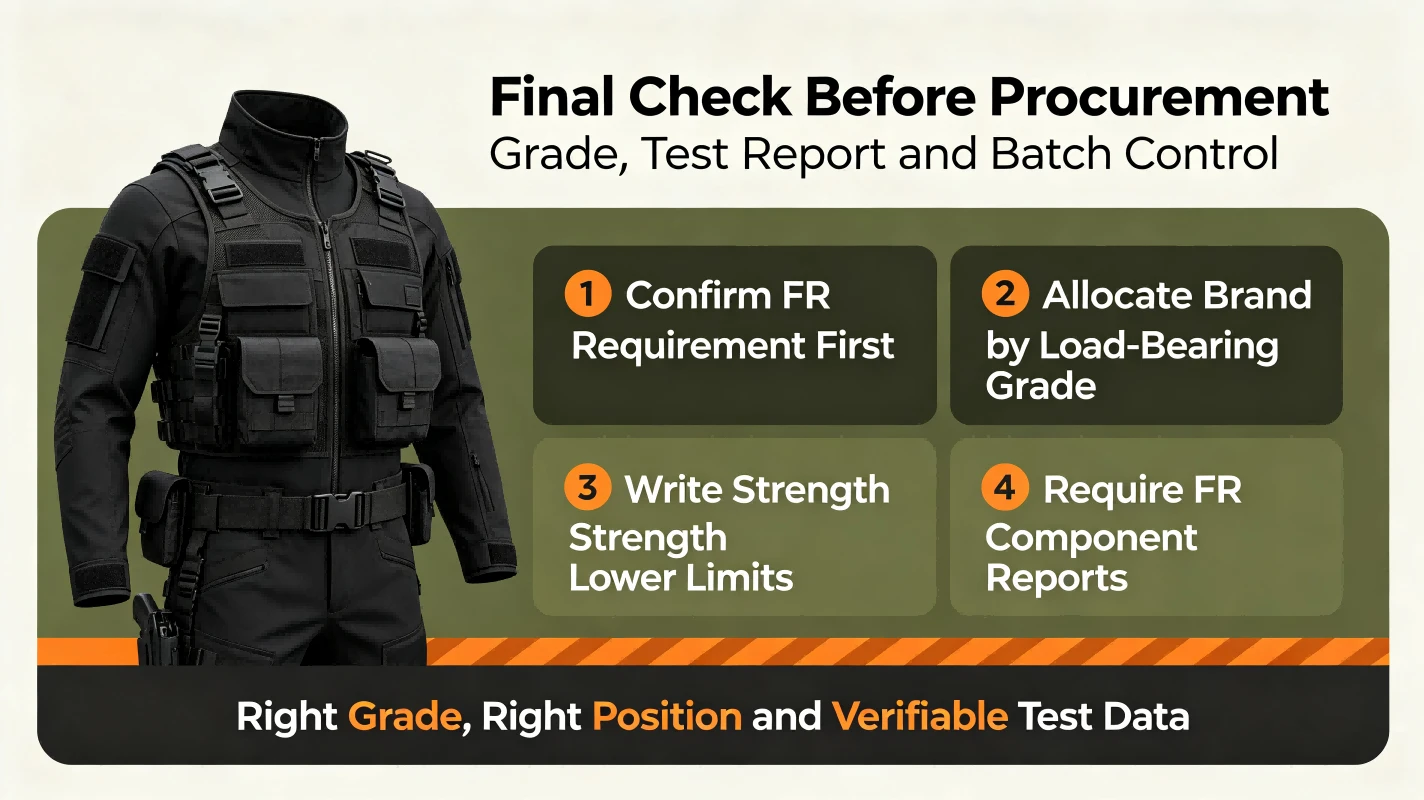
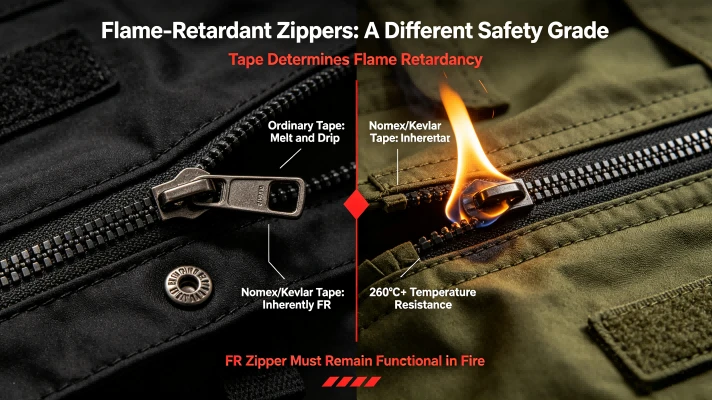
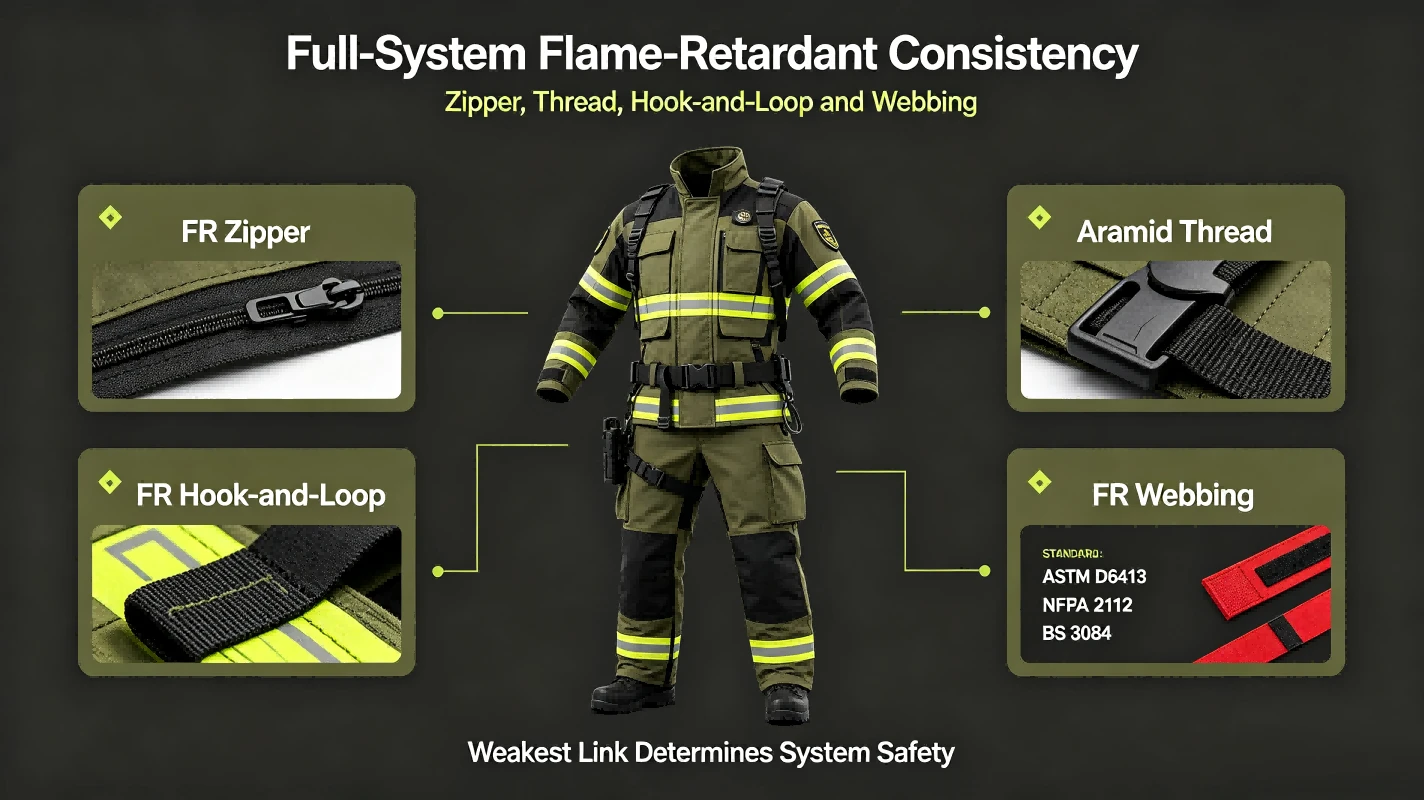
Step One: Determine "whether flame‑retardant is required" before discussing material. Closures on flame‑retardant tactical uniforms (Nomex/aramid, firefighting, flight, EOD) must be metal buttons or flame‑retardant‑treated closures. Ordinary plastic buttons soften and fail at high temperatures, and magnetic closures demagnetise above 80℃ – neither is suitable for flame‑retardant scenarios.
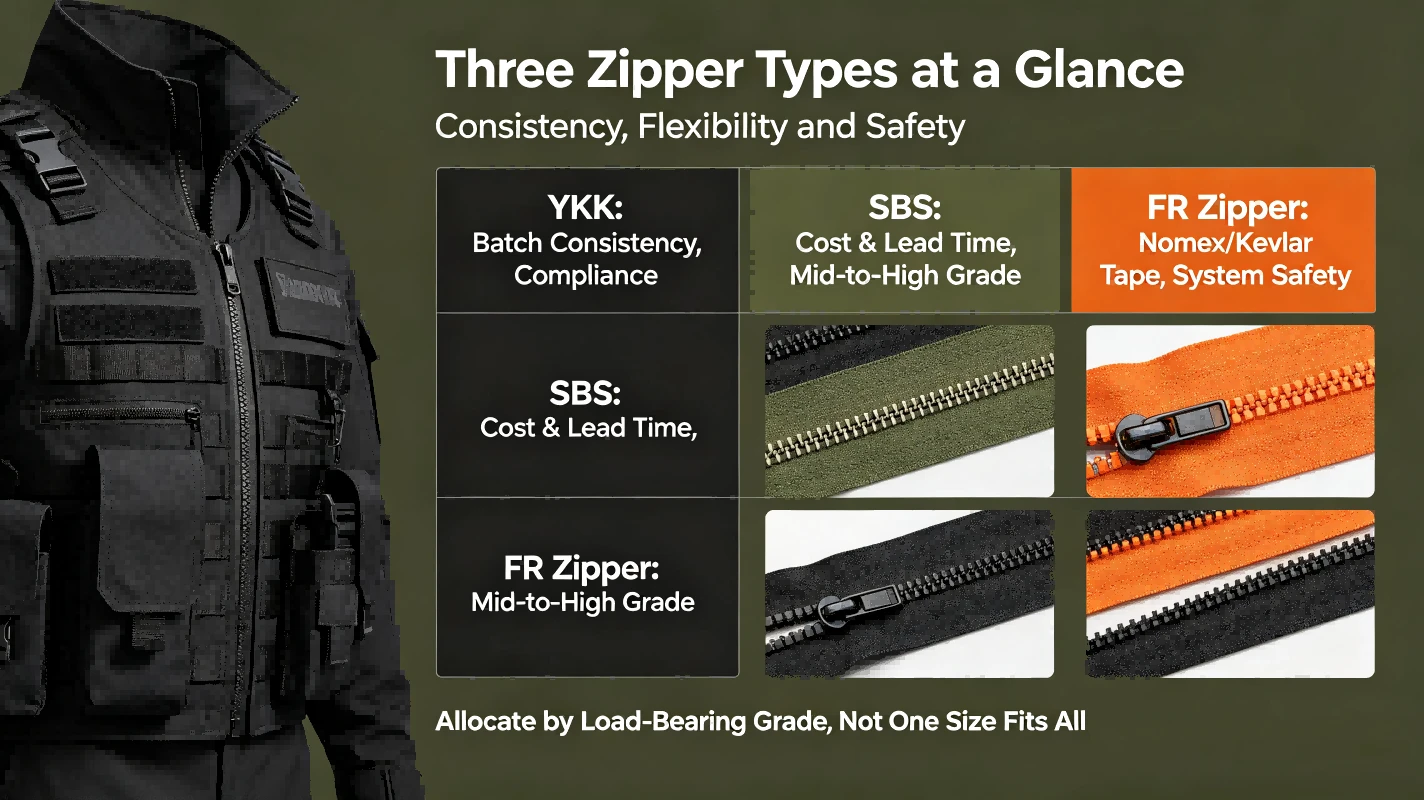
Step Two: Allocate materials by "load‑bearing grade." For primary load‑bearing positions such as the main placket, waistband, and equipment attachment points, prioritise metal buttons (stainless steel or copper alloy); for auxiliary positions such as internal dividers, linings, and non‑load‑bearing pockets, plastic buttons can be used to control weight and cost; for efficiency‑priority positions such as CCW pocket flaps and quick‑release systems, magnetic closures may be selected, but the accidental‑opening risk must be confirmed as acceptable.
Step Three: Confirm "environmental adaptability." For waterborne/marine environments, prioritise stainless steel or plastic buttons and avoid iron‑based buttons; for cold‑region environments, prioritise metal buttons or POM/nylon plastic buttons, with low‑temperature impact data confirmed; for high‑temperature/flame‑retardant environments, use only metal buttons.
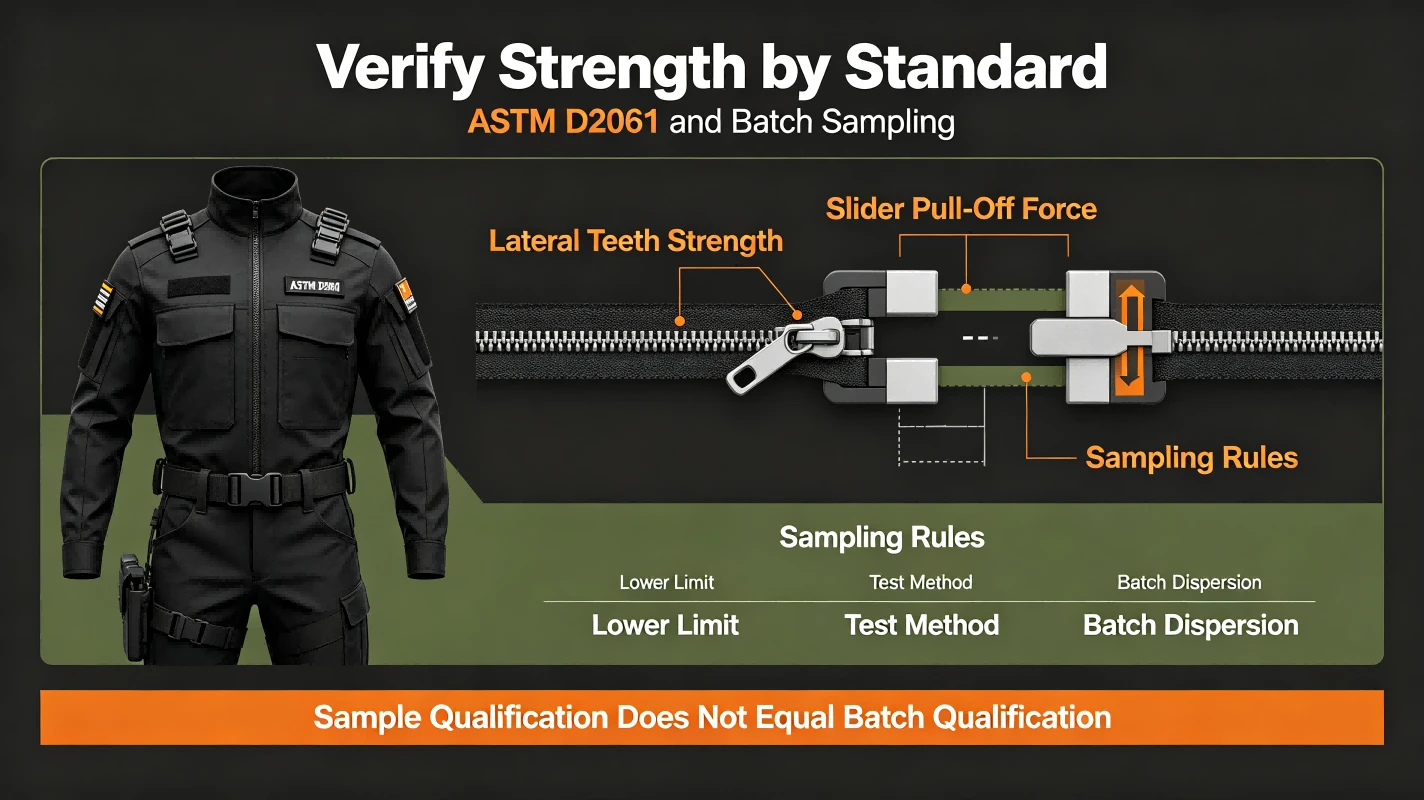
Step Four: Write "test standards" into the procurement specification. Do not simply write "metal snap" or "plastic snap"; specify lower limits for tensile strength, salt spray test duration, low‑temperature impact temperature, magnetic field strength and demagnetisation temperature for magnetic closures, and require test reports for the corresponding standards.
7. Frequently Asked Questions (FAQ)
Q: For the main placket of a tactical uniform, how should metal and plastic buttons be chosen?
A: Prioritise metal buttons. The main placket is a primary load‑bearing, high‑frequency operation position, and metal buttons are far superior to plastic buttons in tensile strength and fatigue resistance. If plastic buttons must be used (e.g., for lightweighting), choose POM or nylon high‑strength snaps and confirm the tensile strength data.
Q: Do magnetic closures open accidentally?
A: Pure magnetic closures carry an accidental‑opening risk under vigorous movement or snagging. This is their fundamental limitation at primary load‑bearing positions. Magnetic closures are suitable for "quick‑open, quick‑close" auxiliary positions (such as CCW pocket flaps), not for "must never open" primary load‑bearing positions. For scenarios requiring both rapid opening and reliable locking, magnetic‑mechanical buckles (magnetic self‑alignment + mechanical locking) can be selected.
Q: Can plastic buttons be used in cold regions?
A: It depends on the material. Ordinary PP and PS plastics may embrittle and crack below -20℃; POM (polyoxymethylene) and nylon have better low-temperature performance but are still inferior to metal. Cold-region equipment should prioritise metal buttons, or require plastic button suppliers to provide low-temperature impact test reports.
Q: Do metal buttons corrode in waterborne environments?
A: It depends on the material. Stainless steel (304/316) has the best corrosion resistance and is suitable for waterborne/marine environments; nickel-plated/zinc-plated iron buttons corrode rapidly once the plating is damaged, causing snaps to seize. Material requirements should be specified during procurement, and salt spray test reports should be required.
Conclusion
Buttons and snaps on tactical uniforms are essentially tools for allocating risk and efficiency. Metal buttons buy strength and temperature resistance, reducing the risk of "failure at primary load-bearing positions"; plastic buttons buy lightweight, corrosion resistance, and cost space, suitable for non-load-bearing positions and waterborne environments; magnetic closures buy the efficiency of one-handed rapid opening, but must accept the positioning of "auxiliary position" and the constraint of accidental-opening risk.
There is no "best button," only a button in the right position, of the right material, with the right test report. Writing the lower limit of tensile strength, salt spray duration, low-temperature temperature, and the demagnetization temperature of magnetic closures clearly in the procurement specification protects the reliability of tactical uniforms under real stress more effectively than writing the three words "metal button" or "magnetic closure."