
Introduction to German Army Trousers in WWII
Apr 17, 2026
Field Trousers
M36 Field Trousers
Before World War II, the German Army issued M36 field trousers to enlisted men and NCOs, mainly to pair with the M36 field tunic. In fact, the M36 field trousers were originally the long trousers issued by the Reichswehr (Weimar Republic's military) in 1922. The key features of the M36 field trousers are: made of stone-grey (Steingrau) wool, high-waisted, straight-legged, worn with suspenders, and equipped with three internal pockets and one watch pocket. When worn in the field, the legs of the M36 trousers were to be tucked into high leather boots.
Front view of the M36 field trousers

Back view of the M36 field trousers

The M36 field trousers were worn with Y-shaped suspenders, which were worn over the shirt.

On the front waistband of the M36 field trousers, there are five exposed buttons. Among them, two on each side are used to attach the Y-shaped suspenders.

On the back waistband of the M36 field trousers, there are two buttons on each side of the V-shaped notch. The soldier could choose one button on each side as needed to attach the Y-shaped suspenders.

The fly of the M36 field trousers is fastened with five buttons. The first button, located on the waistband, is the same size as the buttons used for attaching the Y-shaped suspenders-both are aluminum buttons. The four buttons below are slightly smaller, made of horn, and are hidden when fastened.

The M36 field trousers have three large pockets and one watch pocket. The three large pockets are located on the left and right front sides and on the right rear hip. The front pocket openings are 16 cm long, and the rear pocket opening is 15 cm long. All are designed as slanted internal pockets, allowing easy access even when wearing gloves. A small loop is attached above the watch pocket and below the waistband, used to secure a watch chain. Except for the watch pocket, all pockets are fastened with one button each.

After the introduction of the M40 field trousers, which were made in the same color as the field tunic, the M36 field trousers gradually faded out of use. The main reason was that field trousers had a shorter replacement cycle on the battlefield than field tunics. Therefore, even if a soldier wore an M36 field tunic on his upper body, he would typically be wearing M40 field trousers on his lower body.
The image shows the M36 field tunic paired with M36 field trousers, highlighting the noticeable color contrast between the two.


M40 Field Trousers
In 1940, uniform manufacturers received orders to stop producing stone-grey fabric and began using field-grey fabric, the same color as the field tunic, for making trousers. However, clothing depots continued to issue existing stock, so stone-grey M36 field trousers remained common until around 1942. Apart from the color, the M40 field trousers were identical to the M36 field trousers, with no other changes made.
Front and back view of the M40 field trousers

Color comparison of the M40 field trousers (left) and M36 field trousers (right)

M40 field trousers size markings: inside leg length 76 (from crotch to hem), waist 86, outside length (from waistband to hem) 109, hip circumference 100. Manufactured in Aachen, received into the Frankfurt clothing depot in 1940. OCO is likely the manufacturer.

The fly uses a button-fastening design. This pair of M40 field trousers was clearly made during a time when materials were abundant, as all the buttons are made of aluminum.

The four buttons on the back waistband and the adjustment tabs for waist tightening.

Comparison of the back waist adjustment tabs of the M40 field trousers (left) and M36 field trousers (right). The width of the adjustment tabs varied depending on the manufacturer. The double-prong buckle was made by "PRIMA".

Adopting the same color for tunic and trousers was mainly due to two reasons. The first was economic. Using the same color for both meant producing only one shade of fabric, which saved materials and labor time. The second was camouflage. Different colors between tunic and trousers would create strong contrast in the field, so uniform color improved the camouflage effectiveness of the field uniform. The image below shows the M40 field trousers paired with the M36 field tunic.


M43 Field Trousers
As World War II progressed, various raw materials in Germany became scarce, especially leather, which was an important strategic material. To conserve leather, from 1942 onward, the German Army introduced low boots and gaiters to replace the high leather boots that required large amounts of leather to produce. To accompany this change of footwear, on June 28, 1943, the German Army introduced the M43 field trousers. Another purpose of the M43 field trousers was to serve as a universal field trouser, standardizing all army trousers.
The M43 field trousers were based on the mountain troops' mountain trousers (Berghose), designed specifically to be worn with low boots and gaiters. Unlike previous straight-leg field trousers, the M43 trousers had a leg shape that was wide at the top and tapered at the bottom, which is why they were also called wedge trousers (Keilhose). Other features of the M43 field trousers included reinforced fabric at the seat, tightening straps at the hem, and the addition of belt loops on the waistband. Belt loops were added to field trousers mainly because suspenders were inconvenient to put on and take off. In field conditions, to unfasten the suspenders, a soldier had to remove his equipment belt and field tunic first. With a belt, these steps could be skipped, allowing the field trousers to be taken off directly.

The low boots and gaiters worn with the M43 field trousers.

The wedge-shaped legs of the M43 field trousers seen from the side. According to Army Regulation No. 253 of June 24, 1944, the mountain trousers (Berghose) were discontinued, and mountain troops were uniformly issued the M43 field trousers.

A fabric strip measuring 2 cm wide and 22 cm long is sewn at the hem, with two straps of 1.2 cm wide and 25 cm long sewn at its end, featuring three holes for threading the straps through.

This strap was first passed under the arch of the foot, then threaded through the eyelets and tightened, functioning similarly to a stirrup strap to prevent the trouser leg from riding up during movement. However, if tied too tightly, the resistance of the trousers during vigorous flexion and extension could cause knee injury, so this method of fastening was prohibited in 1944.
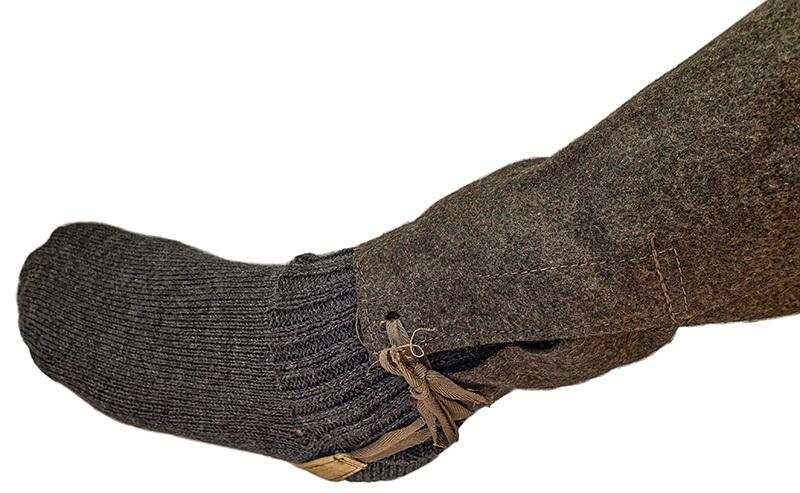
Since the trouser hem was already tapered, it could be tucked directly into the boot shaft, unlike straight-leg trousers which required the cumbersome step of folding the hem before tucking it in.

Another improvement of the M43 field trousers was the addition of belt loops, allowing them to be worn with either suspenders or a belt. The pockets of the M43 field trousers were the same as those on previous field trousers. Two of the belt loops were sewn into the top edge of the waistband and fastened at the bottom with field-grey buttons.

The fly is fastened with six buttons. The top two buttons are field-grey, and the four below are black. Inside the waistband, there are two field-grey buttons on each side for attaching the suspenders.

The suspenders are attached to the buttons on the inside of the waistband.

There are also two belt loops on the back of the waistband. The lower part of each belt loop is fastened with a field-grey button, while the upper part extends to the inside of the waistband, where a white fabric loop secures the button on the upper part.


When the upper part of the belt loop is unfastened, the button can be used to secure the suspenders. On both sides of the trousers are adjustment tabs for tightening.

The M43 field trousers paired with the M43 field tunic and the M43 universal field cap.

The leftmost soldier is wearing M40 field trousers, while the two soldiers on the right are wearing M43 field trousers. The second soldier from the left appears to have wrapped his trouser cuffs with socks. This practice was prohibited by an order issued on June 5, 1944, which stipulated that gaiters must be worn.

M44 Field Trousers
In 1944, the German Wehrmacht introduced the M44 field trousers, primarily designed to be worn with the M44 field tunic, which was introduced on October 21, 1944.
Front and back views of the M44 field trousers

By comparing the three types of field trousers, the features of the M44 field trousers can be seen to include an added pocket on the rear hip, pockets with flaps, belt loops on the front that are sewn directly into the waistband, and elastic bands at the trouser hems.

The M44 field tunic was designed to save materials and reduce labor time, with a shorter length and the omission of two pockets. Because the field tunic was shortened, the pockets of the field trousers became exposed. To prevent debris from entering them, flaps were added to the pockets. At the same time, to compensate for the loss of pocket capacity from the tunic, an additional pocket was added to the rear of the field trousers.

In the photo, the soldier wearing the M44 field tunic is also wearing M44 field trousers, and the pocket flaps on the trousers are clearly visible.

Comparison of the M44 field trousers (top) and the mountain trousers (Berghose, bottom). The pocket flaps on the M44 field trousers are more simplified in style, with wider pocket openings and larger capacity.

The fly of the M44 field trousers is fastened with five buttons, and the lining is made of a cotton and rayon blended fabric.

The inside of the waistband of the M44 field trousers is the same as that of the M43 field trousers, with two buttons on each side for attaching the suspenders, and the belt loops on the back can be opened to secure the suspenders.

The M44 field trousers usually came with a cotton belt that was sewn directly onto the waistband and could not be removed.

Comparison of the M43 field trousers (left) and M44 field trousers (right). The M44 field trousers did not retain the tapered (wedge-shaped) leg design, but instead returned to a straight-leg cut to reduce manufacturing steps.

The cuffs of the M44 field trousers are fitted with elastic bands to tighten the hem. The button on the inside of the cuff prevents the elastic band from slipping into the interior of the trouser leg.

Tightening the hem allows it to fit closely around the ankle, but because the trousers have a straight leg, they appear somewhat bunched and puffy above the gaiters.

Although the trousers came with an integrated belt, suspenders had been used previously, so abruptly abolishing that method was likely difficult to implement. In the photo, the belt of the M44 field trousers shows no signs of use, suggesting that the trousers were once worn with suspenders.

The advantage of suspenders is that they do not constrict the abdomen and place less burden on the body, while the disadvantage is that they are inconvenient to put on and take off.

Long Trousers
Branch-Colored Striped Trousers
Officers and enlisted men of the Wehrmacht used various types of trousers, including M35 dress long trousers, standard long trousers, training trousers, field trousers, as well as specialized trousers for specific branches such as mountain trousers for mountain troops, riding breeches for cavalry, field trousers for armored troops, and field trousers for assault artillery, among others. Standard long trousers were the basic trousers for all non-cavalry personnel and were required to be worn by all ranks with both field and dress uniforms. In June 1935, the Wehrmacht introduced long trousers with branch-colored piping (Waffenfarbe) along the outer seams-officers of the General Staff and generals had additional stripes. These were worn by non-cavalry NCOs and enlisted men with the parade uniform, and by all ranks with the walking-out uniform. Initially made of stone-grey fabric, from 1940 onward the trousers were required to be made of field-grey fabric. After the outbreak of World War II, production of branch-colored piped trousers ceased, though they could still be purchased privately.
Officers and certain senior NCOs were required to purchase their uniforms privately and received a uniform allowance through the Army Clothing Account System (Kleiderkasse). They could choose to purchase uniforms from Army clothing depots or acquire higher-quality tailor-made uniforms from private tailors. Although enlisted uniforms were issued by the Wehrmacht, enlisted men were also permitted to purchase uniforms privately, though at potentially higher cost.
The image shows a pair of long trousers manufactured in 1940, made of grey wool doeskin fabric, with a straight leg cut. The fly is fastened with one metal hook-and-eye closure and four buttons. At the back of the waistband there is an adjustment tab for tightening the waist. The outer seam is decorated with branch-colored piping made of green wool.

On the inside of the waistband, there are two buttons on each side for attaching suspenders. On the back of the waistband, two belt loops can be unfastened to secure the suspenders.

Shown here is a pair of long trousers manufactured after 1940, made of field-grey wool fabric. The fly is fastened with five buttons. There are two sewn-on belt loops on the front and three on the back. On each side of the waistband there is an adjustment tab for tightening the waist. On the inside of the waistband there are buttons, and on the back there are belt loops that can be unfastened. The outer seams are decorated with white branch-colored piping, representing infantry.


General's Long Trousers
The general's long trousers shown in the image are made of stone-grey wool fabric. They feature two vertical slit pockets on the front, a watch pocket, and one buttoned pocket on the right rear hip. The fly is fastened with one metal hook-and-eye closure and four buttons. The waistband lining is made of patterned rayon fabric, while the fly and pocket linings are made of grey cotton fabric. On each side of the trousers there is an adjustment tab with a metal buckle.
Front view of the general's long trousers

The fly of the general's long trousers. At the top is a metal hook-and-eye closure, below which are four grey-brown plastic buttons.

On the inside front of the waistband of the general's long trousers, two buttons are sewn on each side. On the back are two belt loops that can be unfastened.

The side view of the general's long trousers. The outer seams are decorated with branch-coloured piping in crimson, and on both sides are crimson stripes (Lampassen), all made of crimson wool.

On each side of the general's long trousers there is an adjustment tab for tightening the waist.

Back view of the general's long trousers

Shown here is another pair of general's long trousers. Because private tailoring was permitted, they differ slightly from the pair above. These general's long trousers are made of stone-grey wool fabric. They feature two slanted hip pockets on the front, a watch pocket, and two button-flap pockets on the back. The fly is fastened with six brown plastic buttons. On the front of the waistband, four buttons are sewn; on the inside of the back waistband, two buttons are sewn. The waistband and pocket linings are made of grey cotton fabric.
Front view of the general's long trousers

The fly of the general's long trousers

The side view of the general's long trousers. The crimson piping runs from below the waistband down to the hem, but the crimson stripes (Lampassen) run from below the pocket down to the hem. There are no adjustment tabs for tightening the waist.

Each hem of the general's long trousers is fitted with an elastic stirrup strap, attached to the inside of the hem with a button. When wearing the trousers, the foot goes through the stirrup strap, which prevents the hem from riding up during movement.


General Staff Officer's Long Trousers
The general staff officer's long trousers shown in the image are made of stone-grey wool fabric. They feature two slanted hip pockets on the front, a watch pocket, and one buttoned pocket on the right rear hip. The fly is fastened with one metal hook-and-eye closure and four brown buttons. The waistband is made of grey rayon fabric, and the lining is made of grey cotton.
Front view of the general staff officer's long trousers

The fly of the general staff officer's long trousers

The side view of the general staff officer's long trousers. The stripes (Lampassen) and piping are both made of magenta wool, which was the branch color (Waffenfarbe) for general staff officers.

A leather stirrup strap is sewn into each hem, with the strap secured by a button.

Riding Breeches
Cavalry Riding Breeches
Cavalry riding breeches were issued specifically to cavalry personnel. Like standard long trousers, they were initially made of stone-grey fabric and switched to field-grey fabric from 1940 onward. The distinctive features of riding breeches are the wide, baggy thighs that taper down toward the calf, allowing the hem to be easily tucked into riding boots. The inner thighs, which come into contact with the saddle, are reinforced with additional leather. However, due to leather shortages during the war, this leather reinforcement was replaced with double-layer wool fabric.
Shown here is a pair of cavalry riding breeches, made of stone-grey wool.

The fly is fastened with eight brown buttons. On each side of the front, there is a slanted hip pocket with a button. Four belt loops are sewn onto the waistband.

The waistband lining is made of grey rayon fabric, with two brown buttons sewn on each side.

The back view of the cavalry riding breeches. Two brown buttons are sewn on the waistband, and below them is an adjustment tab for tightening the waist. On the right hip there is a pocket with a buttoned flap. The inner thighs are reinforced with brown suede leather.

The slit at the calf is fastened with three black buttons.

Officer's Riding Breeches
Officer's riding breeches were one of the distinguishing features of an officer. According to uniform regulations, officer's riding breeches were required to be worn while on duty, guard duty, parades, and when reporting. They could also be optionally worn in the field and while walking out. Like standard long trousers, officer's riding breeches were initially made of stone-grey fabric and switched to field-grey from 1940 onward. The style of officer's riding breeches was essentially the same as that of cavalry riding breeches, but because officer's breeches could be worn for everyday non-riding use, the inner thighs were usually not reinforced with leather. Since officers had to purchase their own uniforms, they had a wider variety of styles to choose from, and many unofficial modifications appeared. Privately purchased uniforms for NCOs and enlisted men could only be used after passing inspection by a superior.
Shown here is a pair of general's riding breeches, made of stone-grey wool fabric.

On the front, there are two slanted hip pockets and a watch pocket.

The fly is fastened with a metal hook-and-eye closure and grey buttons.

The waistband lining is made of striped rayon fabric, with a total of six brown buttons sewn on the front and back to secure the suspenders.

The back view of the general's riding breeches. On the right hip there is a pocket with a buttoned flap, and on each side there is an adjustment tab for tightening the waist.

The side of the general's riding breeches is decorated with crimson piping and stripes (Lampassen).

The slit at the calf has a total of 24 eyelets (12 on each side), through which a lace is threaded to adjust the tightness. The closure of the calf slit was typically achieved with laces, buttons, zippers, or a combination of two methods.

Shown here is a pair of officer's riding breeches, made of stone-grey wool fabric. On the front there are two slanted hip pockets and a watch pocket, each with a buttoned flap. Four belt loops are sewn on the front and sides of the waistband.

The fly is fastened with one metal hook-and-eye closure and four buttons.

The waistband lining is made of white cotton fabric, with four buttons sewn on each side.

The back of the officer's riding breeches has two pockets with buttoned flaps, and on each side there is an adjustment tab for tightening the waist. In the center of the waistband, two unfastenable belt loops are sewn.

The outer seam is decorated with a pink wool piping, representing the armored branch (Panzer troops).

The calf slit is closed with a zipper.

Shown here is a pair of officer's riding breeches, made of field-grey wool fabric. On the front, there are two slanted hip pockets with buttons and a watch pocket.

The fly is fastened with one metal hook-and-eye closure and four olive-colored buttons (one button is missing/damaged in the photo). An additional fabric tab with buttonholes has been added on the waistband for fastening.

The waistband lining is made of medium-grey polished cotton fabric, with four olive-colored buttons sewn on it. On the back, the two belt loops have been replaced with one wide belt loop fitted with two buttons.
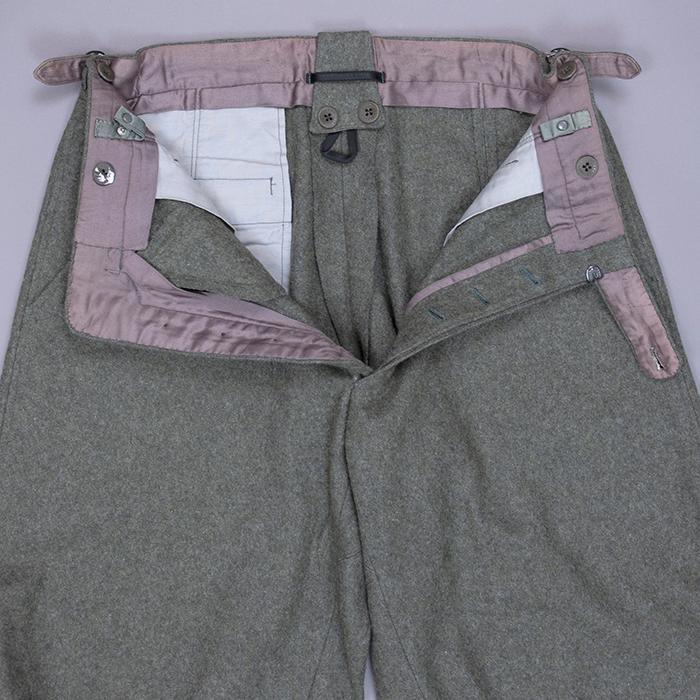
Back view of the officer's riding breeches

On the back, there is a buttoned pocket on the right hip. On each side of the waistband, there is an adjustment tab for tightening the waist.

The upper part of the calf slit is closed with a lace, while the lower part is made of cotton fabric and closed with buttons. Since riding breeches need to be tucked into high leather boots, some officers used different materials on the calf area to prevent wear and tear.


