


Tactical Clothing Factory | Comparison of Abrasion Resistant Fabrics for Tactical Pants: Cordura vs. Nylon 6.6 vs. Thickened Polyester
Apr 24, 2026
1. Introduction: Why Abrasion Resistance Is the Top Performance Indicator for Tactical Pants
Typical use scenarios for tactical pants include crawling, rock climbing, repeated rubbing against equipment (buttstock, tool hooks, safety ropes), and sitting/lying on rough terrain. These actions generate much higher fabric wear than ordinary casual trousers.
The first line of defense in tactical pant fabrics is their remarkable tear resistance. Fabrics blended with 600D Cordura nylon and cotton fibers can withstand over 300 Newtons of lateral pull in laboratory tests-which is equivalent to the force of two adult goats tearing in opposite directions. This property is particularly crucial in wilderness rescue: when rescuers navigate through dense underbrush, the plain weave structure on the fabric surface disperses the impact like a chain. Even if scraped by sharp branches, it only leaves slight marks rather than fatal tears. More advanced aramid fiber blended fabrics can even maintain toughness in -40°C environments, avoiding the risk of ordinary fabrics becoming brittle due to freezing.
If a tactical clothing factory chooses fabrics with insufficient abrasion resistance, the following problems occur:
Knees, seat, and cuffs develop pilling or holes quickly
End-user return rates rise, brand reputation suffers
Rework and after-sales costs increase, eroding profit margins
As a high-strength nylon fiber, CORDURA fiber takes wear resistance to new heights. It is known for being 10 times more wear-resistant than ordinary cotton fabrics. Whether it is friction with rocks and branches during outdoor activities or frequent use in daily wear, it can handle them easily. Meanwhile, it also provides good breathability and comfort, making it a common choice for tactical pant fabrics.
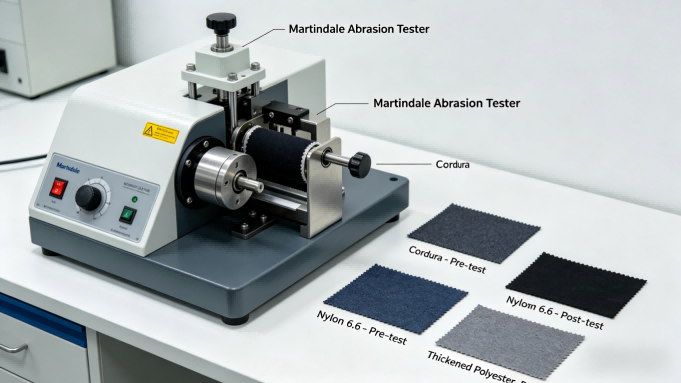
Currently, the three most common abrasion resistant fabrics for tactical pants are Cordura, Nylon 6.6, and Thickened Polyester. Based on standard laboratory test methods (ISO 12947, ASTM D5034), this article provides quantitative comparison data.
2. Detailed Parameter Comparison of the Three Fabrics (Core Table)
The table below summarizes key indicators. Tactical clothing factory purchasing staff are advised to save this table directly.
| Parameter | Cordura | Nylon 6.6 | Thickened Polyester |
| Main composition | Nylon 66 (special air‑jet textured yarn) | Nylon 66 | Polyester (PET) |
| Typical denier | 500D / 1000D | 420D / 840D | 600D / 1200D |
| Martindale abrasion cycles (ISO 12947) | >100,000 | ~60,000–80,000 | ~30,000–50,000 |
| Breaking force (warp, ASTM D5034) | ≥3000 N | ≥2500 N | ≥1800 N |
| Tear strength (tongue method) | ≥120 N | ≥90 N | ≥60 N |
| Inherent flame resistance | No (coating can be added) | No | No |
| Hand feel & breathability | Slightly stiff, moderate breathability |
Relatively smooth, slightly slippery | Stiff, poor breathability |
| UV resistance (200 hours) | Grade 4 | Grade 4 | Grade 3.5 |
| Reference cost per meter (150cm width, RMB) | 35–60 | 25–40 | 12–20 |
| Typical brand / source | Cordura® (INVISTA) | INVISTA, Solutia, domestic yarn | No specific brand |
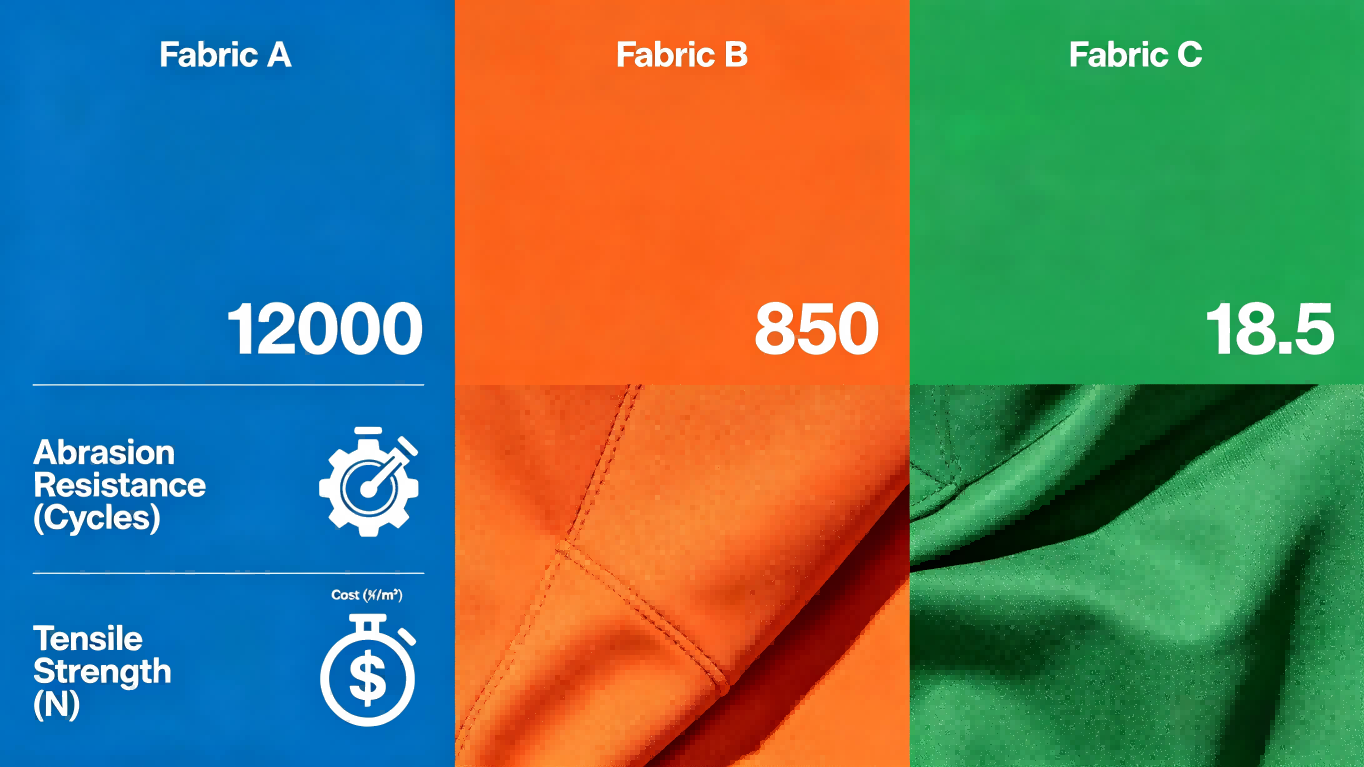
3. Detailed Interpretation of Laboratory Data
3.1 Martindale Abrasion Curve Comparison
The Martindale test (ISO 12947) uses wool abrasive under 9 kPa pressure, rubbing the specimen in a plane, and records the number of cycles until yarn breakage or hole formation.
Cordura (500D): Only slight pilling appears at 100,000 cycles; no broken filaments. Single filament breakage occurs after 120,000 cycles. This is due to Cordura's special air textured yarn structure where individual filaments form loops that protect each other.
Nylon 6.6 (420D): Local filament breakage begins around 70,000 cycles; breakage area expands after 80,000 cycles but no hole yet.
Thickened Polyester (600D): Obvious pilling at 40,000 cycles; hole >2 mm in diameter appears after 50,000 cycles.
Conclusion: Cordura has more than twice the abrasion life of thickened polyester.
3.2 Tear Strength Test (Single Tongue Method, ASTM D2261)
This measures the force required to tear a fabric after a cut is made, simulating how tactical pants resist tearing when snagged.
| Fabric | Warp tear strength (N) | Weft tear strength (N) |
| Cordura 500D | 135 | 122 |
| Nylon 6.6 420D | 105 | 98 |
| Thickened Polyester 600D | 68 | 55 |
Note: Thickened polyester tends to "brittle tear" – once a tear starts, it propagates rapidly.
3.3 Colorfastness Comparison
For dark colors (black, olive drab, coyote brown):
Rubbing colorfastness (dry/wet): Cordura 4-5 / 4; Nylon 6.6 4-5 / 4; Thickened Polyester 4 / 3 (wet rubbing tends to bleed).
Washing colorfastness: Grade 4-5 for all three – minor difference.
Light colorfastness (40 hours): Cordura grade 4, Nylon 6.6 grade 4, Thickened Polyester grade 3.5 (more noticeable fading after prolonged sun exposure).
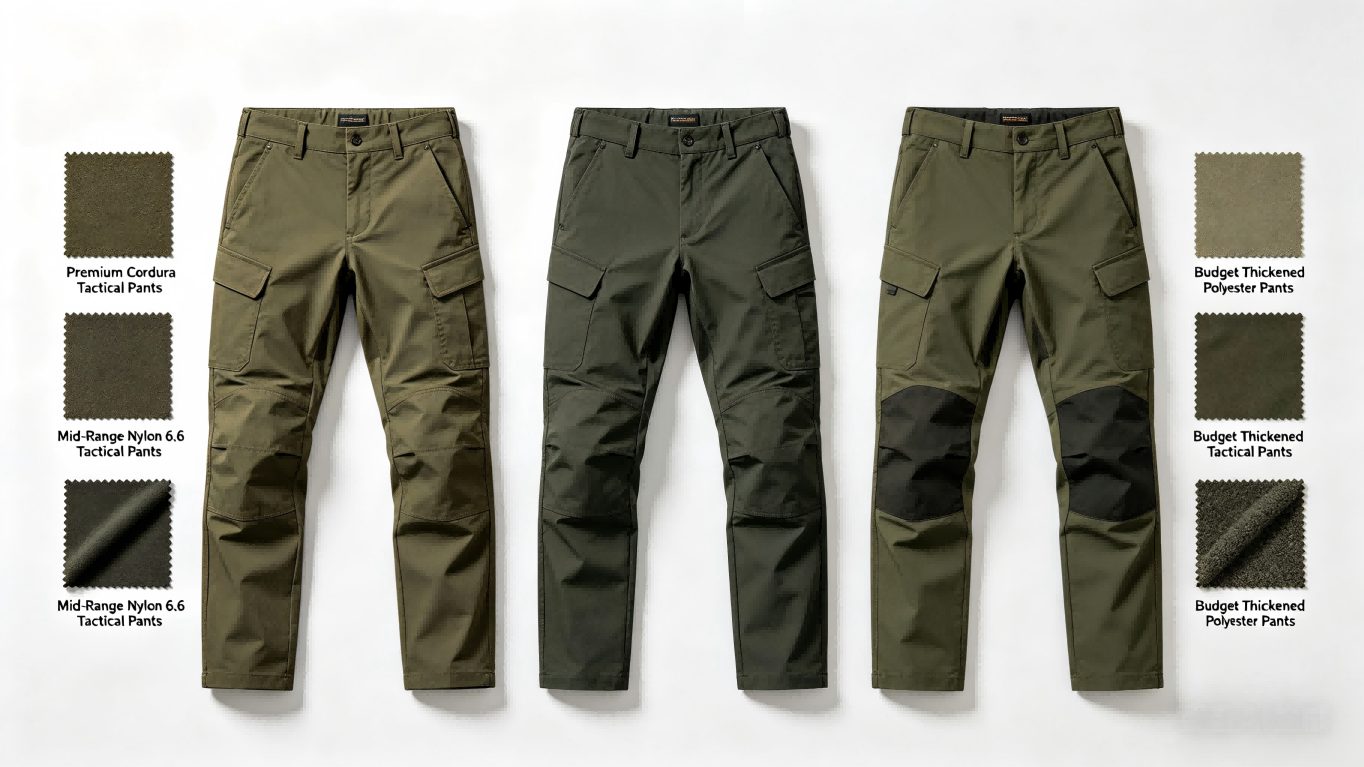
4. Material Selection Recommendations by Application Scenario (For Tactical Clothing Factory Production Planning)
4.1 High end tactical pants (military/police procurement, export orders, flagship brand models)
Preferred fabric: Cordura 500D – 1000D
Recommended after treatments: Teflon water repellent + anti microbial finish
Suitable styles: Combat pants, duty pants, assault pants
Cost control tip: Use Cordura only for local reinforcement (knees, seat) and Nylon 6.6 for the rest.
4.2 Mid range tactical / outdoor brands (mainstream e commerce, consumer grade)
Preferred fabric: Nylon 6.6 (virgin or modified Nylon 6)
Reinforcement method: Add double layer patch or abrasion resistant fabric on inner knee area
Suitable styles: Urban tactical pants, hiking pants, shooting training pants
4.3 Low price / disposable tactical pants (workwear, training uniforms, promotional items)
Preferred fabric: Thickened polyester (600D – 900D)
Compensatory process: Use double needle lapped seams on all stress points to increase seam strength
Clear drawbacks: Poor breathability, hot in summer, static build up
4.4 Blend options
Cordura/cotton (65/35): Better moisture absorption, softer hand feel, but abrasion resistance drops ~30% (suitable only for daily wear tactical pants).
Cordura/polyester (50/50): Cost reduced ~20%, retains ~80% abrasion resistance, suitable for price sensitive products that still need a brand endorsement.
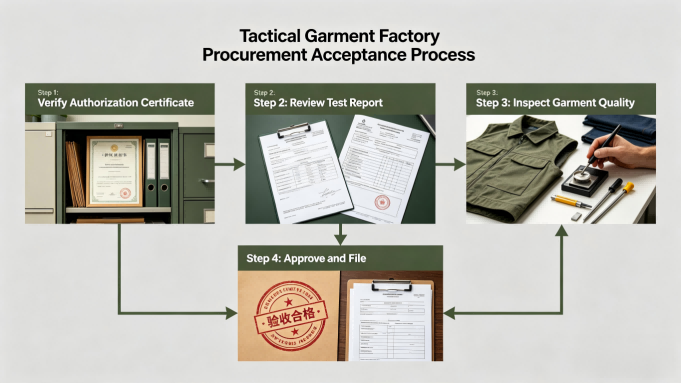
5. Factory Incoming Inspection Checklist (Copy ready)
When dealing with fabric suppliers, tactical clothing factories should verify the following:
License proof: For Cordura, require Cordura® brand license and hangtag usage agreement.
Test report: Request a third party abrasion test report from the last year, stating Martindale cycles, abrasive type, and load pressure.
Yarn confirmation for Nylon 6.6: confirm whether it is virgin Nylon 66 chips or modified Nylon 6 (the latter has 15 20% lower performance).
Thickened polyester verification: Request both gram weight (g/m²) and denier – avoid inflated denier with low weight (e.g., 600D but only 180 g/m²).
Heat shrinkage test: Put 1 meter of fabric in an 80°C oven for 30 minutes; measure warp shrinkage ≤3%.
6. Conclusion & Quick Selection Table
| Your priority | Recommended fabric | One‑sentence reason |
| Maximum abrasion resistance, ample budget | Cordura | Military‑grade, longest service life |
| Balanced abrasion resistance and cost | Nylon 6.6 | Performance close to Cordura, 30% lower price |
| Only low cost, short‑term use | Thickened polyester | Lowest cost, suitable for one‑time or light‑duty use |
Final advice for tactical clothing factories: For long term reputation, choose Cordura; for high volume price driven styles, you can blend Nylon 6.6 + polyester. Always clearly label fabric composition and test data to help end users compare and trust your products.
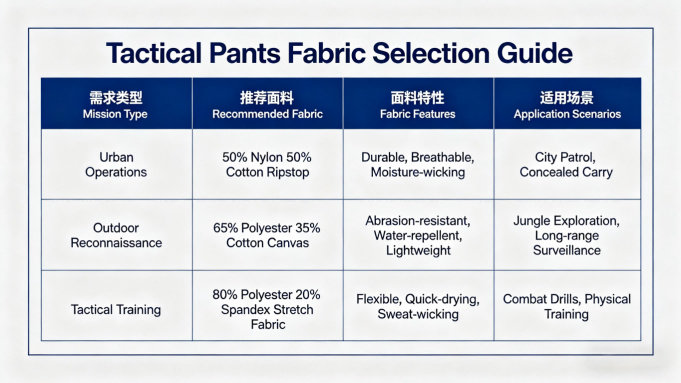
At the same time, tactical pant fabrics pay great attention to breathability, which can quickly wick away sweat even after high-intensity activities, keeping the body dry. In summer, tactical pants may use lightweight and breathable fabrics, such as four-way stretch fabrics with a cool touch, to enhance breathability and a sense of coolness, allowing users to remain comfortable in hot environments.
These fabric technologies hidden behind seams and pockets are actually humanity's rational response to extreme environments. When a firefighter rushes into a fire wearing flame-retardant tactical pants, and when a geologist relies on wear-resistant fabrics to maintain balance on steep cliffs, what we see is not just the persistence of a pair of pants, but also the solemn commitment of material science to life safety. Perhaps future tactical pant fabrics will incorporate more intelligent elements, but what remains unchanged is the confidence that allows users to dare to face challenges head-on.


