

Tactical Clothing Factory Quality Control Checklist: 10 Mandatory Test Indicators (Abrasion Resistance, Tear Strength, Colorfastness, Seam Slippage, etc.)
May 22, 2026
1. Introduction: Why Tactical Garments Need Stricter QC Indicators
The use scenarios for tactical garments are far more demanding than ordinary clothing. Military and law enforcement personnel, outdoor enthusiasts, and duty officers routinely experience: crawling (abrasion), climbing and snagging (tearing), sun and rain exposure (fading, waterproof failure), and high‑intensity movement (seam stress, sweat evaporation). Standard national garment standards (e.g., GB/T 2660-2017 for shirts) cannot cover these extreme requirements.
If a tactical clothing factory relies only on routine fabric testing, the following problems often occur:
New trousers wear through at the knees after one month → high return rate
Underarm seam bursts during strenuous activity → safety hazard
Olive green fades after three washes → customer complaints
Waterproof softshell leaks after half an hour in rain → brand damage
Therefore, tactical clothing factories must establish an internal QC system that is stricter than ordinary garment standards. This article lists 10 mandatory test indicators, each with:
Recommended standard values (referencing military/international standards)
Test methods (laboratory or in‑house)
Common failure causes and corrective actions
Applicable product types
These 10 indicators cover fabric durability, colorfastness, dimensional stability, functionality, and seam quality, and are applicable throughout the entire process from incoming quality control (IQC) to outgoing quality control (OQC).
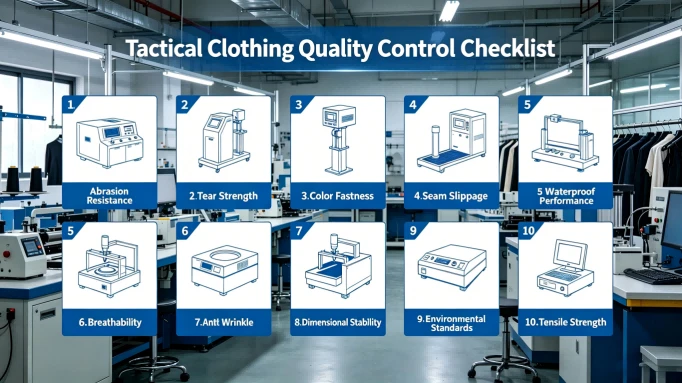
2. Quick Reference Table of 10 Mandatory Test Indicators
| No. | Indicator | Core meaning | Recommended standard (tactical grade) | Example test method |
| 1 | Abrasion resistance | Resistance to repeated rubbing | ≥20,000 cycles (Martindale) | ISO 12947 |
| 2 | Tear strength | Resistance to snagging tears | ≥50 N (tongue method) | ASTM D2261 |
| 3 | Colorfastness (rubbing/light/washing) | Color stability | Dry rubbing 4-5, light 4 | ISO 105 |
| 4 | Seam slippage | Resistance to seam opening | ≤3 mm opening | ASTM D434 |
| 5 | Breaking strength | Tensile strength without breaking | ≥600 N (warp) | ISO 13934 |
| 6 | Pilling resistance | Resistance to surface fuzz balls | ≥3-4 grade | ISO 12945 |
| 7 | Dimensional stability (shrinkage) | Size stability after washing | Within ±3% | AATCC 135 |
| 8 | Water penetration resistance (for waterproof fabrics) | Rain resistance | ≥8000 mm (before wash) | ISO 811 |
| 9 | MVTR (for waterproof breathable fabrics) | Sweat evaporation comfort | ≥5000 g/m²/24h | JIS L1099 B1 |
| 10 | Perspiration resistance | Resistance to sweat discoloration/staining | Grade 4 | ISO 105-E04 |
Note: The above standards are minimum recommended values for tactical garments. Military/police orders or high‑end export products require higher standards (e.g., abrasion ≥50,000 cycles, tear ≥80 N).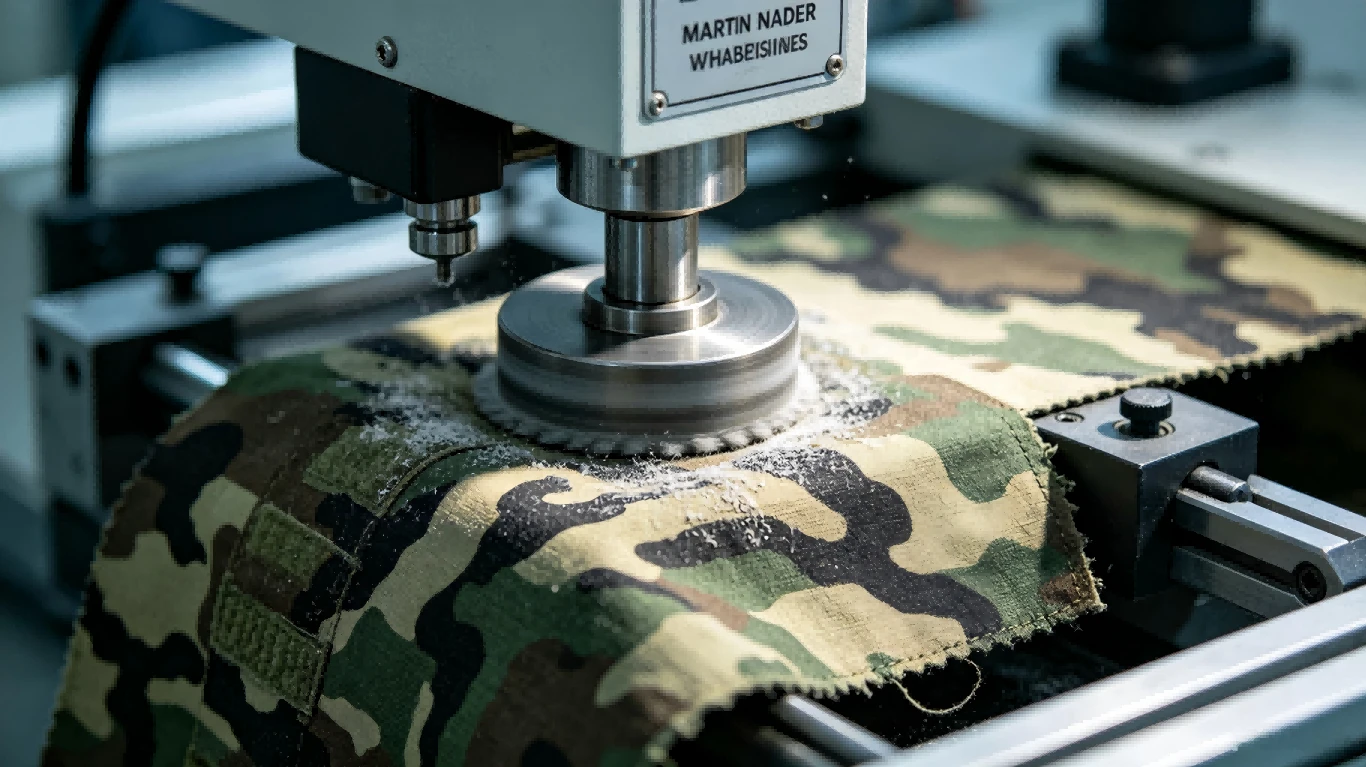
3. Detailed Explanation of the 10 Indicators
3.1 Abrasion Resistance
Test principle: Martindale method (ISO 12947) – a circular specimen is rubbed against standard wool abrasive under 9 kPa pressure in a planar motion. The number of cycles until yarn breakage or hole formation is recorded. The Taber method (rotary abrasion) can also be used for coated fabrics.
Tactical requirements:
General tactical trousers, combat uniforms: ≥20,000 cycles without obvious holes
Military/police procurement, high‑end brands: ≥50,000 cycles (knee/seat reinforcement areas may require higher)
Common failure causes:
Fabric denier too low (e.g., <300D)
Too high cotton content in polyester/cotton blends (cotton has poor abrasion resistance)
Coating or membrane too thin, peeling off after rubbing
Corrective actions:
Use high‑strength yarns such as Cordura or Nylon 6.6
Increase fabric density or use oxford weave
Add double‑layer patches or abrasion‑resistant fabric on high‑wear areas (knees, elbows, seat)
In‑house test method: Use a simple Martindale abrasion tester (approx. 3000 RMB). After 5000 cycles, visually assess fuzzing; after 20,000 cycles, check for holes.
---
3.2 Tear Strength
Test principle: Tongue method (ASTM D2261) – a "tongue" cut is made in the fabric and the force required to tear it is measured. Simulates resistance to tearing when snagged by a sharp object.
Tactical requirements:
Warp ≥50 N, weft ≥40 N (general areas)
Knee/elbow/crotch reinforcement areas: ≥80 N
Common failure causes:
Insufficient yarn strength (low‑denier nylon or recycled polyester)
Too loose fabric construction (e.g., thin plain weave)
Excessive after‑treatment (e.g., over‑calendering causing fiber embrittlement)
Corrective actions:
Use high‑strength yarns (Nylon 6.6 preferred)
Use canvas or oxford weave to increase interlacing points
Avoid overly aggressive chemical treatments
In‑house quick test**: Tear the fabric by hand to feel the resistance. Genuine Cordura requires significant force and tears unevenly; poor‑quality fabric tears easily in a straight line.
3.3 Colorfastness
Colorfastness includes several sub‑tests. Tactical garments should focus on the following three:
3.3.1 Rubbing colorfastness (dry/wet) – ISO 105‑X12**
Requirement: Dry rubbing ≥4, wet rubbing ≥3-4 (dark colors like black, coyote brown may allow wet rubbing ≥3)
Failure cause: Insufficient dye fixation, inadequate after‑wash rinsing, surface color from coating
Corrective action: Use high‑quality reactive or disperse dyes, strengthen soaping and fixation
3.3.2 Light colorfastness (40 hours) – ISO 105‑B02
Requirement: ≥4 (prevents olive green, coyote brown from fading or yellowing)
Failure cause: Poor UV resistance of dyes, common in cheap polyester
Corrective action: Use light‑fast dyes (e.g., CIBA light‑fast series) or add UV absorbers
3.3.3 Washing colorfastness – ISO 105‑C06
Requirement: Color change ≥4, staining ≥4
Failure cause: Insufficient removal of surface dye
Corrective action: Increase soaping cycles, use effective soaping agents
In‑house test methods:
Wet rubbing: Rub a white cloth dipped in water against the dark fabric 10 times and observe staining.
Light: Cut two samples, cover half of one with foil, place both on a sunny windowsill for one week, then compare color change.
---
3.4 Seam Slippage
Test principle: ASTM D434 – a fixed load (typically 120 N) is applied to a sewn seam, and the width of the opening at the seam is measured. Reflects the seam's resistance to "grinning" (yarn shift).
Tactical requirement: Opening ≤3 mm under load (military ≤2 mm)
Common failure causes:
Low fabric density (sparse warp/weft)
Seam tension too high or too low
Stitch length too long (>4 stitches/cm)
Insufficient seam allowance (<1 cm)
Corrective actions:
Increase fabric warp/weft density
Adjust sewing machine bobbin tension, use smaller needles (#18 or below)
Control stitch density at 8-10 stitches/inch (approx. 3-4/cm)
Increase seam allowance to 1.2-1.5 cm
In‑house quick test: Draw two lines 5 mm apart on either side of the seam, pull the seam forcefully, and measure the maximum opening between the lines.
---
3.5 Breaking Strength
Test principle: ISO 13934 (strip method) – a specified width of fabric is clamped in a tensile tester and pulled until break. Measures the fabric's ability to withstand overall tension.
Tactical requirements:
Warp ≥600 N, weft ≥400 N (roughly equivalent to 60 kg and 40 kg tensile force)
Military grade: warp ≥800 N, weft ≥600 N
Common failure causes:
Yarn count too low (e.g., cotton below 20s)
Too loose fabric construction
Damage from after‑treatment (e.g., strong acid/alkali)
Corrective actions:
Use higher denier yarns (e.g., 500D or above)
Increase warp/weft density
Adjust after‑treatment processes
Note: Breaking strength is different from tear strength. A fabric with high breaking strength may still have low tear strength (e.g., high‑density brittle fabric). Both must meet standards.
---
3.6 Pilling Resistance
Test principle: ISO 12945 (Martindale rubbing or random tumble) – the fabric is rubbed against itself or standard abrasive for a specified number of cycles, and the degree of pilling is rated.
Tactical requirement: ≥3-4 grade (after 2000 cycles, slight pilling allowed but not obvious)
Common failure causes:
Improper polyester/cotton blend ratio (polyester staple fibers pill easily)
Low yarn twist, excessive hairiness
Insufficient singeing
Corrective actions:
Use high‑twist yarns
Improve singeing process
Add anti‑pilling fibers (e.g., anti‑pilling acrylic)
Apply anti‑pilling finish to finished fabric
In‑house test method**: Rub the fabric surface with a nylon brush 20 times and visually assess pilling.
---
3.7 Dimensional Stability (Shrinkage)
Test principle: AATCC 135 – simulates home laundering, measuring dimensional change before and after washing.
Tactical requirement: Shrinkage ≤±3% in warp and weft (military ≤±2%). Exceeding this causes garment distortion, zipper puckering, and misalignment after washing.
Common failure causes:
Fabric not pre‑shrunk
Excessive pulling during sewing (garment shrinkage greater than fabric shrinkage)
Washing temperature too high (for heat‑sensitive fabrics)
Corrective actions:
Pre‑shrink fabric before cutting (steam or water)
Reduce pulling during sewing
Specify low‑temperature washing on care labels
In‑house test method: Cut a 50×50 cm sample, wash and tumble dry in a domestic machine, then remeasure.
---
3.8 Water Penetration Resistance (Hydrostatic Head) – For waterproof fabrics only
Test principle: ISO 811 – the fabric is clamped, and water pressure is increased from below; the pressure at which the third drop appears is recorded (mmH₂O).
Tactical requirements:
Softshells, rainwear, waterproof pants: ≥8000 mm before wash, ≥6000 mm after 5 washes
Ordinary DWR‑treated fabrics: hydrostatic head not required, only water repellency rating
Common failure causes:
Pinholes in membrane or lamination damage
Seams not seam‑sealed or poor sealing
DWR failure on face fabric – water wets the fabric prematurely, increasing pressure
Corrective actions:
Add online pinhole detection (spark test) during lamination
Apply heat‑seal tape to all seams
Improve DWR treatment
In‑house quick test: Make a transparent vertical water column (1.2 m high), clamp fabric at the bottom, fill water to 1 m, and observe for 1 minute. No leakage indicates ≥10,000 mm.
---
3.9 Moisture Vapor Transmission Rate (MVTR) – For waterproof breathable fabrics only
Test principle: JIS L1099 B1 (inverted cup method) – a water cup is inverted so that hot vapor rises through the fabric and is absorbed by desiccant; the amount of vapor transmitted in 24 hours is calculated. This method best simulates actual wear.
Tactical requirement:≥5000 g/m²/24h (comfortable for moderate activity); high‑end requires ≥8000.
Common failure causes:
Membrane pores blocked (excessive adhesive)
Face fabric DWR too heavy or poor breathability
Membrane inherently low MVTR (e.g., ordinary PU membrane)
Corrective actions:
Use hydrophilic TPU membrane or microporous membrane
Control adhesive coating weight at 8‑12 g/m², use gravure roller
Avoid high‑density coating on face fabric
Note: Different test methods produce vastly different results. The test method must be specified in contracts (e.g., JIS B1), otherwise results cannot be compared.
---
3.10 Perspiration Resistance
Test principle: ISO 105‑E04 – fabric and multifiber adjacent fabric are immersed in artificial sweat (acidic and alkaline), held at 37°C for 4 hours, then rated for color change and staining.
Tactical requirement: Both color change and staining ≥ grade 4
Common failure causes:
Dye has poor acid resistance
Residual salts or alkalis from after‑treatment
Dark colors especially prone to staining
Corrective actions:
Use sweat‑resistant dyes (e.g., metal complex dyes)
Thorough soaping and neutralization
Apply fixing agent
In‑house test method: Soak a sample in artificial sweat (commercially available reagent), place between glass plates in a 37°C oven for 4 hours, then compare to a gray scale.

4. QC Process and Sampling Plan
4.1 Incoming Quality Control (IQC)
Sampling ratio: Inspect 10% of each fabric batch (at least 1 roll), take 2 meters full width from each roll
Mandatory tests: Abrasion resistance, tear strength, colorfastness (dry/wet rubbing), shrinkage
Recording: Fill IQC report; label non‑compliant fabric with red sticker and isolate
4.2 In‑Process Quality Control (IPQC)
Timing: After first article approval and during bulk sewing
Mandatory tests**: Seam slippage, breaking strength (at sewn areas)
Frequency: 3 pieces per 200 garments
4.3 Outgoing Quality Control (OQC)
Sampling plan: AQL 2.5 (critical defects 0, major defects 2.5, minor defects 4.0)
Mandatory tests: All 10 indicators. Abrasion, tear, and colorfastness may reference fabric test reports, but seam slippage, water pressure, and MVTR must be tested on finished garments.
4.4 Third‑party testing frequency
First production of a new style: must send to CNAS laboratory for full test suite
Repeat styles: test one batch per quarter (at least 1 garment + 1 m fabric)
Upon customer request: test according to specified standards

5. Common Failure Causes and Quick Troubleshooting Table
| Indicator | Most common cause | Quick in‑house check |
| Poor abrasion resistance | Low fabric denier | Rub with abrasion tester for 20 min, visually inspect |
| Low tear strength | Brittle yarns | Hand‑tear sample and compare to genuine fabric feel |
| Wet rubbing bleeding | Insufficient dye fixation | Rub dark fabric with wet white cloth 10 times |
| Excessive seam slippage | Too high seam tension | Remove seam and see if yarns contract |
| Shrinkage out of spec | No pre‑shrinking | Measure 50×50 cm sample before/after wash |
| Low hydrostatic head | Membrane damage | Hold fabric against strong light to look for pinholes |
| Low MVTR | Too much adhesive | Weigh adhesive coating weight |
| Perspiration discoloration | Dye not acid‑resistant | Soak in white vinegar for 20 minutes, observe |

6. QC Report Template (Ready to Use)
> Tactical Clothing Factory QC Test Report
> Order No.: __________ Style: __________ Batch: __________ Inspection Date: __________
>
> 1. Abrasion (Martindale): ______ cycles (std ≥20,000) □ Pass □ Fail
> 2. Tear strength (warp): ______ N (std ≥50) □ Pass □ Fail
> 3. Colorfastness: dry rub ______ / wet rub ______ / light ______ / wash ______
> 4. Seam slippage: ______ mm (std ≤3) □ Pass □ Fail
> 5. Breaking strength (warp): ______ N (std ≥600) □ Pass □ Fail
> 6. Pilling resistance: grade ______ (std ≥3-4) □ Pass □ Fail
> 7. Shrinkage: warp ______% / weft ______% (std ±3) □ Pass □ Fail
> 8. Water pressure resistance: ______ mm (std ≥8000) □ Pass □ Fail □ N/A
> 9. MVTR: ______ g/m²/24h (std ≥5000) □ Pass □ Fail □ N/A
> 10. Perspiration resistance: color change ______ / staining ______ (std ≥4) □ Pass □ Fail
>
> Overall conclusion: □ Accept □ Rework □ Reject
> Inspector: __________ Approved by: __________
7. Advice for Factory Owners
Setting up a complete 10‑indicator QC system requires an initial investment (testing equipment approx. 20,000‑30,000 RMB), but it can prevent hundreds of thousands of RMB in losses from batch returns each month. Most cost‑effective approach:
1. First buy a Martindale abrasion tester (approx. 3000 RMB) and a hydrostatic head tester (DIY for about 500 RMB)
2. Sign a contract with a third‑party lab for full test suites once per quarter
3. Train one dedicated QC person to perform routine inspections according to this checklist
QC is not a cost – it is insurance for your profit.


