
Tactical vest (Part II)
Apr 12, 2025

Tactical vest (Part II)
Part 3: Introduction to Tactical Vests of Different Countries
Tactical Vests of the US Military: Rich in Resources and Varied in Styles
The US military started researching, developing, and using individual field carrying equipment relatively early. Since the introduction of the ALICE system during the Gulf War, the US military has developed a variety of different tactical vests suitable for various application scenarios.
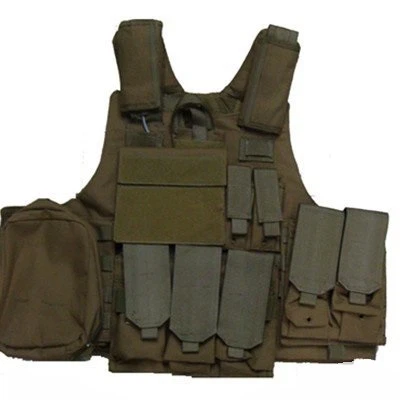
One of the most classic tactical vests of the US military is the TAC-V1 N series tactical vest produced by Eagle Company. Even today, it can still be seen worn by special police or military personnel. This tactical vest has strong versatility. It can be used not only in general urban areas but also for special missions in deep jungles. The TAC-V1 N uses reinforced nylon mesh as the base body, with bags of various purposes sewn onto the vest. There are about six magazine pouches on the abdomen. Each magazine pouch has elastic bands on both sides, which can fix the magazines and prevent clashing sounds. There are horizontal equipment pouches of different models on the chest, which are lined with hook-and-loop fasteners and can fix various modular equipment. The larger horizontal equipment pouches also have elastic bands to secure the items inside. Generally, auxiliary ammunition, grenades, knives, etc. can be placed in them. The equipment pouches on the shoulders can hold items such as compasses and first aid bandages. There is also a document pocket inside the vest, which can hold important documents or flat objects. The lower hem of the vest has fixing rings for the belt, which are fixed with copper buttons and hook-and-loop fasteners. There are ALICE fixing points on the back of the vest, which can be used to hang various ALICE equipment.

The AC-V1 adjusts the size of the vest with ropes on both sides of the vest, which is not very convenient. Therefore, in later models, it was changed to use three webbing straps on each side to adjust the size of the vest. There is a rescue handle at the collar on the back of the tactical vest, which is connected to the shoulder straps. In case of an emergency, comrades can drag the wearer out of the dangerous area through this handle or lift the wearer with a helicopter. There is a water bag on the inner side of the back of the vest, which can hold three liters of water for quenching thirst and maintaining life in an emergency.
Another example is the RCBS tactical vest produced by DBT Company, which is often used by law enforcement agencies such as the FBI in the United States. It is one of the earliest tactical vests with a quick-release system. There is a bulletproof insert in the vest.

Once inserted, the tactical vest has bulletproof functionality at the same time, but the weight of the vest will also increase significantly. To this end, the vest has been specially strengthened for situations such as falling into water or needing to be dragged by teammates after being shot. There is a quick-release pull ring on the front of the vest. In case of an emergency, instead of taking apart the vest, just pull this pull ring hard, and the vest can be quickly disassembled to get rid of this heavy burden. In addition, the "hook-and-loop fastener" can also be easily torn open from the inside of the vest, and the bulletproof insert can be pulled out, turning the heavy bulletproof tactical vest into a lightweight non-bulletproof tactical vest.
Tactical Vests of the Russian Military: Sturdy and Durable
Military equipment made in the Soviet Union and Russia has always been known for its sturdiness and durability. Russian-style tactical vests should be used in conjunction with the Russian-made AK rifle series. For example, the Defender 2 tactical vest is a heavy-duty tactical vest specially developed for the Russian military special forces. It can carry a lot of tactical equipment and greatly improve the overall protection ability. The vest is made of 1000D Cordura nylon fabric, which has strong wear resistance and can meet the usage requirements in special environments. Similar to some tactical vests of the US military, the Defender 2 is equipped with detachable collars and groin protectors, which can protect the soldiers' vital parts such as the neck and lower abdomen from the damage of flying shrapnel. Bulletproof inserts can be added to the inside of the vest to enhance the protection ability.
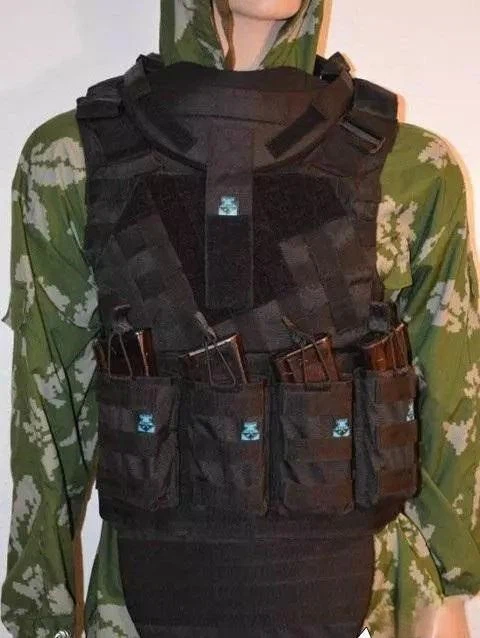
This tactical vest adopts a pullover design. The user can put on and take off the vest by pulling off and sticking the hook-and-loop fastener on the front. The size of the vest after wearing can also be adjusted through the nylon webbing on the side. The front, back, and sides of the vest are all equipped with a large number of MOLLE webbing, which can fix various weapons and equipment on the webbing. This makes the entire vest an active storage warehouse.
Of course, like many Russian-made military products, the Defender 2 has the disadvantage of being relatively bulky. The net weight of the single vest is 2.2 kilograms. If bulletproof inserts, collars, and groin protectors are added, it will be even heavier. When fully armed, it is more like a bloated and clumsy bear, which will inevitably hinder the soldiers' mobility and prevent them from traveling light. In hot weather, this kind of vest will also cause an increase in body temperature and more sweating, which will somewhat affect combat effectiveness.
The characteristic of "sturdiness" of the Russian military is reflected in the tactical vest as a large loading capacity. Another Russian military tactical vest exhibited in 2011 is equipped with as many as 5 huge magazines, with a cartridge-carrying capacity of up to 300 rounds.

Tactical Vests of the German Military: Unique
As a modern military power, Germany's military technology still stands out today. The tactical vests of the German military do not completely follow those of the US military but have their own characteristics. Take the old-fashioned IDZ SET tactical vest of Germany as an example. It can be equipped with a radio pouch, G36 magazine pouches (single and double), grenade pouches (single and triple), a GPS pouch, a sundries pouch, etc. Its webbing system has a basic installation method similar to the MOLLE system of the US military. Just insert the straps of the equipment accessories into the webbing. However, since both the straps of the equipment accessories and the webbing of the vest are softer than those of the MOLLE system, the installation is easier and very firm at the same time.
In addition, the IDZ also allows the user to install the equipment pouch at a 90-degree rotation. In this way, according to the user's habits, various equipment can be taken from the vest more flexibly. In addition, there is a row of five-piece connecting buckles at the bottom of the vest, which can hold five-piece equipment. Overall, the German IDZ is lighter than the US MOLLE, but at the same time, it also leads to incompatibility with the equipment pouches of the US military. This can probably be regarded as an expression of the German or European military's insistence on maintaining a certain degree of independence.
Part 4: What is the Difference between a Tactical Vest and a Bulletproof Vest?
A tactical vest and a bulletproof vest are two different pieces of equipment. Although they are both vests, their functions are completely different. The former is mainly used for carrying ammunition and items, while the latter is mainly used to protect soldiers from the killing of bullets and shrapnel. Of course, in actual use, a soldier usually needs both functions at the same time.
There are mainly two methods to combine these two functions. One is to wear two vests at the same time. The bulletproof vest is worn on the inside, and the tactical vest is put on the outside. In this way, when ammunition or other tools are needed, they can be taken from the tactical vest; once being hit by a bullet, there is still the bulletproof vest for protection. The other is to add bulletproof modules to the tactical vest, such as inserting bulletproof inserts and accessories for protecting the neck and groin, etc., so that the two are combined into one, and they can also be disassembled and separated when necessary.