The Evolution History of Camouflage Art Entering Battlefield Camouflage Patterns
May 23, 2025

The troops receiving the review appeared in new camouflage uniforms. The new camouflage uniforms, affectionately known as the "Starry Sky Camouflage" by military fans, made their debut and immediately triggered widespread attention.
Today, the militaries of the vast majority of countries in the world have their own camouflage uniforms. As the first line of protection for soldiers on the battlefield, camouflage uniforms have become a unique symbol of the armed forces of various countries. The world's major military powers attach great importance to the research and development of camouflage uniforms.
The research, development and production process of a set of camouflage uniforms with good camouflage effect is quite complex. Take Russia as an example. The new camouflage uniform began to be developed in 2007 and was not fully equipped until 2019. During this period, it went through many technical breakthroughs and actual combat tests. So, how did camouflage uniforms develop? What are the difficulties in creating a camouflage uniform with good camouflage effects?
"Reverse Design" from the Battlefield
Walking on the streets, camouflage elements are not uncommon. Whether on clothes, shoes, or even accessories, camouflage, as a fashion symbol highly respected by teenagers, never seems to go out of style.
In fact, camouflage has been in people's vision for less than a hundred years. Its birth and use have always been closely related to war and military affairs.
Although there were military uniforms made of tree branches, leaves and animal skins for battlefield camouflage in ancient times, the real sense of camouflage uniforms was exchanged for failure and blood on the battlefield.
For a long time, military uniforms with bright colors and unique styles dominated the battlefield. With a long history regiments were often accustomed to designing various military uniforms according to their own characteristics. For example, the Austrian light cavalry in modern history wore exquisite blue tunics and red riding breeches, carried short swords at their waists, and wore helmets decorated with beautiful feathers; another example was the British Army in scarlet jackets and white trousers. However, it was precisely these brightly colored military uniforms that brought huge casualties to the troops.

In 1899, the British Army invaded South Africa and clashed with the Boers, descendants of the local Dutch. The Boers found that the British red military uniforms were extremely eye-catching in the forests and savannas of South Africa, making them easy to spot. Inspired by this, they painted their uniforms and firearms yellow-green, then hid in the dense grass and launched surprise attacks. The British Army struggled to locate the Boers. Although the three-year "Anglo-Boer War" ended with British victory, the British Army paid a heavy price for being caught off guard.
This war made European countries realize the importance of personnel camouflage on the battlefield. Many nations promptly changed their bright military uniform colors to green or yellow for concealment. Military uniforms in single colors close to battlefield natural tones became the prototype of modern military camouflage, hence known as "protective camouflage".
In the 20th century, the emergence of airplanes further promoted the birth of modern military camouflage. During World War I, airplanes were used for aerial reconnaissance of enemy artillery and vehicle positions. Based on this intelligence, friendly forces could directly strike these targets. Facing this "natural enemy" from the sky, soldiers began finding ways to make themselves less visible on the battlefield. American soldiers dirtied their uniforms with mud, while the German Army ordered all soldiers to paint their helmets in different colors.
During World War II, with the invention of various optical reconnaissance equipment, soldiers in single-color uniforms faced more arduous challenges to survive on the battlefield. Many countries accelerated the development of multi-tone military uniforms to adapt to more complex battlefield environments. In September 1939, when Nazi Germany invaded Poland, it first issued new uniforms to several SS units. This was a brown, green, and yellow three-color camouflage uniform with irregularly shaped three-color patches – in actual combat, these patches could blur the outline of the human body, allowing soldiers to blend as much as possible with the background color.
Since then, traditional patch camouflage has developed rapidly amidst the (artillery fire) of World War II. Researchers from various countries extracted typical colors and characteristic patches from battlefield backgrounds to design various camouflage patterns. In 1943, the Soviet Army adopted camouflage uniforms printed with wooden and broad-leaved camouflage patterns.
At around the same time, they also issued a new type of woodland camouflage uniform, featuring brown leaf and branch patterns on a dark green base. In 1943, the U.S. Army equipped the Marine Corps fighting in the Pacific theater with "frog camouflage uniforms," which resembled the protective coloration of frogs and adopted a double-sided camouflage design.
With the rapid development of psychology and visual cognition technology, people no longer only consider the similarity between the color and pattern of camouflage uniforms and the background. Instead, they design camouflage suitable for multiple backgrounds by leveraging the theory of visual illusion, starting from the mechanism of human visual cognition.
Traditional patch camouflage, characterized by large spots, smooth edges, and interlocking patches, was mainly used to counter close-range, low-resolution optical imaging reconnaissance. Since the 1980s, battlefield reconnaissance has developed towards high resolution and digitization, with target details becoming important exposure features. The confusing effect of traditional patch camouflage has been significantly reduced.
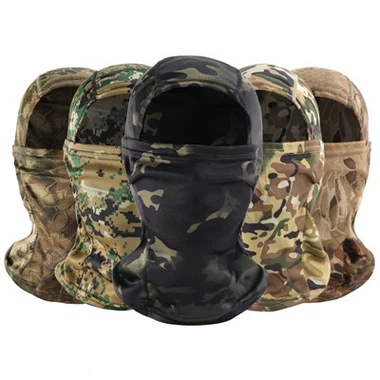
In 1997, the Canadian Army took the lead in developing digital camouflage, opening a new era of digital camouflage. In 2002, the U.S. Marine Corps first equipped MARPAT digital camouflage. Since then, digital camouflage has become the first choice for combat training uniforms of various armies. Many countries such as Singapore, South Korea, and Argentina have developed and equipped their own digital camouflage.
With the rapid development of psychology and visual cognition technology, people need to not only consider the similarity between the color and characteristic patterns of camouflage uniforms and the background but also design camouflage applicable to multiple backgrounds by starting from the mechanism of human visual cognition and using the theory of visual illusion. In the early 21st century, the U.S. Army first developed the "Scorpion" camouflage suitable for mixed backgrounds for soldiers stationed in the Afghan battlefield, pushing camouflage uniforms into another brand-new development stage.

More Dazzling Camouflage Techniques
Many animals in nature are masters of camouflage. There are some online quizzes that challenge people to find animals hidden in natural backgrounds, but few can spot the target at once.
After in-depth research into how humans perceive shapes, volumes, and colors, scientists have found that only a small part of the human eye can sense color, while the rest relies on the brain to "fill in" what the eyes see.
The high-resolution design of modern camouflage uniforms takes advantage of this principle, making observers perceive the camouflage as part of the background; even if you see it, you may not notice it.
At present, camouflage with good disguise effects often has strong three-dimensional and hierarchical senses, which can simulate the macro and micro texture features of the background, causing "visual illusions". They can be applied to a wide range of environmental conditions and help maintain the effectiveness of the pattern, enabling effective "stealth" even in low-resolution patterns at close range and natural environments. Take digital camouflage as an example: when viewed up close, the irregular, grid-like color blocks create a sense of uncertainty similar to the basic pixels in digital images through internal wrapping and peripheral arrangement, simulating the 摇曳 (swaying) effect of tree shadows and the mottled characteristics of leaves, gravel, etc., in jungle or desert backgrounds; when viewed from a distance, different color spots produce spatial color mixing through juxtaposition and interlacing, forming a large-spot segmentation effect that easily blends into various backgrounds.
Such technologically advanced pattern designs do not come from a single designer or artist, but require continuous modification, improvement, and realization through processes such as background feature extraction, camouflage pattern generation, and disguise effect evaluation.
For the design of the main color and characteristic patch shapes of camouflage, background feature information needs to be extracted first. Researchers use algorithms like mean clustering to analyze and calculate background photos, extract dominant colors, and generate an initial clustering distribution map of the scene image to determine the color and shape of camouflage units. With the advancement of processing technology, the number of camouflage colors has developed from the commonly used 3-4 types to the current 5-7 types. The minimum size of camouflage units is set to the minimum value distinguishable by the human eye at a certain observation distance to achieve the best color mixing effect.
There are usually two ways to generate camouflage patterns. The first is based on existing camouflage templates, using computer deep learning to extract and learn the color and texture features of the background, thereby generating new camouflage patterns that simulate the background. The second is that after respectively extracting the dominant colors and their proportions, as well as shape and distribution features commonly found in the background, R&D personnel rely on experience and use computer pattern design tools to draw the patterns. These camouflage patterns often have color distributions and edge contours that can blend with the surrounding background.
After the camouflage pattern is generated, it first needs to undergo computer evaluation of its camouflage effect, including edge detection and background texture similarity assessment. The optimized camouflage pattern is then printed on fabrics to make camouflage uniforms, which are sent to the military for discovery probability testing. Only after meeting military standards is the pattern finally determined.
Therefore, the designed camouflage pattern needs to go through repeated evaluations and modifications before it can be finally finalized for use. This is also one of the reasons why it often takes years or even longer for a camouflage pattern to be finalized and put into service.
The evolution of battlefield camouflage knows no end. The "spear" of reconnaissance and the "shield" of invisibility are locked in a constant cycle of mutual restraint and evolution. In informationized warfare, operations cover vast areas with complex and changeable backgrounds, giving rise to various challenges.
In the 2001 Afghan battlefield, U.S. soldiers wearing desert camouflage marched through woodlands and deserts. The open geographical environment and mixed, changeable terrain frequently exposed them to the snipers and artillery of Afghan militia forces. A series of casualty reports drew the attention of U.S. military leaders: Could a camouflage pattern be developed to provide effective concealment across multiple terrain environments?
The design of "multi-environment" camouflage was quickly prioritized. The U.S. CP Defense Company and the U.S. Army launched the "Scorpion Program" for the R&D of next-generation combat systems. After two years of planning, drafting, and exchanging feedback with frontline soldiers for testing, they submitted a new "composite camouflage" proposal. This camouflage integrates technologies such as "visual illusion-like patterns" and "ambient light reflection," enabling wearers to achieve optimal integration with environmental colors and object shapes in diverse environments.
In August 2014, the U.S. military officially released the "Scorpion II" camouflage pattern. The new camouflage inherits the original "multi-environment" design but breaks away from the traditional square unit structure, adopting richer design elements like "brush strokes," "hachures," "mud spots," and "shadow traces." This results in more fragmented patterns and diverse color blocks, better adapting to combat terrains such as woodlands, deserts, and urban areas.
However, such multi-background adaptive camouflage can only suit green-toned, yellow-toned, and mixed backgrounds, failing to change colors with environmental shifts. Achieving "dynamic integration" with terrain backgrounds during rapid mobile operations has always been the goal of camouflage technology. The development of camouflage from passive "static" disguise to active "dynamic" camouflage is an irreversible trend. Currently, the advancement of dynamic color-changing camouflage that can display real-time colors offers possibilities for achieving higher-level objectives.

Inspired by the mechanism of chameleons, Japanese scientists once attempted to develop a color-changing suit equipped with cameras. This suit could project images of the surrounding environment onto the fabric, making the wearer "appear invisible," but its bulky system hindered practical application. American scientists are also researching color-changing fibers. Military uniforms made from these fibers absorb environmental light waves and change color automatically. Soldiers wearing such uniforms are like being wrapped in chameleon skin, blending with the environment's color and achieving "dynamic" camouflage by adapting to environmental changes. Some countries have used reflective display technology to develop color-changing camouflage with five color patches, each capable of at least three color transformations. By controlling the color changes of the five patches, it can switch between "woodland-desert-urban" camouflage patterns.
In modern battlefields, optical detection devices, high-precision infrared night-vision goggles, and long-range 单兵雷达 (personal radar) are widely deployed, imposing requirements for infrared and radar stealth on camouflage uniforms. Thus, high technologies like multispectral compatible stealth, thermal infrared stealth, and electromagnetic stealth have entered the field of camouflage design. It is reported that a foreign company has developed a 3D camouflage system with three-dimensional random 凹凸 (concave-convex) patterns on the material panels. This system not only simulates the texture of complex three-dimensional backgrounds but also has infrared camouflage and radar wave-absorbing properties.
"Color-changing and stealth-capable" camouflage has been deployed in partial battlefields by some countries in recent years. However, issues such as incomplete light reflection prevention, difficult infrared stealth, and high production costs have delayed its mass production and deployment.
Despite these challenges, the trend of modern camouflage toward invisibility is unstoppable. Currently, 各国 (countries) are intensifying R&D investments in camouflage mechanisms for optics, infrared, and electromagnetism, aiming to make soldiers invisible or indistinguishable from the environment to enemy visual, optical, infrared, and personal radar reconnaissance equipment-thereby reducing the probability of detection and creating true "invisible soldiers."