What are the members of China's first-generation firearms family, the Type 56 series?
Dec 12, 2025
What are the members of China's first-generation firearms family, the Type 56 series?
China had already realized the concept of "firearms family standardization" in the mid-1950s, and developed its first-generation firearms family in 1956 - the Type 56 series. Essentially, all models within the Type 56 family are licensed copies of Soviet-era firearms.

While not an independent R&D effort, its significance is unparalleled - it marked the dawn of China's small arms development and the future of firearms family standardization. Some enthusiasts often ask: What models are included in the Type 56 series? In this article, we'll provide a concise overview for you.

The Type 56 firearms family comprises three core variants: the Type 56 Semi-Automatic Rifle, the Type 56 Assault Rifle, and the Type 56 Squad Machine Gun.
First up is the Type 56 Semi-Automatic Rifle - affectionately nicknamed the "Type 56 Ban" by veterans. In essence, it is a licensed copy of the Soviet SKS semi-automatic rifle.

They are essentially similar in overall appearance, structure, and operating principle - so much so that casual observers can barely tell the Type 56 apart from the original SKS. However, distinguishing between the later-production Type 56 and the SKS became much easier: the original SKS semi-automatic rifle was equipped with a sword-shaped combat bayonet.

Early versions of the Type 56 shared the same sword-shaped bayonet, but it was later replaced with a triangular bayonet - a key distinguishing feature between the two. The Type 56 Semi-Automatic Rifle also fires the same 7.62×39mm M43 intermediate cartridge as the SKS. After being licensed-produced in China, this cartridge was renamed the Type 56 Rifle-Machine Gun Cartridge, compatible with both rifles and light machine guns.

It features a fixed magazine with a 10-round capacity, typically loaded via a stripper clip in one go. Upon its introduction, the Type 56 Semi-Automatic Rifle became the primary service weapon of the Chinese military, replacing the earlier Type 53 Carbine - a licensed copy of the Mosin-Nagant. The "Type 56 Semi" also boasted an extensive service life.

It remained in active service with the Chinese military from the mid-1950s until the mid-1980s, when it was fully retired. Some decommissioned Type 56 rifles were later issued to militia units in other regions.
The second model is the Type 56 Assault Rifle. However, China's understanding of the "assault rifle" concept differed at the time - any weapon with a submachine gun-like form factor capable of full-auto fire was uniformly classified as a "submachine gun."

Thus, the Type 56 - which is essentially an assault rifle - was designated as the "Type 56 Submachine Gun." Veterans also gave it the nickname "Type 56 SMG." Designed after the 3rd-generation Soviet AK-47, the Type 56 Assault Rifle shares nearly identical external appearance, internal structure, and operating principle with the AK-47. However, there are key differences between the two, with the first being the bayonet.

The original AK-47 was typically equipped with a detachable sword-shaped bayonet, while the Type 56 SMG (Submachine Gun) featured a triangular bayonet - also known as a triangular combat bayonet. Under normal circumstances, this bayonet is non-detachable and can only be folded when not in use.

It can only be removed with tools during maintenance or inspection of the weapon. The second difference lies in the front sight: the AK-47 features a half-circle notch front sight.

The Type 56's front sight features a fully enclosed circular design.

This design was intended to prevent soldiers from mistakenly using the front sight guards on both sides as the front sight due to nervousness during night operations - a mistake that could lead to wasted ammunition and compromised combat effectiveness. The Type 56 Assault Rifle also uses the 7.62×39mm Type 56 Rifle-Machine Gun Cartridge, fitted with a 30-round stamped metal magazine identical to that of the AK-47. In 1963, the Type 56 Assault Rifle spawned a derivative model: the Type 56-1.

Similar to the Soviet AKS-47, the Type 56-1 was developed as a lightweight variant. It featured a foldable simplified stock, significantly reducing the overall weight of the rifle. Typically, it was not equipped with a bayonet, while also enhancing portability.

The Type 56-1 Assault Rifle was primarily issued to armored troops, motorized troops, paratroopers, reconnaissance troops, and artillery units at the time. It still utilized the 7.62×39mm Type 56 Rifle-Machine Gun Cartridge, paired with a 30-round curved magazine. In the 1980s, the Type 56-2 Assault Rifle was developed as a further derivative of the Type 56-1.

The most distinctive feature of this variant is its foldable skeletonized metal stock, which can be folded to the right during non-combat situations to reduce the rifle's overall size. Notably, even when the stock is in the folded position, it does not affect firing functionality.
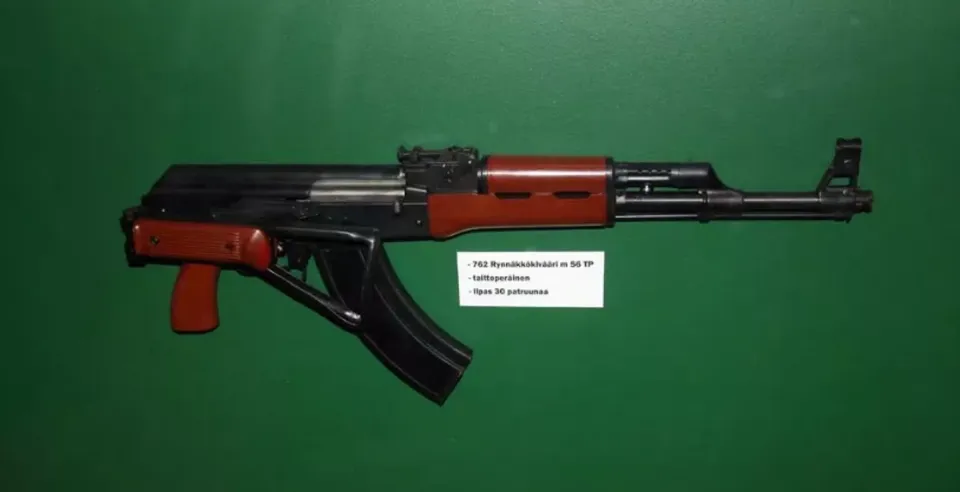
This type of stock was later adopted by the Type 81-1 Assault Rifle (often referred to as the "Type 81 Bang"). In the later production runs of the Type 56-2, its handguard, pistol grip, stock cheekpiece, and magazine were all upgraded to polymer materials, further reducing the rifle's weight. However, the Type 56-2 was not widely issued domestically at the time - the majority of units were produced for export.

The Type 56-2 Assault Rifle gained immense trust and recognition across the Middle East, Southeast Asia, and Pakistan - our "Iron Brother." In the 1990s, the ultimate iteration of the Type 56 SMG emerged: the Type 56C Compact Assault Rifle.

Developed on the framework of the Type 56-2, this model retained the predecessor's stock. The Type 56C featured substantial upgrades, including a gas expansion chamber integrated into the barrel to reduce firing noise.

A birdcage-style flash hider was added in front of the gas expansion chamber to reduce muzzle flash during firing. Additionally, the Type 56C's pistol grip and handguard are constructed from black engineering plastic, making it lighter than its two predecessors. The unloaded weight (including the magazine) is only 2.85 kilograms.

As a compact assault rifle, the Type 56C also features a short overall length - 764 millimeters when the stock is extended, and just 557 millimeters when folded. The cartridge remains unchanged: it still fires the 7.62×39mm round. However, to further reduce space occupation, the Type 56C is equipped with a 20-round magazine instead of the standard 30-round one.

Since its introduction in the 1990s, the Type 56C Compact Assault Rifle has been issued to China's naval special forces, submarine units, surface ship units, with a small number also serving in the Armed Police Force and border defense units. The entire Type 56 series of assault rifles boasts an extensive service life.

In particular, the Type 56 and Type 56-1 remained in service until the 1980s, when they were finally replaced by the Type 81 firearms family following its formal adoption by the military. The third model is the Type 56 Squad Machine Gun - similarly, it was also a licensed copy of the Soviet Union's counterpart.

Its prototype is the Soviet RPD Light Machine Gun. Unsurprisingly, its external structure and operating principle are nearly identical to the original RPD. The Type 56 Squad Machine Gun also fires the 7.62×39mm Type 56 Rifle-Machine Gun Cartridge, typically fed by a 100-round belt box.

It has a theoretical rate of fire of approximately 700 rounds per minute in full-auto mode, with an effective range of 800 meters. In the 1960s, the Type 56 Squad Machine Gun underwent upgrades and spawned the Type 56-1 variant, which was formally finalized in 1963.

Externally, the Type 56-1 shows no noticeable difference from the original Type 56. However, the belt box of the early Type 56 was prone to deformation when subjected to pressure, and the stock and handguard were also inadequately finished. These components were reinforced in the Type 56-1.

An inner lining was also added to the interior of the belt box to prevent deformation. The most significant change, however, was the revised front sight of the Type 56-1 Squad Machine Gun - the original half-circle notch front sight was replaced with a fully enclosed circular front sight, consistent with that of the Type 56 assault rifles.

This design revision was also driven by tactical considerations for night operations: machine gunners, when under stress, might mistakenly use the front sight guards on both sides as the actual front sight - a mistake that not only wastes ammunition but also severely compromises combat effectiveness.
The upgraded Type 56-1 Squad Machine Gun entered service in the 1960s, replacing the earlier less refined Type 56. It remained in service with the Chinese military until the 1980s, when it was finally superseded by the emergence of the Type 81 firearms family.
These are all the core members of the Type 56 firearms family - now you have a general overview, right?