

Why Are School Uniforms and Camouflage Uniforms Mostly Made of Polyester-Cotton Blends? The Science of Polyester/Cotton Ratios and Wearing Comfort
Aug 14, 2026
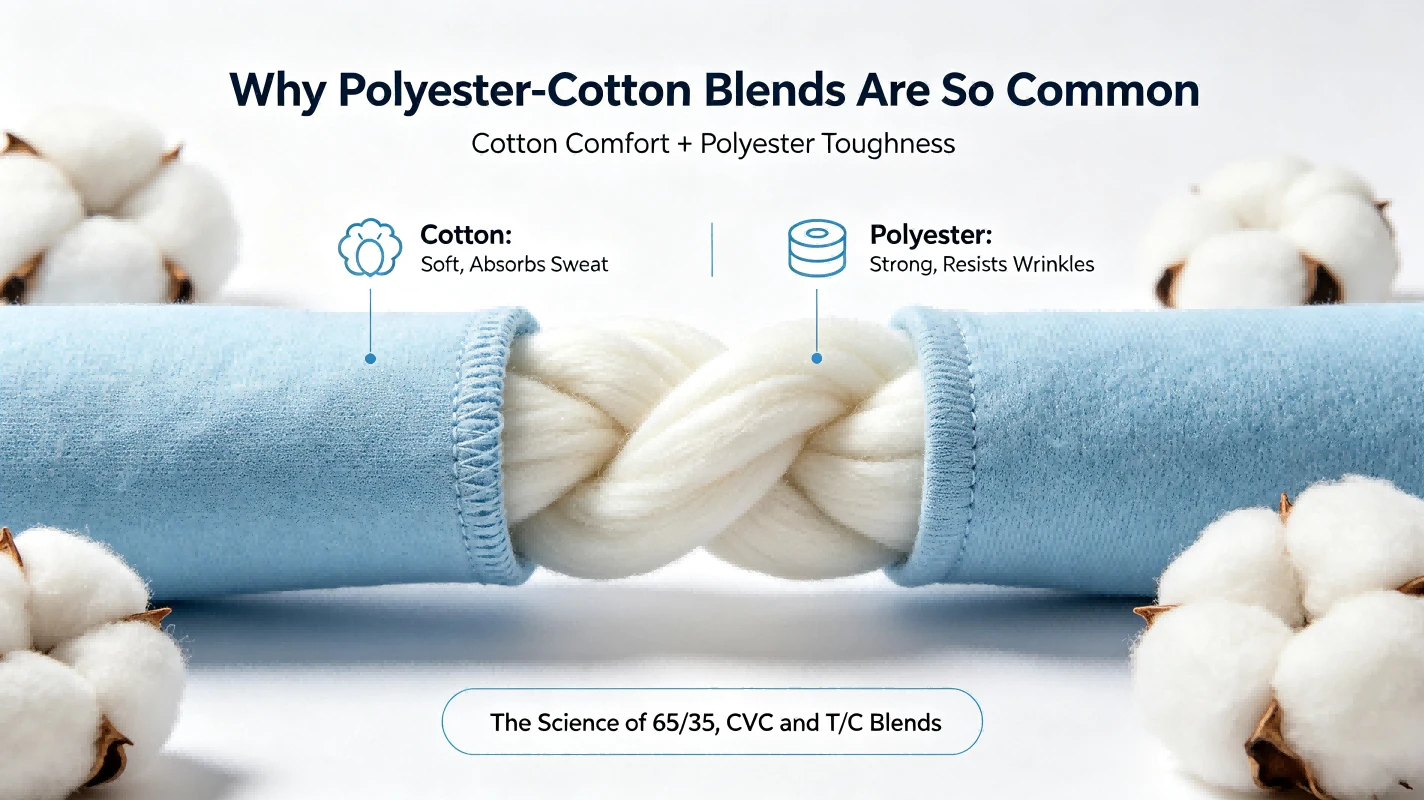
1. Getting to Know the Two Fibres: What Does Polyester and Cotton Each Do Best?
To understand the benefits of "blending," we first need to know the strengths and weaknesses of each fibre on its own.
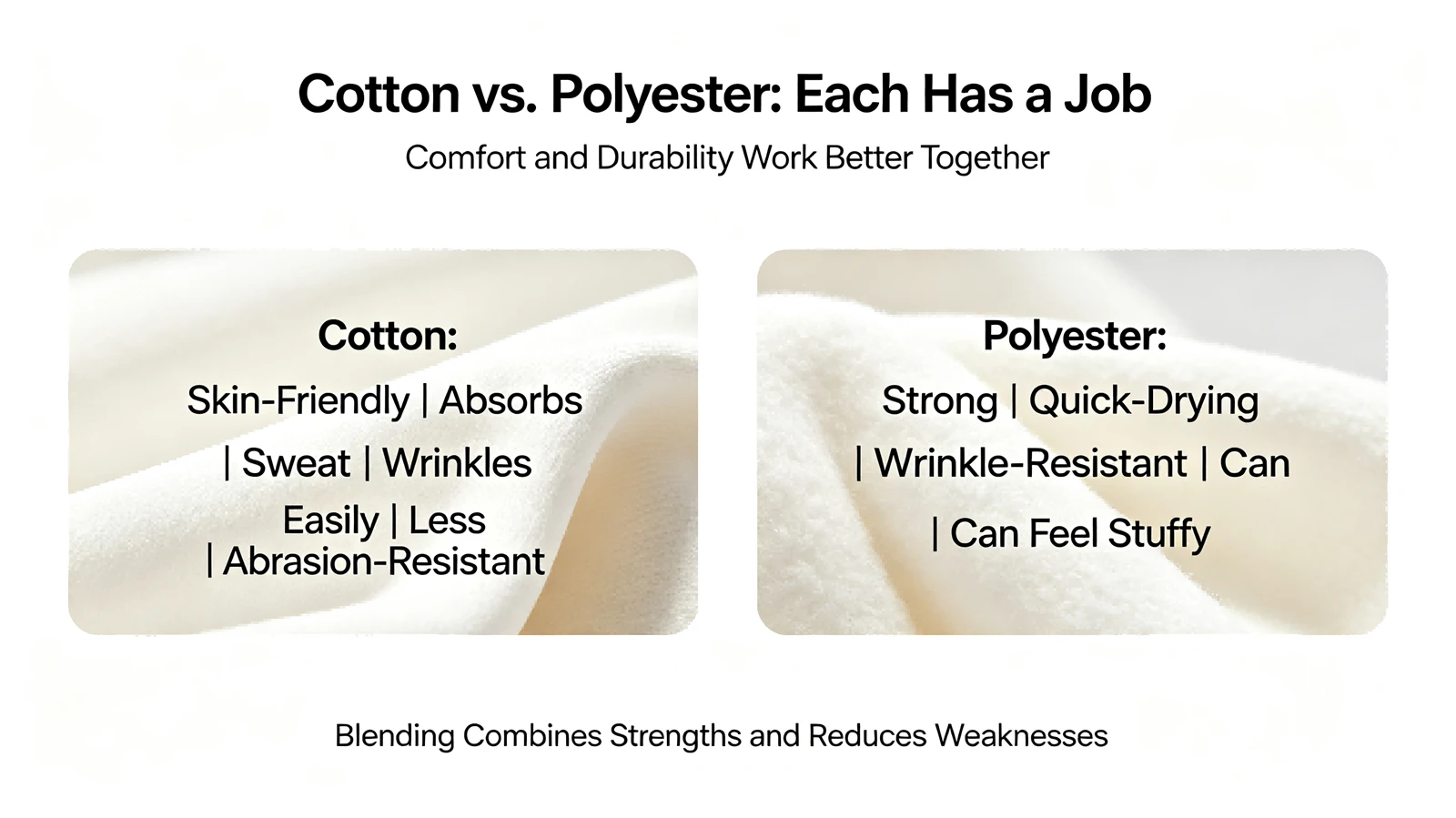
Cotton is a natural fibre. Its biggest advantages are skin-fiendliness, comfort, and moisture absorption. Cotton fibres have a hollow internal structure that quickly absorbs sweat from the skin surface, keeping the body feeling dry. That's why a pure cotton T-shirt feels "comfortable" - it doesn't trap sweat and feels good against the skin.
But cotton has obvious drawbacks: it wrinkles easily, isn't very abrasion-resistant, and deforms after repeated washing. Pure cotton garments look crumpled after a few washes, collars lose their shape, and they simply don't hold up well in high‑activity or frequent‑washing scenarios.
Polyester (polyethylene terephthalate fibre) is a synthetic fibre that excels exactly where cotton falls short: high strength, abrasion resistance, wrinkle resistance, and dimensional stability. It holds its shape after washing and dries quickly. But polyester has its own weaknesses: poor moisture absorption, stuffiness, and a tendency to generate static electricity. In summer, pure polyester clothing traps sweat against the skin, creating an uncomfortably sticky, clammy feeling.
In short: cotton provides "comfort," while polyester provides "toughness." Each fibre has its strengths – and its clear limitations.
2. The Core Logic of Blending: Complementing Each Other's Strengths
A polyester-cotton blend simply mixes polyester and cotton in a certain ratio to spin into yarn and weave into fabric. The benefit isn't a simple "1+1=2" – it's about performance complementarity. Polyester compensates for cotton's tendency to wrinkle and wear out; cotton compensates for polyester's poor breathability and lack of skin-friendliness.
Take the most common ratio of 65% polyester + 35% cotton as an example: polyester provides the fabric's "skeleton" – crispness, wrinkle resistance, abrasion resistance, and quick drying; cotton provides the fabric's "soul" – moisture absorption, breathability, and comfort next to the skin. The result is a fabric that is tougher and crisper than pure cotton, yet more breathable and comfortable than pure polyester.
That is the fundamental reason why polyester‑cotton blends are the go‑to fabric for school uniforms, camouflage uniforms, and workwear – it's not a "compromise" but a "win-win."
3. Different Ratios, Different Personalities
Polyester-cotton blends are not a single formula; the ratio is adjusted according to the intended use. Different ratios directly determine the fabric's "character."
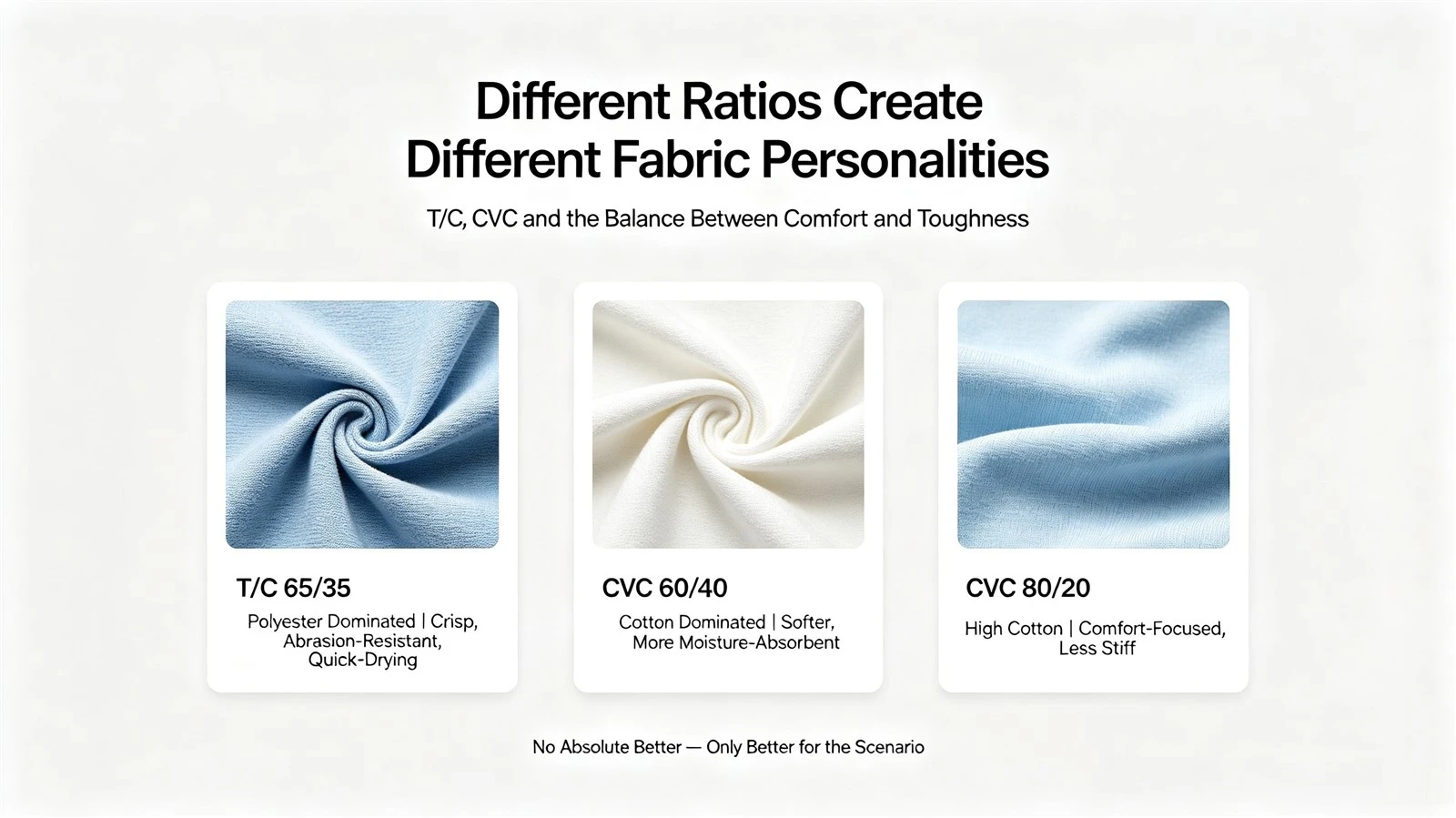
T/C (polyester-cotton) – polyester dominates
T/C refers to blends where polyester content exceeds 50%. The most common ratio is 65% polyester + 35% cotton. This fabric is crisp, abrasion-resistant, wrinkle-resistant, and quick-drying, maintaining its shape even after repeated washing. The downside is that its moisture absorption is relatively weaker, and it feels less comfortable against the skin than high-cotton blends.
Best for: scenarios requiring frequent washing and high-intensity activity – military training camouflage uniforms, workwear, and sports school uniforms are typical examples. The 65/35 ratio strikes an excellent balance between strength, drape, breathability, and wash durability.
CVC (cotton‑polyester) – cotton dominates
CVC refers to blends where cotton content exceeds 50%. Common ratios include 60% cotton + 40% polyester or 80% cotton + 20% polyester. The higher the cotton content, the softer, more skin-friendly, and more moisture-absorbent the fabric becomes, though abrasion resistance and wrinkle resistance decrease accordingly.
Best for: scenarios where wearing comfort is the priority – daily school uniforms and next to skin garments tend to favour CVC fabrics.
Performance trends across different ratios: the higher the polyester proportion, the better the fabric's resistance to stretching, bursting, wrinkling, and bending. At the same time, pilling tendencies also shift. It's a trade-off between "performance" and "comfort" – there's no absolute "better" or "worse," only what fits the scenario.
4. From Training Camo to School Uniforms: How Polyester-Cotton Blends Perform in the Real World
Why are military training camouflage uniforms almost always made from polyester-cotton blends?
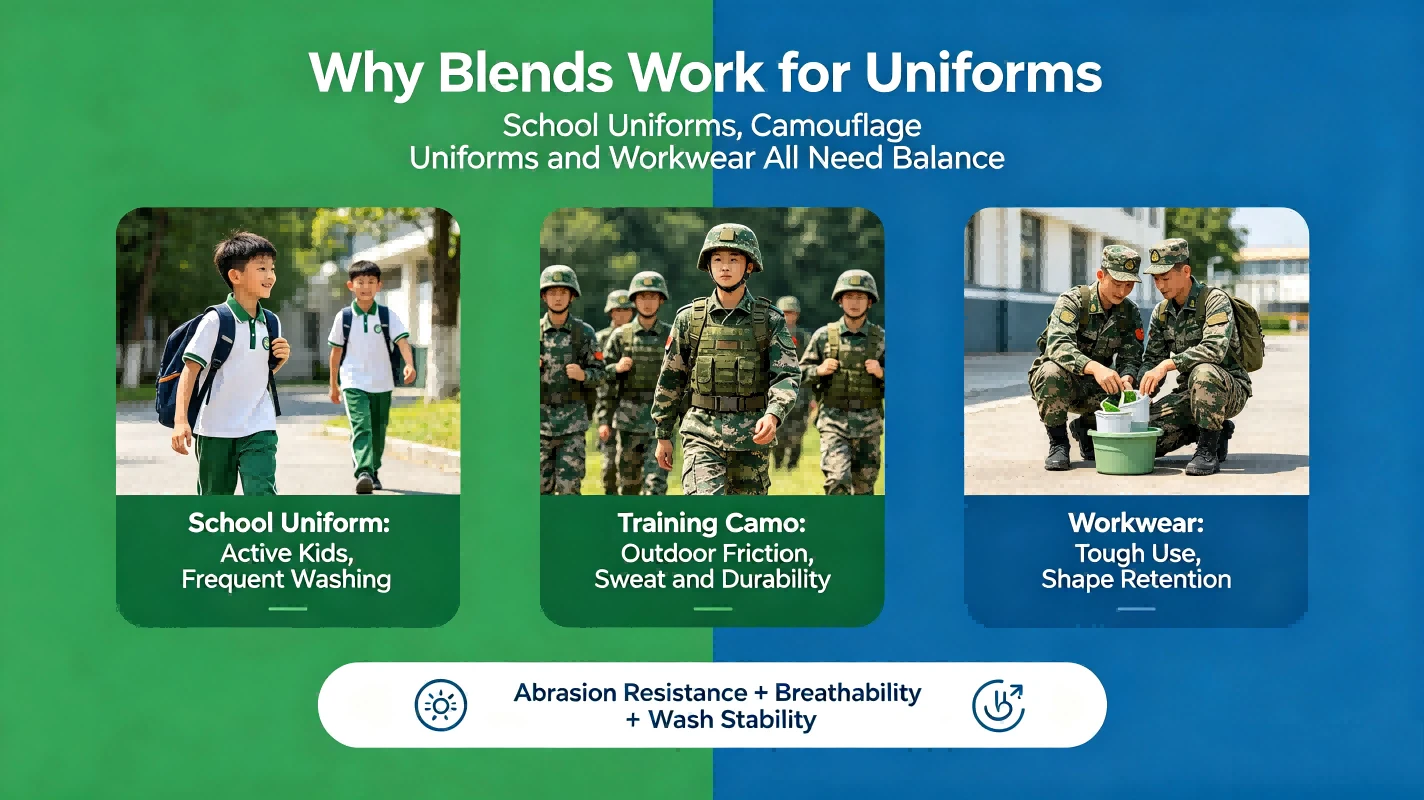
The use case for training uniforms is demanding: long hours outdoors, heavy sweating, constant friction, and repeated washing. Pure cotton feels comfortable but wrinkles after a few washes and wears through after repeated abrasion. Pure polyester, though tough, traps heat and doesn't breathe. The classic 65% polyester + 35% cotton ratio satisfies all four requirements at once: abrasion resistance, crispness, breathability, and wash durability. At the same time, polyester's dyeability allows camouflage patterns to bond firmly to the fabric without fading easily.
The logic is similar for school uniforms. Students are active throughout the day, sweat frequently, and uniforms need regular machine washing. Polyester-cotton blends maintain colour stability and shape after repeated washing, while the cotton component ensures basic comfort next to the skin. That's why spring/autumn sports uniforms overwhelmingly prefer polyester-cotton blends.
5. Tips for Buying and Caring
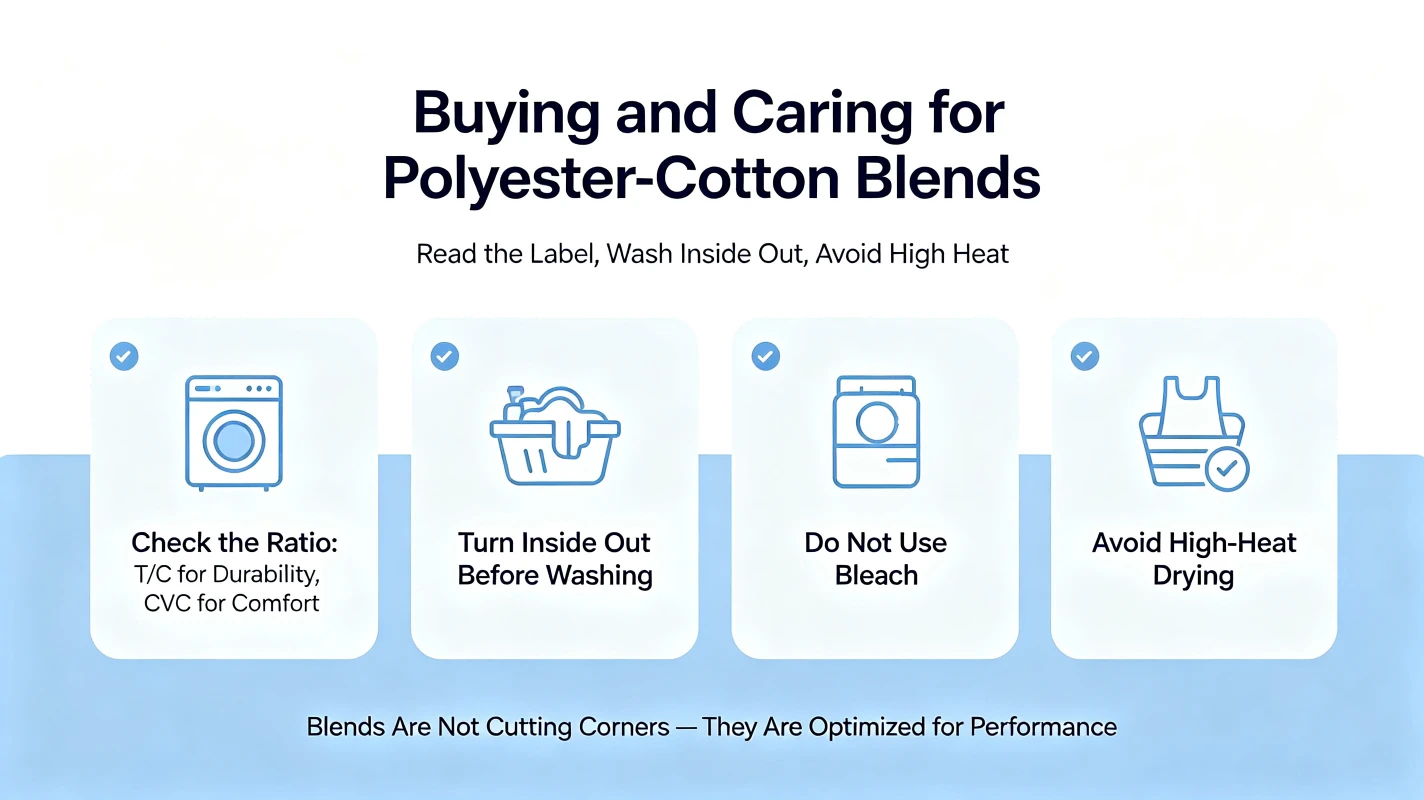
Check the label: When buying a school uniform or camouflage uniform, look at the care label. T/C 65/35 is the "durable" classic ratio; CVC 60/40 or 80/20 is the "comfort-oriented" choice. Choose the ratio based on the intended use – CVC for daily wear, T/C for outdoor training.
Washing tips: Polyester-cotton blends are machine-washable, but it's recommended to turn them inside out to reduce surface friction and pilling. Do not use bleach – it damages cotton fibres and affects polyester's colour. Avoid high-heat drying – the cotton component may shrink.
Don't be obsessed with "100% cotton": Pure cotton may feel comfortable, but in high‑use, high‑wash scenarios like school uniforms and camouflage uniforms, its durability simply isn't enough. Polyester-cotton blends are not "cutting corners" – they are scientifically optimised for maximum performance.
Conclusion
Polyester-cotton blends have become the mainstream fabric for school uniforms, camouflage uniforms, and workwear – not simply because they are cheaper (though they are indeed more cost-effective than pure cotton) – but because they find the optimal balance across comfort, durability, and ease of care. The classic 65/35 ratio is no accident; it is the result of countless real‑world trials. The next time you put on a school uniform or camouflage uniform, you can tell those around you: there is a whole body of materials science behind why this garment feels good and lasts long.


