
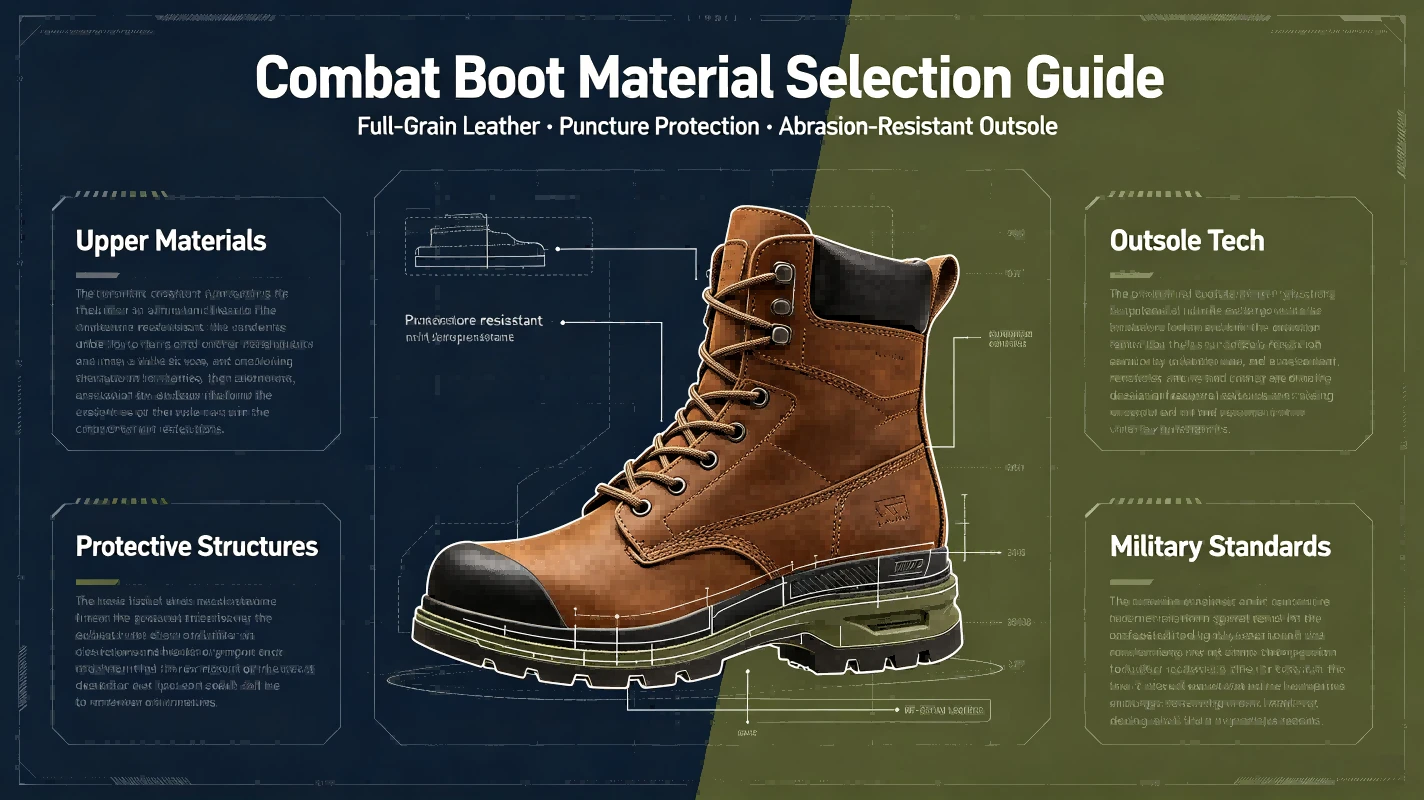
Combat Boot Material Selection Guide: Full-Grain Leather, Composite Canvas, Puncture-Resistant Midsoles, and Tactical Outsole Abrasion Test Standards
Aug 11, 2026
1. Introduction: The "Military Standard" Threshold of a Combat Boot
Combat boots are one of the most basic yet material-science-demanding categories of individual soldier equipment. Unlike ordinary military boots or outdoor footwear, combat boots must simultaneously meet requirements for durability, protection, environmental adaptability, and ceremonial appearance. From the first-generation Type-97 combat boots issued to the Hong Kong Garrison in 1997, to the full-scale replacement with Type-21 combat boots in 2021, the Chinese military's combat boots have undergone a leap from "liberation shoes" to "premium battle boots" in just over two decades.
The designers of the Type-21 combat boot once released a set of data: after more than 60 trials and testing over 30 materials, the development benchmarked against high-end outdoor sports footwear standards. A qualified standard-issue combat boot must have an upper that withstands repeated flexing, a sole that endures tens of thousands of abrasion cycles, and protective structures that shield the feet from puncture and impact injuries on complex terrain.
For tactical clothing factories, understanding the material selection logic for combat boots is not only a prerequisite for securing military/police orders but also the foundation for building professional supply-chain capability. This article systematically analyses the combat boot material selection system from five dimensions: upper materials, protective structures, outsole technologies, manufacturing processes, and testing standards.
2. Upper Materials: The Proportioning Logic from "Full-Grain Leather" to "Composite Canvas"
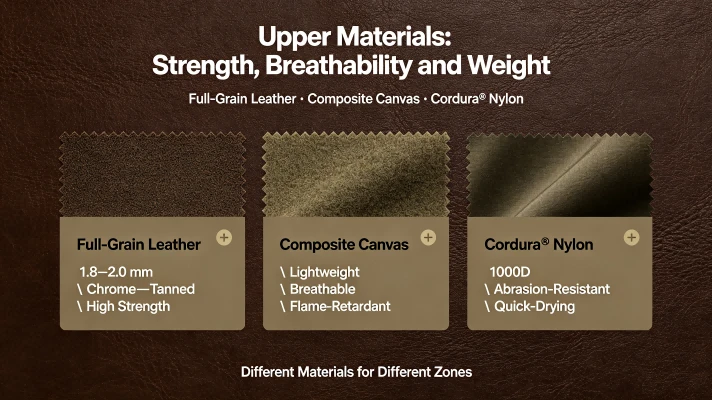
The upper of a combat boot is the key to its durability, breathability, and environmental adaptability. Modern combat boot uppers typically use a composite material construction – different materials for different areas to achieve an optimal performance balance.
2.1 Full‑Grain Leather: The "Skeleton Material" of Combat Boots
Full-grain leather is the most critical material for combat boot uppers. The shaft of infantry boots is typically made from full-grain leather, which provides good waterproofing and breathability, supports the calf muscle groups, and protects the ankle.
Key parameters of full-grain leather:
| Parameter | Typical value / requirement | Notes |
| Thickness | 1.8‑2.0 mm | Common specification for cold‑weather combat boots |
| Tanning process | Chrome‑tanned | Type‑21 uses chrome‑tanned yellow cowhide brown full‑grain suede leather |
| Abrasion resistance | 40% higher than ordinary leather | Advantage of chrome tanning |
| Reflectance | Low | Suitable for field concealment |
The Type-21 combat boot abandoned the previously used black material and adopted chrome-tanned yellow cowhide brown full-grain suede leather, making the upper more durable and robust – closer to actual combat requirements. Full-grain leather not only provides structural strength but also features low reflectance, making the boots less likely to be detected in field environments.
Implications for procurement:
- Distinguish between full-grain leather and split leather: full-grain leather has higher strength and longer service life
- Chrome-tanned leather outperforms vegetable-tanned leather in abrasion and weather resistance
- Thickness of 1.8-2.0 mm is the standard for tactical-grade combat boots
2.2 Composite Canvas: The Lightweight "Breathable Skeleton"
Composite canvas is another core upper material, addressing lightweighting and breathability. The Type-97 combat boot used waterproof leather combined with flame-retardant camouflage canvas for the upper. The Type-21 boot uses pearl-mesh composite canvas for the lining, making the boot lighter and more breathable.
Functions of canvas in combat boots:
- Weight reduction: Type-21 boots weigh less than 1.2 kg, significantly lighter than the Type-07's 1.5 kg
- Breathability: The pearl-mesh composite canvas design reduces stuffiness
- Flame retardancy: Some military-spec canvases are flame-retardant
- Camouflage: Canvas can be printed with camouflage patterns
Canvas technical specifications:
- Composite upper fabric uses square-woven blended fine-weave canvas
- Can be laminated with 389 dtex polyester filament lining fabric
- Some models use warp-knitted polyester spacer mesh for the front vamp lining
2.3 Cordura® Nylon: The "Abrasion Upgrade" for High-End Tactical Boots
For high-end tactical boots or special-operations requirements, the upper may also incorporate Cordura® 1000D abrasion-resistant nylon. Cordura nylon offers:
- Extreme abrasion resistance: 1000D grade withstands high-intensity friction
- Lightweight: lighter than leather of equivalent strength
- Good breathability: the woven nylon structure provides good air exchange
- Quick-drying: dries rapidly after immersion
Comparison of the three upper materials:
| Material | Strength | Breathability | Waterproofing | Weight | Cost | Best for |
| Full‑grain leather | ★★★★★ | ★★★ | ★★★★ | Heavy | High | Main combat boots, cold‑weather boots |
| Composite canvas | ★★★ | ★★★★★ | ★★ | Light | Medium | Tropical boots, training boots |
| Cordura® nylon | ★★★★ | ★★★★ | ★★ | Light | Medium‑high | Premium tactical boots, desert boots |
3. Protective Structures: From "Puncture-Resistant Midsoles" to "Reinforced Toe Caps"
The protective performance of combat boots is what distinguishes them from ordinary military boots. A qualified combat boot must meet military standards in three dimensions: puncture resistance, impact protection, and stability support.
3.1 Puncture-Resistant Midsole: The Foot's "Last Line of Defence"
The puncture-resistant midsole is the most important safety structure in a combat boot. Located in the middle of the sole, it prevents sharp objects (such as nails, glass, or shrapnel) from penetrating the sole and injuring the foot.
Mainstream puncture‑resistant midsole materials:
| Material type | Representative product | Puncture resistance | Characteristics |
| Kevlar® layer | Type‑21 combat boot | Military‑grade | Lightweight, high‑strength, good flexibility |
| Italian‑made ballistic fabric | PS4/PS5 midsole | >1200 N | High insulation, good flexibility |
| Fibreglass composite layer | Type‑97 combat boot | Military‑grade | High hardness, moderate cost |
| Non‑metallic aramid composite | New‑type combat boots | Military‑grade | Lightweight, shock‑absorbing |
The Type-21 combat boot incorporates a Kevlar® lining in the sole to provide puncture resistance, effectively protecting soldiers' feet from sharp objects in harsh battlefield environments. The advantage of Kevlar is that it delivers high-strength protection while remaining lightweight, without significantly increasing the boot's overall weight.
The core technical indicator for puncture-resistant midsoles is puncture resistance force. Military standards require a puncture resistance of above 1100 N. Italian-imported PS4/PS5 puncture-resistant midsoles can achieve >1200 Newtons.
Procurement acceptance points:
- Confirm the type of puncture-resistant midsole material (Kevlar/aramid/fibreglass)
- Require puncture-resistance test reports (≥1100 N)
- Verify midsole flexibility – excessive rigidity affects wearing comfort
3.2 Reinforced Toe Caps and Support Structures
Beyond the puncture-resistant midsole, combat boot protective structures include:
- Reinforced toe cap: the Type-21 boot features a thickened, impact-resistant toe cap for reliable protection in complex hazardous environments
- Ankle support: the high-top design (8-9 inches) protects the ankle and prevents sprains
- Carbon-fibre plate: the Type-21 boot includes a carbon-fibre plate in the sole for excellent support
- Front/rear supercritical elastomer shock-absorbing inserts: enhances cushioning performance

4. Outsole Technology: From "Panama Soles" to "Vibram® Rubber"
The outsole is the part of the boot that directly contacts the ground, determining traction, abrasion resistance, and slip resistance – the three core performance attributes.
4.1 Outsole Materials and Construction
Combat boot outsoles typically use a multi-layer composite structure:
| Layer | Function | Common materials |
| Outsole | Direct ground contact – provides traction and abrasion resistance | Natural rubber, neoprene, Vibram® rubber |
| Puncture‑resistant midsole | Prevents sharp‑object penetration | Kevlar, aramid, fibreglass |
| Midsole | Cushioning and shock absorption | EVA |
| Insole / footbed | Comfort, antimicrobial | Ortholite® antimicrobial, deodorant footbed |
Classic rubber outsole types:
- Panama sole: classic combat boot outsole with large lugs that shed mud easily – ideal for jungle environments
- Vibram® rubber outsole: standard on premium tactical boots – excellent abrasion and slip resistance
- Dual-density rubber injection: used in Type-07 boots – combines hardness and elasticity
4.2 Abrasion Test Standards
Outsole abrasion resistance is the core indicator of combat boot service life. The ultimate performance pursued by a general-purpose combat boot includes outsole abrasion testing.
Key test standards:
| Standard reference | Name | Scope |
| GB/T 3903.2‑2017 | Abrasion test method for whole shoe | Chinese national standard |
| GJB 5435‑2005 | General specification for military combat boots | Military standard |
| GB/T 20991‑2007 | Personal protective equipment – Test methods for footwear | General protective footwear tests |
| ASTM D1630 | Standard test method for rubber abrasion characteristics | International standard |
| ISO 20344 | Personal protective equipment – Test methods for footwear | International standard |
Military-spec abrasion requirements (reference) :
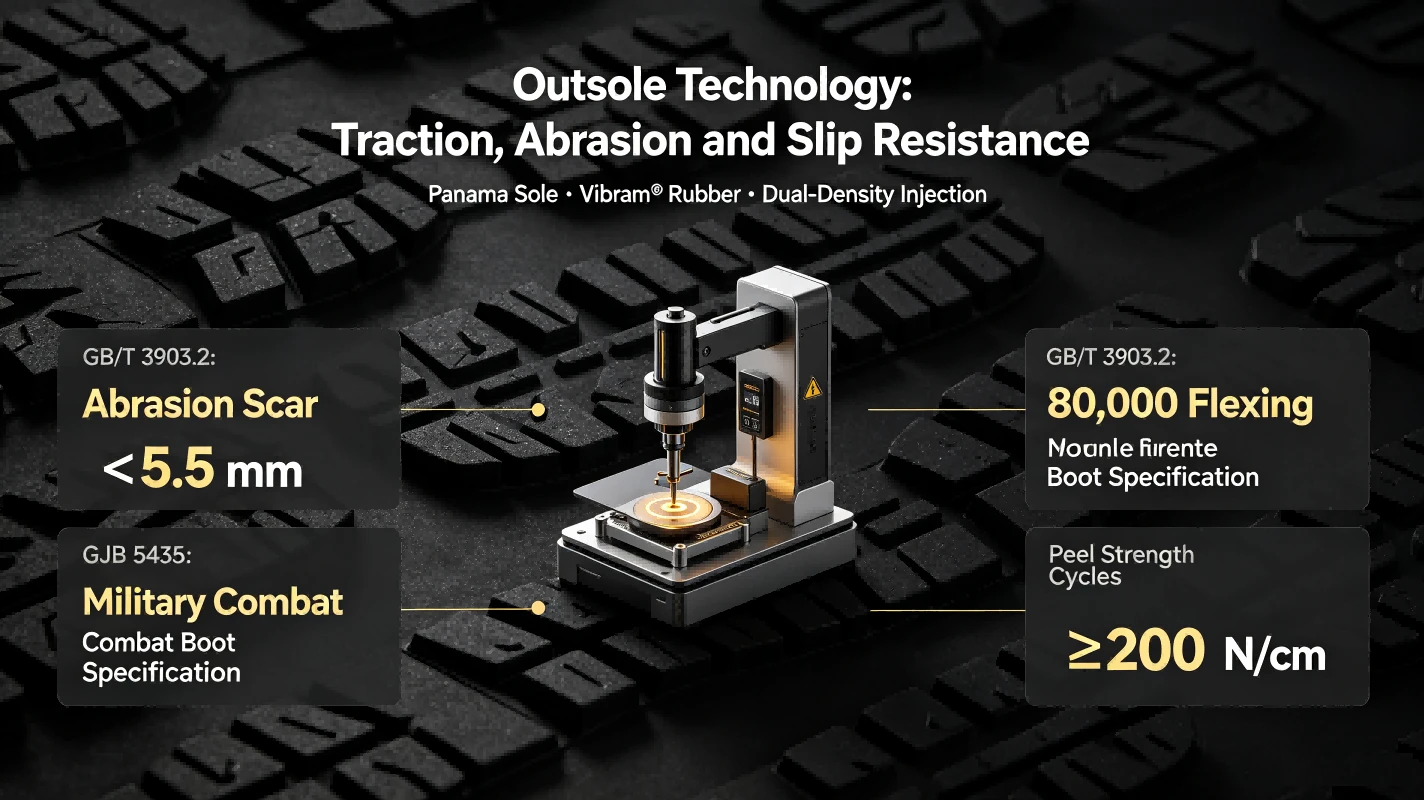
- Per GB/T 3903.2-2017, the abrasion scar length must be less than 5.5 mm
- Type-21 combat boot sole passed 80,000 flexing cycles
- Upper-sole peel strength: ≥200 N/cm for a pair
Procurement acceptance points:
- Require suppliers to provide outsole abrasion test reports (specify the test standard)
- Confirm the number of sole flexing cycles (military standards typically require tens of thousands)
- Verify slip-resistance rating (some premium products meet ASTM F2913 slip-resistance standards)
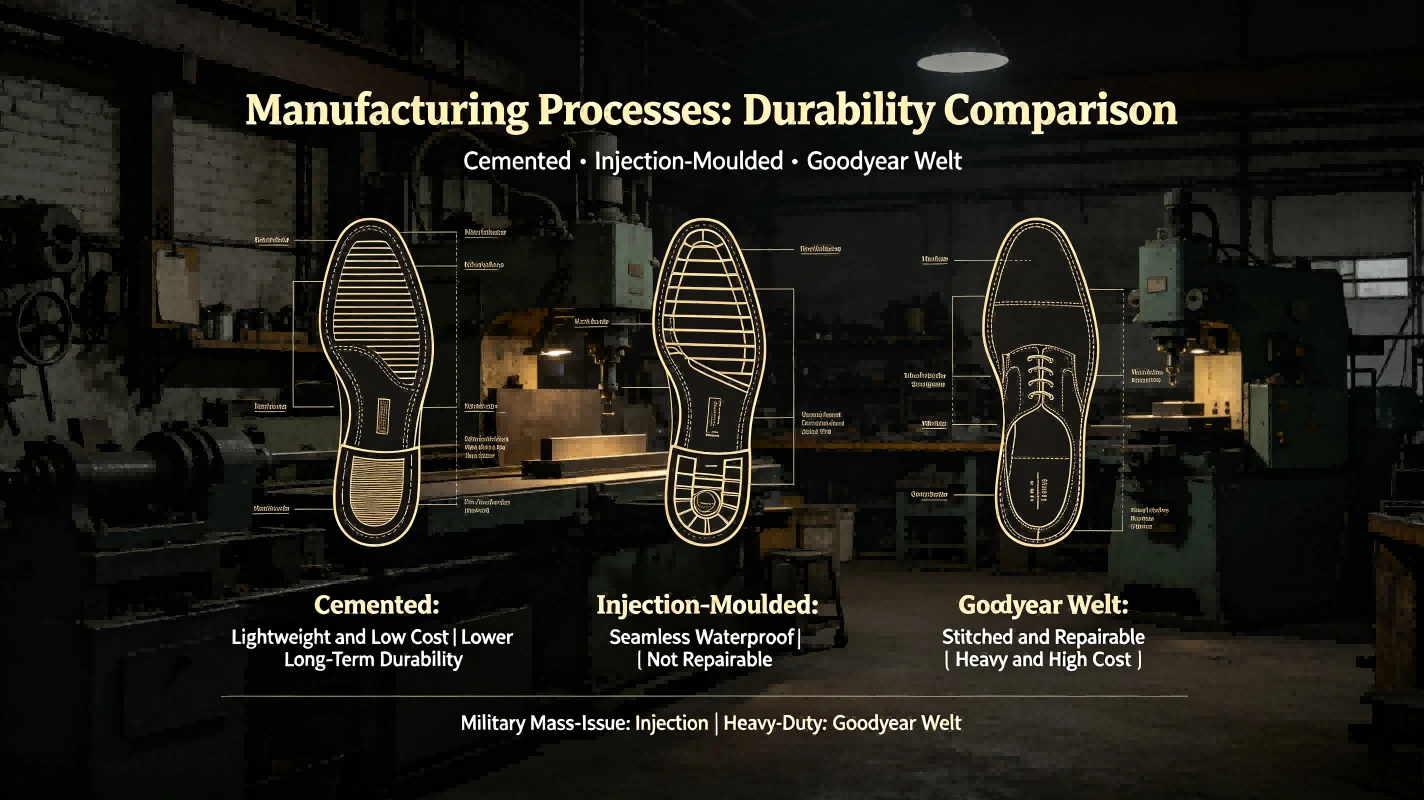
5. Manufacturing Processes: Cemented, Injection-Moulded, and Goodyear Welt – Durability Comparison
The method of joining the upper to the sole directly determines the boot's durability and environmental adaptability.
| rocess type | Characteristics | Advantages | Disadvantages | Best for |
| Cemented | Sole bonded to upper with adhesive | Lightweight, flexible, low cost | Lower long‑term durability | Light‑duty missions, comfort‑focused |
| Direct injection / moulded | Molten sole material moulded directly to the upper | Seamless, waterproof, durable | Not repairable | Wet, muddy environments |
| Goodyear welt | Sole stitched to upper via a welt | Extremely robust, repairable | Heavy, high cost | Extreme environments, heavy‑duty missions |
The Type‑97 combat boot used a neoprene/natural rubber moulded-sole process. Modern combat boot manufacturers such as Belleville, Wellco, and Altama predominantly use moulded-sole processes, while some work-boot brands that take on military orders use the Goodyear welt process.
Process selection recommendations:
- Large-scale standard-issue combat boots: prefer moulded/injection processes (cost-controllable, high consistency)
- Premium special-operations combat boots: consider Goodyear welt (ultimate durability)
- Moulded processes outperform cemented processes in waterproofing and durability

6. Quick Selection Guide for Tactical Clothing Factory Procurement
6.1 Selection by Operating Environment
| Environment type | Recommended upper material | Recommended outsole | Key features |
| Jungle / tropical | Composite canvas + localised leather | Panama sole | Breathable, quick‑draining, puncture‑resistant |
| Desert / arid | Cordura® nylon + nubuck | Vibram® rubber | Breathable, low heat absorption |
| Temperate / all‑terrain | Full‑grain leather + waterproof canvas | Dual‑density rubber | Waterproof, breathable, all‑round |
| Cold‑weather / extreme cold | Thickened full‑grain leather | Slip‑resistant rubber + thermal layer | Warmth, slip‑resistant |
| Urban / SWAT | Full‑grain leather + nylon | Quiet rubber | Comfortable, low‑profile |
6.2 Procurement Acceptance Checklist
- Upper material: confirm full-grain leather thickness (≥1.8 mm) and tanning process
- Canvas specification: confirm flame-retardant and waterproof treatment of composite canvas
- Puncture-resistant midsole: confirm material type (Kevlar/aramid) and puncture resistance (≥1100 N)
- Outsole rubber: confirm rubber type (natural rubber/Vibram®) and abrasion test report
- Manufacturing process: confirm cemented/injection/Goodyear welt process type
- Military-spec compliance: confirm conformity to GJB 5435-2005 "General specification for military combat boots"
- Weight control: confirm single-boot weight meets military spec (Type-21 <1.2 kg)

7. Frequently Asked Questions (FAQ)
- Q: What is the difference between full-grain leather and split leather?
A: Full-grain leather is the outermost layer of the hide, with tight fibre structure, high strength, and good breathability – the standard for combat boots. Split leather comes from lower layers and has lower strength; it is generally not used in military‑grade combat boots.
- Q: Which is better – Kevlar puncture-resistant midsoles or steel plate midsoles?
A: Kevlar puncture-resistant midsoles are lighter and more flexible, providing equivalent puncture resistance (>1200 N) at a far lower weight than steel plates. The Type-21 combat boot's use of Kevlar reflects the current technological trend.
- Q: What are the abrasion test standards for combat boots?
A: The main standards are GB/T 3903.2-2017 "Abrasion test method for whole shoe" and GJB 5435-2005 "General specification for military combat boots." The military standard requires an abrasion scar length of less than 5.5 mm.
- Q: Why is the Type-21 combat boot so much lighter than the Type-07?
A: The Type-21 achieves weight reduction through three measures: ① the upper uses chrome‑tanned yellow cowhide brown full-grain suede leather combined with composite canvas, optimising material proportions; ② the lining uses pearl-mesh composite canvas; and ③ overall structural optimisation reduced the weight from 1.5 kg to below 1.2 kg.
- Q: Which manufacturing process is the most durable for combat boots?
A: The Goodyear welt process is the most durable because the sole is stitched to the upper via a welt – even if the adhesive ages, the sole will not separate. However, it is costly and heavy, primarily used in premium work boots. Mass-issued military boots typically use moulded/injection processes, balancing durability with cost.
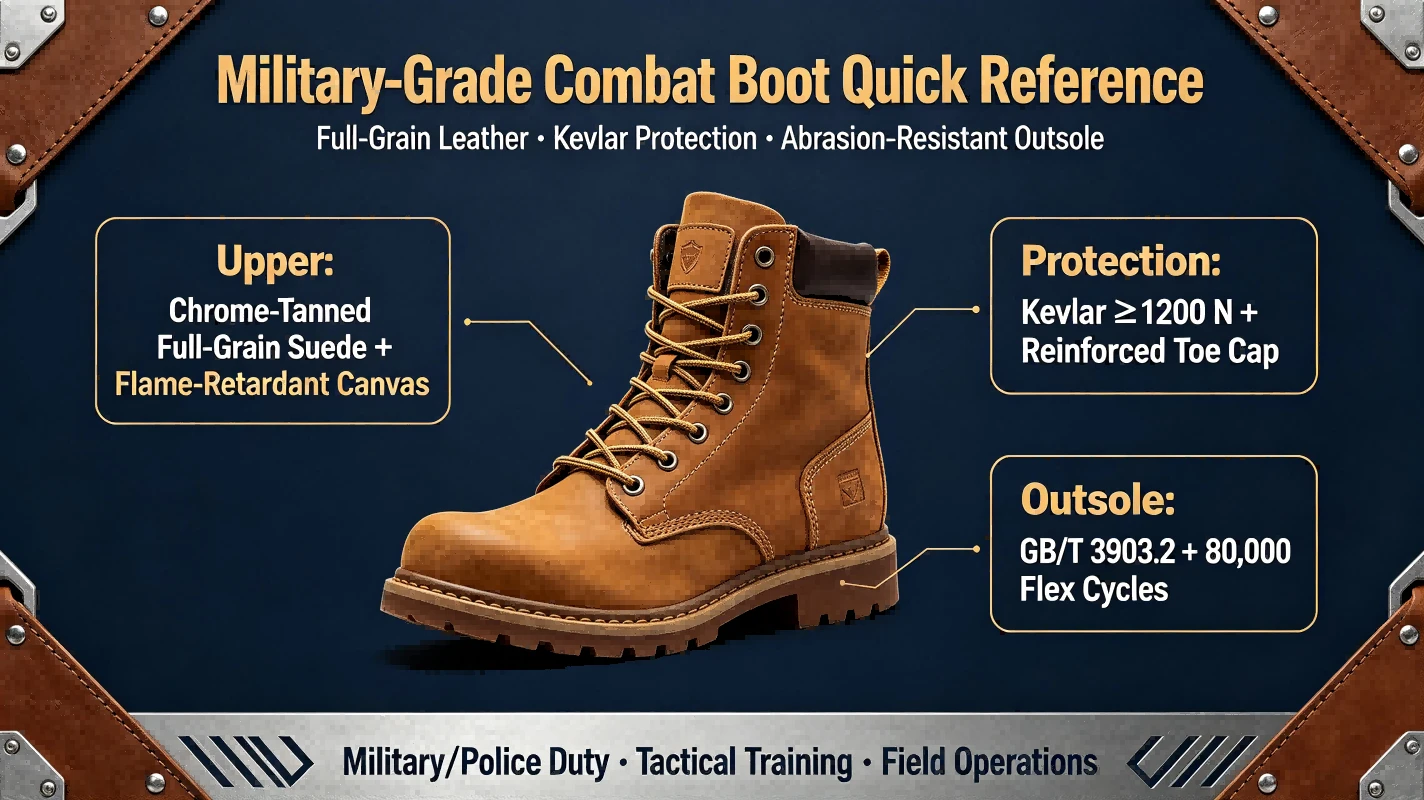
Conclusion: Combat boot material selection is a science of "balance" – finding the optimal solution between strength and weight, protection and comfort, cost and performance. From the Type‑97's "waterproof leather + flame-retardant canvas + fibreglass puncture protection" to the Type-21's "chrome-tanned full-grain suede + composite canvas + Kevlar puncture protection + carbon-fibre plate support," the material system of Chinese combat boots has undergone a leapfrog upgrade in just over two decades.
For tactical clothing factories, understanding the material selection logic for combat boots means grasping the quality thresholds and supply-chain standards of military-grade footwear. The thickness and tanning process of full-grain leather, the flame-retardant and breathable properties of composite canvas, the material type and puncture strength of the puncture-resistant midsole, and the abrasion test data of the outsole rubber – each is a "hard indicator" in military procurement. Only by thoroughly understanding these parameters can factories establish professional supply capabilities in the military/police footwear market.