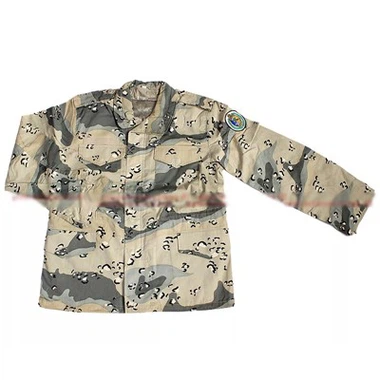
Why are some military training camouflage uniforms covered in mosaic-like patterns?
Aug 05, 2025
If you take a closer look, you'll find that some military training camouflage uniforms look odd-they seem to have been pixelated, covered in mosaics all over-

Not only military training camouflage uniforms, but over the past two decades or so, the "resolution" of armies worldwide has started to decrease. Take a look at the old camouflage uniforms-
 camouflage uniforms with telo mimetico patterns
This mosaic-like camouflage pattern is called digital camouflage. During the military parade celebrating the 70th anniversary of the end of World War II on September 3, 2015, China's Navy adopted this low-resolution digital camouflage design for its uniforms.

Canada has also adopted the pixelated design of CADPAT (Canadian Disruptive Pattern)

Canada's digital camouflage pattern CADPAT
Jordan's KA2 digital camouflage design--

The U.S. military's digital camouflage MARPAT--

Nowadays, military camouflage uniforms look like they've come straight out of Minecraft. Why is that?
Intuitively, this seems unscientific. Shouldn't higher resolution make it easier to blend into the environment, making it harder to be detected by the human eye or machines? After all, few things in nature are made up of standard square pixels-forcing a pixelated effect in natural settings would instead draw attention, wouldn't it?
In fact, contrary to our intuition, the low resolution of modern pixelated camouflage uniforms actually makes it hard for the human eye to distinguish the person wearing them.
Older camouflage designs with smooth lines date back to the 19th century, simulating natural backgrounds like tree leaves. A key method in designing such patterns is using fractals to mimic nature's self-similarity, thereby achieving the effect of blending into the background.
Camouflage that uses fractals for concealment is also called fractal camouflage, with Italy's military Vegetato camouflage being a common example.

Vegetato camouflage
But later, the design philosophy of camouflage began to shift. Of course, blending into nature like an octopus works for concealment, but confusing the enemy like a zebra-dazzling them so they can't pinpoint the boundary between oneself and the environment-is also an effective way to hide.

This type of camouflage that obscures one's own outline and structure from others' view is called disruptive camouflage. Digital camouflage, which emerged in the 1990s, utilizes this principle.
In fact, the Canadian government was the first country to adopt digital camouflage. They spent millions of dollars in the 1990s to develop the CADPAT digital camouflage.
Research by the Canadian military found that compared with the earlier solid olive green design (Olive Drab), the new CADPAT digital camouflage reduced the likelihood of soldiers wearing it being detected by 45% at distances of 50-300 meters. With this camouflage, enemies had to get 35% closer to distinguish the soldiers' outlines.

Olive Drab (military green)
Later, other NATO countries also presented their own designed camouflage uniforms to compare with Canada's CADPAT. NATO's experiments found that the concealment effect of Canada's CADPAT surpassed that of camouflage uniforms from other developed countries, such as the U.S. Woodland, Britain's DPM, and Germany's Flectarn.
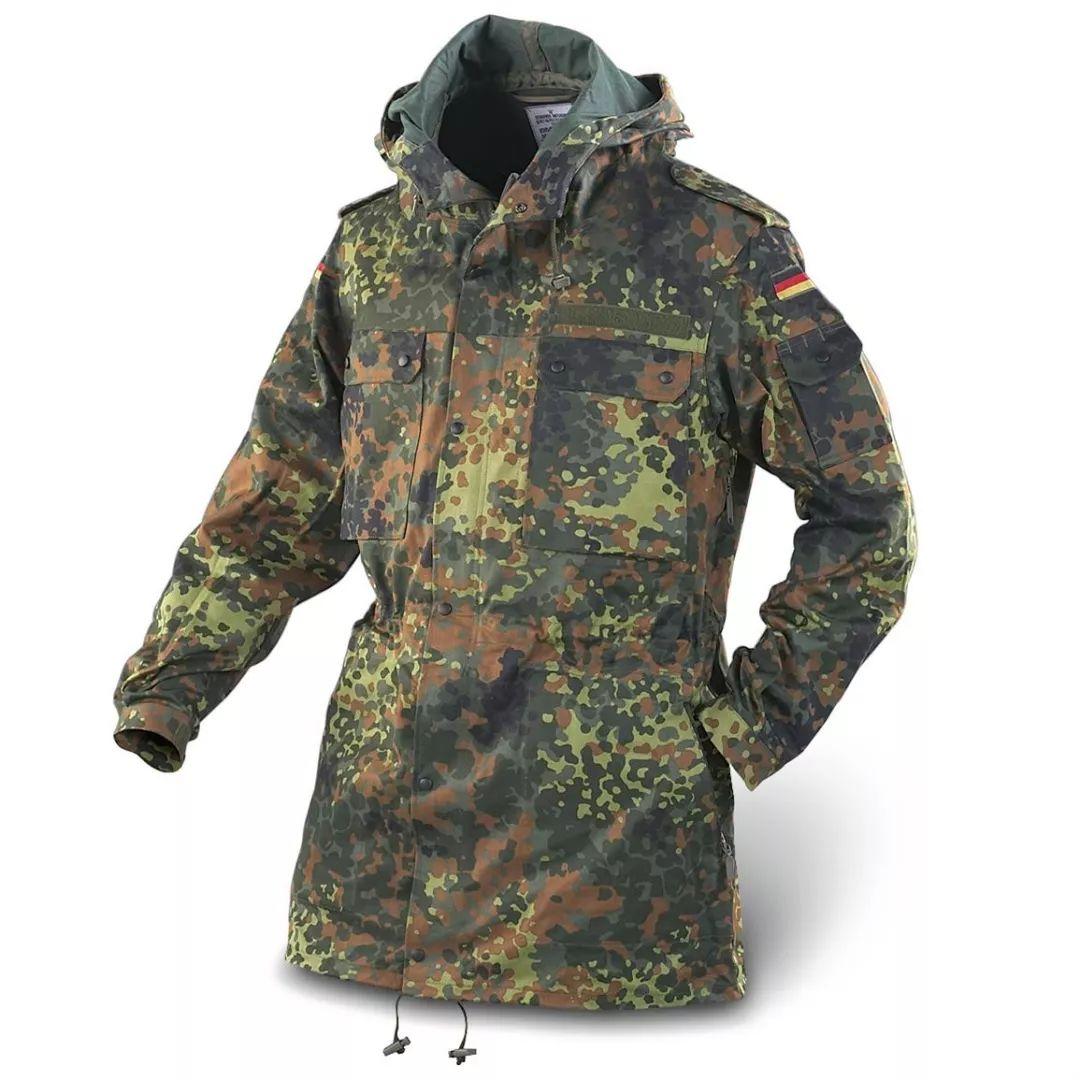
Germany's Flectarn camouflage
In 2012, NATO research once again confirmed that Canada's CADPAT TW camouflage is the most effective camouflage design for tropical and subtropical regions.

NATO's research found that CADPAT TW is the most effective camouflage suitable for tropical and subtropical regions.
Due to the success of Canada's pixelated camouflage uniforms, the U.S. Marine Corps began to show strong interest in digital camouflage. Later, with the permission of the Canadian government, the U.S. Marine Corps started using this pixelated design. The modified U.S. version was later known as MARPAT.

U.S. digital camouflage (second from the left) and Canada's digital camouflage CADPAT TW (first from the right)
In an interview with the BBC, Timothy R. O'Neill, a retired U.S. Marine Corps Lieutenant Colonel who was the original designer and promoter of the MARPAT digital camouflage pattern, stated that generally speaking, large color blocks are suitable for dealing with long-range detection, while small color blocks are better for short-range detection. A good camouflage must provide concealment both at close range and from a distance.
This type of camouflage, suitable for multiple distances, is called multi-scale camouflage. O'Neill pointed out that the square pixel design is an ideal choice for multi-scale camouflage.
Up close, the small color blocks formed by pixels can mimic the natural environment; yet from a distance, the overall form created by fused pixels can also simulate larger background patterns such as tree branches and canopies.

A comparison of concealment effects between olive drab (left), MARPAT camouflage (middle), and old-style NATO camo (right).
But the question returns to the starting point: why does the counterintuitive pixel design perform better than the smooth old-style camouflage when viewed up close?
O'Neill argues that pixelated small squares can enhance the dithering effect, and fragmented, discrete color blocks can disrupt the pattern's outline, blurring the boundaries of the human body.

Dithering effect: Images composed of scattered dots rather than continuous lines have blurred boundaries, which is exactly what camouflage requires.
O'Neill explained that the Office of Naval Research has conducted some related studies. In one study, different soldiers wearing MARPAT camouflage uniforms, old-style NATO camo, and solid-color clothing were tested.

A comparison of concealment effects between MARPAT camouflage (left), olive drab (middle), and old-style NATO camo (right).
As a result, the traditional NATO camo was identified in just 1 second, while it took the human eye an average of 2.5 seconds to recognize the MARPAT camouflage.
The U.S. Marine Corps later conducted numerous studies of its own, which confirmed that MARPAT was indeed more effective than the previous Olive Drab solid-color design: enemies took more than three times as long to detect targets concealed by this camouflage, and more than 2.5 times as long to identify the targets' outlines.
During combat, a difference of a few seconds can mean the difference between life and death, success and failure. This highlights the significance of mosaic-style camouflage uniforms.
In 2004, the U.S. military began full-scale use of the pixelated UCP (Universal Camouflage Pattern) design. Under the influence of the U.S. military, other countries around the world also followed suit by adopting Minecraft-style camouflage designs.

UCP camouflage uniform
Anyway, after hearing the story of camouflage uniforms, we understand this: if you want to quickly cover up a belly, double chin, or the like, just get a pixelated T-shirt. Appearing in others' eyes with a pixelated look can make you look slimmer in a second, or even reduce your presence.