

How to Distinguish Between the Three Submachine Guns of the Soviet Union in World War II: the PPSh, PPD, and PPS
Sep 22, 2025
Submachine guns emerged during World War I, and since then, they have become one of the most indispensable individual light weapons in the armed forces of various countries.
This is because submachine guns are smaller in size than rifles and light machine guns, while also boasting the rate of fire and firepower comparable to machine guns. Their role in street battles and trench warfare is far more significant than that of pistols and rifles.

In particular, during World War II, submachine guns had become widespread in infantry squads of various countries and could be said to have been used quite frequently.
When it comes to the countries that were equipped with the most submachine guns during World War II, the United States ranks first, Germany second, and the Soviet Union third.
This article will therefore focus on the submachine guns of the Soviet Union during World War II.
The Soviet Army was mainly equipped with three types of submachine guns during World War II.

The first one is the PPD series submachine guns used in the early stage of World War II.
The second is the PPSh-41 submachine gun, which began to be equipped in the mid-stage of World War II.
The third is the PPS-43 submachine gun, which started to be equipped in the late stage of World War II.
What are the respective characteristics of these three submachine guns? And how can those who don't know much about them distinguish between them?
The following is a brief introduction to the three Soviet submachine guns of World War II: the PPD, PPSh, and PPS.
I.PPD Series Submachine Guns
They are also known as the PPD series submachine guns or the Degtyaryov series submachine guns.
Why is it called a "series"?
Because this line consists of three specific models.

They are the three models: PPD-34, PPD-34/38, and PPD-40.
Among them, the PPD-34 is the first model in the PPD series. It was developed in 1934 and officially equipped by the Red Army of the Soviet Union in 1935. However, it was not initially issued to ordinary soldiers; instead, it was only distributed to grassroots commanders for self-defense purposes.

The design of the PPD series drew inspiration from Finland's Suomi KP-31 submachine gun. It also featured an integrated wooden stock and handguard, with long strip-shaped heat vents on the barrel-its overall appearance was similar to that of the Finnish Suomi submachine gun.
The PPD-34 submachine gun fired the Soviet 7.62×25mm Tokarev pistol cartridge, offering two firing modes: semi-automatic and fully automatic. It had a theoretical rate of fire of approximately 800 rounds per minute and an effective range of 160 meters.

The initial PPD-34 was fed by a 25-round curved magazine. However, it was later realized that the small ammunition capacity led to issues such as insufficient firepower. Subsequently, the PPD-34 began to be equipped with a 71-round drum magazine, which significantly improved both its ammunition capacity and firepower.
The PPD-34 had an unloaded weight of 3.2 kilograms, an overall length of 788 millimeters, a barrel length of 273 millimeters, and adopted an open bolt design.
The PPD-34 submachine gun equipped with a 71-round drum magazine was highly trusted by grassroots commanders of the Soviet Army at that time.

The second model, the PPD-34/38, was actually the PPD-34 submachine gun produced in 1938. In terms of its appearance, operating principle, caliber, weight, dimensions, and other aspects, it was identical to the original PPD-34 manufactured in 1934.
The only differences were that the 1938 model (PPD-34/38) featured reduced production costs, simplified manufacturing processes, and optimized feeding systems and magazines, which enhanced its reliability.
However, most PPD-34/38 submachine guns were equipped with 71-round drum magazines, and the use of 25-round magazines became rare.

The third model, the PPD-40, was the final version of the PPD series submachine guns and was introduced in 1940.
In terms of design, it retained the characteristics of the previous PPD-34/38 model-its caliber, weight, length, and operating principle remained identical.
However, the PPD-40 could only use 71-round drum magazines and was incompatible with the earlier box magazines. Additionally, it had no dedicated magazine well; instead, the drum magazine was secured in the middle of the feeding system via a simple mechanism, making its design more straightforward compared to previous models.

Additionally, this model featured longer heat dissipation fins on the sleeve, which were no longer as dense as those on previous versions. This not only improved heat dissipation efficiency but also made it easier for users to clean the sleeve later.
However, since all parts of the PPD-40 submachine gun were made by milling, its production cost was relatively high, and large-scale production and issuance to troops could not be achieved. Therefore, from 1940 to 1941, before the launch of the PPSh-41, only over 90,000 units of the PPD-40 were produced. Nevertheless, this model was still the one with the highest output in the entire PPD series.

In the early stages of World War II, before the PPSh-41 submachine gun was introduced, the PPD series served as the main submachine guns of the Soviet Red Army. Although their numbers were limited, they still played a role in the anti-fascist war.
After 1941, the PPD series was gradually replaced by the more superior PPSh-41 submachine gun. However, some second-line units of the Soviet Army, as well as certain non-conventional combat personnel, continued to be equipped with small quantities of specific models from the PPD series.
II.PPSh-41 Submachine Gun
The PPSh-41, also known as the "PPSh - 41" submachine gun, was developed by Soviet weapons designer Georgy Shpagin in 1941. Shortly after its development, it began to be issued to the Soviet Red Army and became the replacement for the previous-generation PPD series submachine guns.
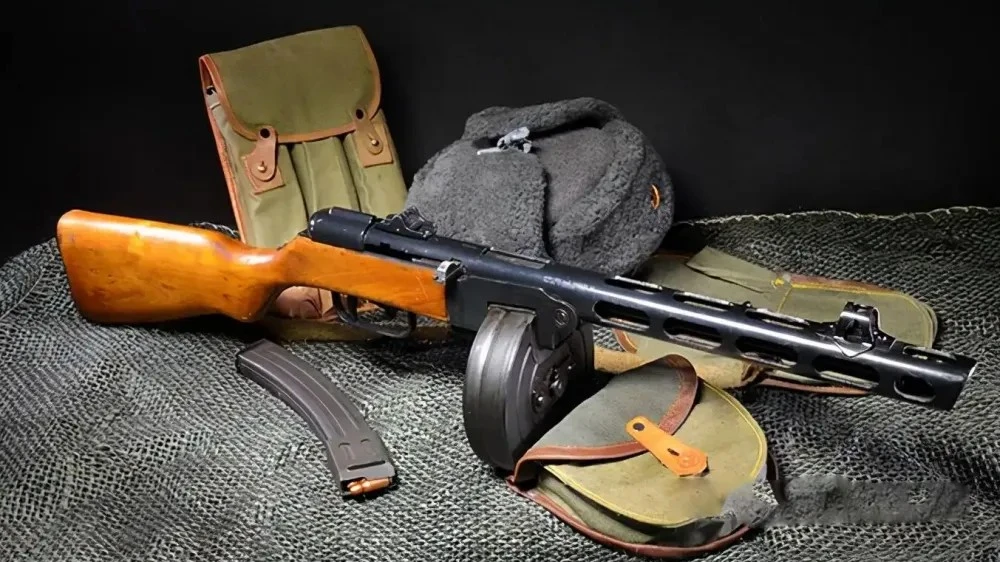
Compared with the PPD series, the most prominent feature of the PPSh-41 submachine gun was its extensive use of stamped and welded parts. This not only reduced production costs but also increased manufacturing speed, making it easy to equip troops on a large scale.
In terms of appearance, the PPSh-41 also had an entirely new design: the sleeve had a more balanced shape, and its length extended beyond the barrel. Additionally, the front end of the sleeve was angled downward-this design prevented muzzle rise and also served a recoil reduction function.

The PPSh-41 submachine gun also fired the 7.62×25mm Tokarev pistol cartridge. It could be fed by either a new 35-round curved magazine or a 71-round circular drum magazine, with a theoretical rate of fire of up to 900 rounds per minute and an effective range of 200 meters. It also featured two firing modes: semi-automatic and fully automatic
With an overall length of 840 millimeters and an unloaded weight of 3.63 kilograms, the PPSh-41 was slightly larger and heavier than the previous PPD series submachine guns. However, it offered greater reliability and outstanding performance.

Due to its low production cost, the PPSh-41 became the most widely produced submachine gun in the Soviet Union throughout World War II. Mass production began in 1942 and continued until the late 1940s, with approximately 6 million units manufactured during this period-making it one of the most produced submachine guns globally during the war.
During World War II, the PPSh-41 served as the primary submachine gun of the Soviet military. It was used by personnel such as squad leaders, assault troops, commanders, tank crews, and vehicle drivers in every infantry unit, becoming an iconic symbol of the Soviet Red Army during the war.

After the founding of the People's Republic of China, China also produced a copy of this submachine gun, which was officially designated as the Type 50 submachine gun in 1950.
III.PPS-43 Submachine Gun
It can also be referred to as the "P 波波斯 - 43" submachine gun. Developed by Soviet weapons engineer Alexei Sudayev in 1943, this model was introduced that same year, with its predecessor being the experimental PPS-42 submachine gun.

Many people mistakenly believe that the PPS-43 is a simplified version of the PPSh-41. While the PPS-43 features a simple design, it has no connection to the PPSh-41 whatsoever.
The PPS-43 was improved based on the PPS-42, with a distinct positioning and structure. Furthermore, it was designed by a different engineer. It can only be said that the PPS-43 is similar to the PPSh-41-there is no derivative or improvement relationship between them.

The PPS-43 submachine gun also fired the 7.62×25mm Tokarev pistol cartridge. It typically used the 35-round curved magazine that was compatible with the PPSh-41, but the selector switch was removed, leaving it capable of only fully automatic fire.
To conserve ammunition and improve accuracy, its rate of fire was reduced-from 900 rounds per minute to 650 rounds per minute-with an effective range of approximately 100 to 200 meters. Although the rate of fire was lower, it did not compromise the weapon's firepower or overall performance.

The PPS-43 also utilized a large number of metal stamped parts. Moreover, it abandoned the solid wooden stock; instead, a simple foldable metal stock was added at the rear end. This design enhanced portability and made the weapon suitable for use in confined spaces.
The PPS-43 had an unloaded weight of approximately 3.36 kilograms and a barrel length of 254 millimeters. With the stock extended, its overall length was 820 millimeters, and when the stock was folded, this length reduced to 615 millimeters. Whether in terms of size or weight, the PPS-43 outperformed the PPSh-41.

During World War II, approximately 1 million units of the PPS-43 submachine gun were produced, second only to the earlier PPSh-41.
Back then, this weapon was widely issued to Soviet tank crews, artillerymen, commanders, and assault units, serving as a primary submachine gun alongside the PPSh-41.

Similarly, China also produced a copy of this submachine gun in the 1950s, which was named the Type 54 7.62mm Submachine Gun in 1954.
That covers the respective characteristics and distinctions of the three Soviet submachine guns-the PPD series, PPSh-41, and PPS-43-used during World War II. If there are any errors in the text, we would greatly appreciate your comments and corrections. For more content, please remember to follow us, and we will continue to update in the next issue.