Old Photos Take You to See the Most Authentic U.S. Military in the Korean War
Sep 20, 2025
It is undeniable that the U.S. military was extremely powerful during the Korean War. Not only was its weaponry and equipment several times more advanced than ours, but it also had a massive logistical support system behind it. Moreover, the real-life U.S. military was far from being as vulnerable as depicted in some film and television works; in fact, it was even stronger than you might imagine. Given this, it was incredibly difficult for the Chinese People's Volunteers to defeat them back then.
Now, let's use color vintage photos to learn about the most authentic U.S. military during the Korean War together. It has to be said that their weaponry, equipment, supplies, food, and clothing back then were indeed enviable.
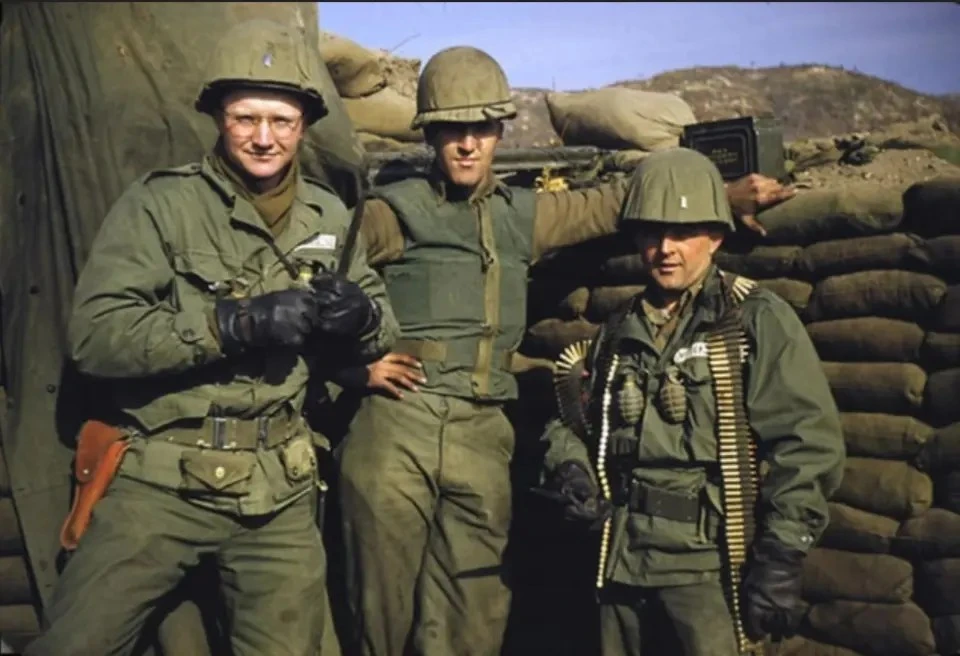
Figure 1: These are three U.S. Army officers and soldiers taking a group photo. The one on the left wearing glasses is clearly an officer; judging from the insignia on his helmet, he should be a first lieutenant, and he also has a pistol tucked at his waist. The one on the right is also a first lieutenant, with hand grenades and a machine gun ammunition belt on his person.
The one in the middle should be an enlisted soldier, and he is also wearing a bulletproof vest. This was the first bulletproof vest equipped by the U.S. military. However, the U.S. military did not initially call it a "bulletproof vest"; instead, they referred to it as the M51 "Armored Vest." Such equipment was quite advanced for its time.
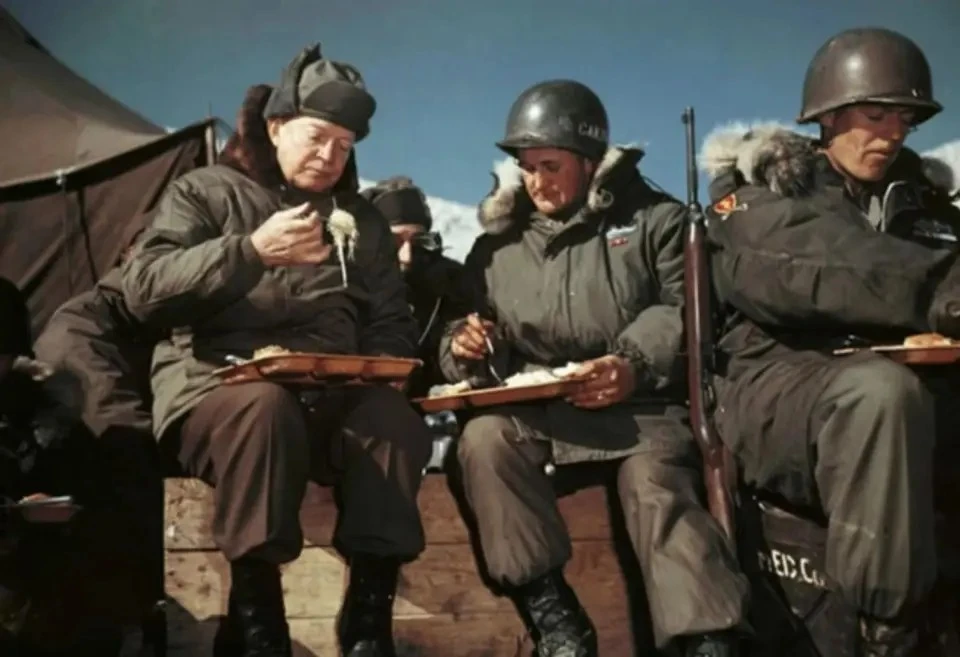
Figure 2: These are several U.S. Army officers having a meal. Although the rank insignia on their uniforms are not visible, judging from the age of the officer on the left, he must be at least a major general, and the two on the right must be at least colonels.
It is evident here that their meals were quite good. Each of them could get a dining plate during meals, and they had access to a variety of dishes and staple foods.

Figure 3: This is a U.S. military sniper observing the situation. On his head, he is wearing an M1 steel helmet with a "Duck Hunter" camouflage cover set. Based on this outfit, he should be a member of the U.S. Marine Corps.
The sniper rifle in his hand is likely a model that began service during World War II-the Springfield M1903A4. It fires 7.62x63mm Springfield ammunition. Though it was a weapon from World War II, it could still play a significant role on the Korean War battlefield in the 1950s. Moreover, the Chinese People's Volunteers also preferred to capture this type of sniper rifle back then.

Figure 4: In the distance is a U.S. military C-124 "Globemaster" strategic transport aircraft. This model completed its first flight in 1949, was commissioned by the U.S. Air Force in the 1950s, and participated in the Korean War. Back then, in addition to transporting large quantities of strategic materials, it was also responsible for carrying U.S. military personnel.
The people in the picture are U.S. Army officers and soldiers who are preparing to board the plane and head to the battlefield.

Figure 5: This is a U.S. military camp during the Korean War. In the foreground, three U.S. military company-grade officers are taking a group photo. The taller one on the left is a first lieutenant, the one in the middle is a captain, and the rank insignia on the hat of the one on the right is not clearly visible-he should also be a company-grade officer.
All three are wearing the M1951 series military uniform, which includes the M51 patrol cap on their heads, the M51 Army shirt on their upper bodies, and the M51 work pants on their lower bodies-all belonging to the same series. However, the footwear on their feet is not the M1951 military boots, but the M1943 field boots from World War II.

Figure 6: This is a U.S. Army soldier eating a meal on the spot. On his mess tray, in addition to regular food, there is a large piece of meatloaf-clearly showing how good the U.S. military rations were back then. There was even leftover food to feed dogs.
Now, let's think back to the Chinese People's Volunteers (CPV) of that time. On good days, all they had were fried noodles, potatoes, and hardtack. When supply lines were strained, they could not even get enough to eat-they had to gnaw on tree bark and eat snow just to stave off hunger. Compared with the well-provisioned U.S. military, their conditions were incredibly harsh.

Figure 7: This is a U.S. military team in combat. A soldier in the distance is firing a recoilless rifle, which is presumably the M18 model. This type of weapon was highly effective at destroying tanks and bunkers. Back then, the Chinese People's Volunteers (CPV) also liked to use it after capturing it, and later developed the Type 52 recoilless rifle based on this original model.

Figure 8: In the photo is a U.S. military anti-aircraft vehicle. Its chassis is based on the M3 half-track from World War II, and its weapon system consists of four 12.7mm M2 heavy machine guns combined together-thus forming an anti-aircraft vehicle.
While this was not an advanced piece of equipment, it still posed a significant threat to the Chinese People's Volunteers (CPV), who lacked heavy weapons in the early stages of their entry into the Korean War.

Figure 9: In the photo is a U.S. military artillery unit conducting deployment. The weapons in the distance are all M2 105mm howitzers, a type of artillery that was widely equipped by the U.S. military at that time.
In addition to firing conventional artillery shells, the M2 howitzer could also launch incendiary shells, shrapnel shells, and chemical shells. Its maximum range could reach 11.18 kilometers. Before the Chinese People's Volunteers (CPV) received Soviet-made artillery, their favorite was this U.S.-made M2 howitzer.

Figure 10: This is a U.S. military machine gun team in combat. A Browning M1919A4 medium machine gun is set up at the front. In fact, this model is an air-cooled machine gun improved from the M1917 water-cooled machine gun. It also fires 7.62x63mm bullets, uses a belt feed system, has a theoretical rate of fire of 400-500 rounds per minute, and an effective range of approximately 1,000 meters.
Though this type of machine gun was a product developed before World War II, it was still combat-effective during the Korean War in the 1950s. Both in terms of firepower and rate of fire, it outperformed the "internationally-sourced" machine guns of the Chinese People's Volunteers (CPV). Naturally, this machine gun was also one of the U.S.-made trophies most favored by the CPV back then.

Figure 11: In this photo, a U.S. military medical unit is evacuating wounded soldiers. It can be seen that on the Korean War battlefield in the 1950s, helicopters were already being used to transport the wounded. Moreover, intravenous drips had been administered to the wounded in advance-clearly showing how advanced their medical conditions were at that time. As long as resources were sufficient, almost every wounded soldier could receive such treatment.
In contrast, what about the Chinese People's Volunteers (CPV) and the Korean People's Army (KPA) during the same period? Not to mention getting intravenous drips on a helicopter-they didn't even have enough basic medical supplies.

Figure 12: This is a U.S. military officer during the Korean War. He is wearing an M1 steel helmet and a khaki combat jacket, and the rank insignia on his helmet indicates he is a captain.
This outfit was quite popular at that time. Jackets like this were not only issued to officers-ordinary U.S. soldiers also received them. They could be freely matched according to different situations, which clearly shows how good the U.S. military's conditions were back then. In contrast, during the same period, each soldier of the Chinese People's Volunteers (CPV) and the Korean People's Army (KPA) only had one military uniform. Even in winter, they couldn't even get enough cotton-padded clothes and cotton-padded shoes.

Figure 13: This is a U.S. military armored unit during the Korean War. At that time, it was equipped with a variety of new-type tanks, among which two models were common: one was the M46 "Patton" medium tank, and the other was the M26 "Pershing" heavy tank.
The tank in the photo is the M46 model, which was a type of tank developed by the U.S. in the late 1940s. It was mainly used to replace the Sherman M4 series from World War II. The M46 was among the most advanced medium tanks on the Korean War battlefield. Equipped with a 90mm tank gun and with armor thickness of 101mm, it was significantly superior to the T-34/85 tanks equipped by the Chinese and North Korean forces in terms of firepower, protection, and mobility.

Figure 14: In the photo is an M46 medium tank undergoing maintenance. A maintenance vehicle behind it is hoisting the engine, while the technical soldiers nearby are inspecting for faults.

Figure 15: This is a U.S. military armored column firing at a hilltop. Leading the column is an M26 "Pershing" heavy tank. Developed in the late stages of World War II, this model was originally designed to counter the German Tiger heavy tanks. However, World War II ended as soon as this tank was introduced-before it had a chance to fulfill its role. Later, in the early 1950s during the Korean War, the M26 tank finally got the opportunity to demonstrate its capabilities.
This tank was also among the most advanced on the Korean War battlefield at that time, and it was even more powerful than the Soviet-made IS-2 heavy tanks that the Korean People's Army (KPA) was equipped with in the later stages of the war.

Figure 16: This photo shows U.S. military personnel taking a group photo with the Turkish Corps at the forward position. In the photo, only the U.S. military officer in the middle-who is wearing a shirt and has his hands on his hips-is an American; the rest, with "Middle Eastern-style" features, are all Turkish officers and soldiers.
Furthermore, all these Turkish military personnel are wearing U.S.-made equipment, such as U.S.-made bulletproof vests, U.S.-made combat boots, and U.S.-made military uniforms.

Figure 17: These are three U.S. military officers taking a group photo. Each of them is wearing an M1951 field uniform. Behind them, there are several Ford M151 jeeps, and a few tents can be seen in the distance. Judging from the scene, this should be a U.S. military rear command post.

Figure 18: These are U.S. military officers and soldiers taking a group photo at a rear camp. Thanks to good rations, adequate food, and sufficient nutrition, all of them look energetic and in high spirits.
In contrast, the Korean People's Army (KPA) soldiers during the same period, who suffered from inadequate food supplies, were all thin and small in stature with dark complexions. Even the South Korean military soldiers of the same period looked healthier than them.

Figure 19: This is an S-55 helicopter equipped by the U.S. Army during the Korean War, with several U.S. soldiers preparing to board it for combat.
The S-55 was the first multi-purpose helicopter widely equipped by the U.S. military. Development began after World War II, it completed its first flight in the late 1940s, and was soon commissioned by the U.S. military. This helicopter undertook support, troop transport, and medical evacuation missions on the Korean War battlefield.
It must be said that the U.S. military was truly ahead of its time back then. As early as the early 1950s, it was already using helicopters that could operate alongside infantry. Not to mention North Korea-even Western countries envied this capability.
The above presents the most authentic image of the U.S. military during the Korean War. In contrast to the Chinese People's Volunteers (CPV) and the Korean People's Army (KPA) of that era, what are your thoughts?