

Spanish Galleons: Spanish Shipbuilding Methods Before tSpanish Galleons: Spanish Shipbuilding Methods Before the 18th Centuryhe 18th Century
Dec 22, 2025

Spanish galleons were primarily used for armed transport to Spanish colonies, notably as part of the famous treasure fleets, with the Manila Galleon also being a component of the Spanish treasure fleet.
Despite the fame of Spanish galleons, discussions about their construction and assembly are quite scarce on domestic platforms. The limited available introductions to shipbuilding are predominantly based on English methods, often overlooking the fact that in the 16th and 17th centuries, the shipbuilding techniques of the three maritime giants-England, the Netherlands, and Spain-were distinctly different.
This article focuses on the restored model of the Santiago de Oliste, created by Spanish master model maker Ramón Olivenza Gallardo, to introduce the construction and assembly of galleons.
The Santiago de Oliste is also a renowned ship. Built around 1620 in Pasajes, Spain, it had a tonnage of approximately 900 tons, was equipped with 44 cannons, and measured about 42 meters in length and 11 meters in width.

It participated in the Battle of Abrolhos as the flagship of the Spanish-Portuguese fleet under the command of Antonio de Oquendo, defeating the Dutch fleet in Brazil and causing the explosion of the Dutch flagship, the Willem de Zwijger.
Construction of the Hull Framework
Laying the Keel

The first step in constructing the hull is, of course, laying the keel. The restored ship uses three keel pieces spliced together. During this period, Spain employed a rather unique keel splicing method, utilizing a butt joint rather than the more common scarf joint.

It may sound quite surprising, but this splicing method is documented in Spanish technical materials and later archaeological discoveries. It was not until the early 18th century that it was replaced by the scarf joint in warship construction.

The groove on the top side of the keel is used to install the lowest side plank of the hull, with the edge of the side plank fitted into the groove of the keel. Below the groove at the butt joint, wooden pins are installed for waterproofing.
Once the keel is laid, the next step is to install the stem, sternpost, and stern framework.
Installing the Stem and Sternpost

The stem is composed of the central stem piece and two reinforcing members on either side, with these three components together forming the complete stem structure.

The components of the stem are secured using iron pins and then joined to the keel. Unlike the British, who-particularly during the galleon era-typically favored wooden pins in shipbuilding, the Spanish commonly employed iron pins.

Next, the sternpost is installed. Positioned centrally, the sternpost is flanked by the stern knee at the front and the false post at the rear. These components are also secured to one another using iron pins, while the sternpost itself is tenoned into the keel.

Then, assemble the stern frame and fit it into the sternpost.

With this, the backbone of the ship is completed, and the next step is to install the ribs.
Installing the Ribs

The rib frame represents yet another significant difference between the Spanish shipbuilding system and other shipbuilding methods.

The Spanish shipbuilding method employs a lap-jointed framing system (varenga-genol). A set of ribs consists of five futtocks joined together using mortise-and-tenon joints and pins, a technique that is distinctly different from the methods used in other Western European countries.
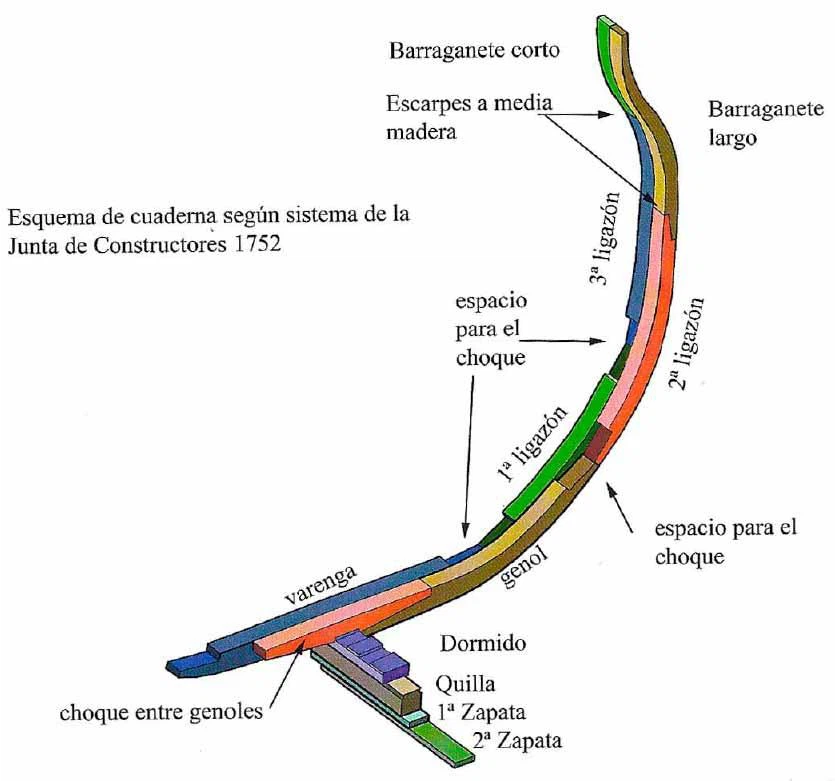
The English framing system consists of two rib frames placed side by side, with their component joints staggered. At each joint, a triangular notch is carved, and a triangular wooden piece is inserted to connect the framing components.
Detailed information about this shipbuilding technique is scarcely available on domestic platforms, and even internationally, very few model makers faithfully recreate it, making it a niche within a niche.
The lap-jointed framing method requires a significant amount of large timber, resulting in much higher construction costs. It was phased out in the early 18th century, with warships transitioning to British and French shipbuilding methods instead.

Next, the central main rib and the main ribs at the bow and stern are installed on the keel. The ribs are secured to the keel using two large iron nails driven diagonally, with one nail on the front side and one on the rear side of each rib.

The three ribs, along with the ribbands nailed to their outer edges, outline the shape of the hull. The ribbands are used to stabilize the position of the ribs and indicate the location and curvature of the ribs yet to be installed. These ribbands are removed once the framing is completed.
In actual warship construction, ribbands are typically installed in sets of five on each side. However, the author, being a model maker, installed only three on each side for this model.

The next step is to fill in the rib frames, completing the midsection of the hull with rib frames. Following this, the rib frames for the bow and stern are installed, and the bow and stern frameworks are sealed.

The rib frames at the bow and stern taper inward and rise progressively from low to high, creating the elegant curved bottom of the sailing ship. The rounded bow is formed by directly filling the space with timber.

Thus, the construction of the hull framework is now complete.

Internal and External Assembly of the Hull
Installing the Inner Bottom Planking and Supports

Once the outer framework is completed, the next step is to install the inner keelson. Grooves are carved on the underside of the keelson to align with the ribs below, and it is secured to the ribs and keel using bolts. The sections of the keelson are joined together using scarf joints.

Then, the inner bottom planking is laid to seal the hull's bottom-specifically, the floor timber sections-leaving only small gaps in the center for purposes such as drainage and ventilation.
Between the floor timbers, materials like lime and gravel are packed to fill and reinforce the hull's bottom. This is not the formal ballast; the formal ballast is placed on top of the inner planking.

Along the edges of the inner bottom planking, a layer of serrated margin planks is laid. The recesses of these planks correspond to the gaps between the ribs, while the gaps themselves align with the edges of the floor timbers.

Wooden blocks are then inserted into these serrated gaps to seal the spaces between the ribs, providing protection for the floor timbers and enhancing waterproofing.\

After this, the mast steps are installed in the hull's bottom. Only the foremast and mainmast steps are located in the hull bottom, while the mizzenmast step is positioned on the quarterdeck.
Transversely arranged arch-shaped beams are installed in the hull bottom to reinforce it as well as the bow and stern, helping to withstand underwater pressure. Above the inner bottom planking, additional inner planking is visible. The inner planking above the hold floor is intentionally spaced with gaps to allow ventilation and prevent moisture buildup.

External Assembly of the Hull

First, the wales-also known as the sheer strakes-are installed. At this stage, the ribbands used as auxiliary construction guides have already been removed. The wales consist of three groups, arranged from bottom to top in layers of three, two, and two planks.
The wales are significantly thicker than ordinary hull planks, forming distinct raised ridges on the completed hull. They serve to tightly brace and reinforce the framework. The thickened planks also provide protection for the crew on the gun deck, a shipbuilding practice later inherited by sailing ships of the line in subsequent eras.

The wales are fastened to the framework using iron nails, with one large nail driven into each frame. Their dark color is attributed to the common practice of coating galleon planks with pitch or tar, as evidenced by surviving oil paintings that show most galleons appearing black or dark brown.
 Next, the bottom planking is completed. Similar to the fastening method used for the wales, each hull plank is secured to every rib with two iron nails, and the butt joints between the planks are staggered.

Under normal circumstances, the hull bottom was protected with a coating made from a mixture of materials such as lime, sulfur, horsehair, and various other substances to safeguard the hull and repel marine borers.
Artists of the time faithfully captured this characteristic, depicting the hull bottom with a yellowish-white appearance.

However, few people are aware that Spain began using lead sheathing to protect hull bottoms as early as 1514. Because its effectiveness was far inferior to the later widespread use of copper sheathing, this method gained little recognition.

The method of applying lead sheathing was quite similar to that of copper sheathing. First, tarred canvas was laid over the hull planking, and then lead plates were overlapped and nailed onto the planks.

After the bottom planking is completed, the next steps involve the installation of internal decks, beams, and pillars. However, to maintain continuity, the external assembly of the hull will be described first.

The hull planking follows the same method as the bottom planking, with gunports already cut out. Three vertical beams are added amidships, a decorative feature characteristic of galleons and often seen on later sailing ships of the line as well.
The planking of the forecastle and sterncastle differs from other hull planking, employing the clinker (or lapstrake) method, which creates overlapping ridges resembling roof tiles. The reason for this is that the clinker method is lighter, helping to reduce weight in the upper part of the hull and enhance stability.

Next comes the decoration of the stern and bow. At the stern, there is a spacious stern gallery, accessible through side doors. The small cabin at the end of the stern gallery serves as the toilet for officers and the captain.
During the galleon era, hull decorations were highly ornate, often featuring elaborate sculptures and intricate paintings.

The bow also features the distinctive large beakhead characteristic of galleons. The forward section of the bow platform consists of grated planks, while the aft section is made of solid wood. The wooden seat with holes along the ship's edge serves as the crew's toilet.
A circular hole can be seen at the center of the bow, which is the mounting position for the bowsprit.

Internal Assembly of the Hull

On the inner planking of the hull's hold, ballast such as stones and iron ingots is placed, with barrels and crates of miscellaneous cargo stacked above. These barrels are filled with water or wine.
At both the forward and aft ends of the hold, there are small compartments enclosed by wooden planks, specifically designated for storing mercury cargo boxes.
This galleon was used for West Indies trade. Since the amalgamation method for refining gold and silver required large quantities of mercury, mercury had to be transported from Spain to the New World. On the return voyage, the ship carried goods from the New World back to Spain.

A brick wall was constructed in the stern to protect and isolate the gunpowder magazine, which is located centrally behind this wall.

The upper level of the magazine is the cartridge-filling room, illuminated by an adjacent lamp room, where gunpowder is loaded into cartridges. Nearby, miscellaneous items such as sacks and timber are stored.


Above the hold are the lower deck beams. One end of each beam is fitted into the lodging knees using dovetail joints, while the upper end is secured with covering knees for clamping. The bases of the deck beams are reinforced with numerous horizontal knees, and vertical knees are also installed above them.
 Movable planks are laid over the deck beams to allow easy access to supplies stored in the hold below.

Like the hold, the lower deck is divided into compartments using bulkheads, which store supplies such as canvas, ropes, and other materials.

Above the lower deck is the lower gun deck. To support the weight of heavy cannons, closely spaced small joists are laid between the deck beams and interlocked with longitudinal beams along both sides of the ship's midsection.

Beneath the deck beams, knees are installed on the sides of the beams to provide vertical support, while the longitudinal beams are also reinforced with pillars. The deck beams are slightly arched in shape to prevent sagging deformation and facilitate drainage.

After the deck beams are planked, the heavy cannons are arranged in a row on the deck, with the weight of the cannonballs around 24 pounds. The gun carriages are also quite distinctive, resembling shortened versions of army gun carriages, unlike the British four-wheeled gun carriages.
Inner planking is installed on the interior walls of the gun deck and painted red. The protruding pillars along the center of the ship serve as bitts for securing ropes.

The mizzenmast step is located at the aft end of the lower gun deck. Since the mizzenmast bears less load, it does not need to be mounted directly on the keel.

Above the lower gun deck is the upper gun deck. The deck framing structure is similar, but the cannons here are of smaller caliber, around 12 pounds.

At the bow of the upper gun deck, hawseholes are drilled for the anchor cables. Behind these holes, vertical wooden boards are installed to block seawater from entering through the openings. Just aft of the hawseholes are the bitts, around which the anchor cables are wound during anchor deployment and retrieval.
 In the midsection of the hull, there are two piston pumps installed to draw water from the bilge and discharge it through scuppers on the sides of the ship.

The lower gun deck is also equipped with a row of scuppers, made of copper, designed to drain water from the deck.

At the stern of the upper gun deck, one of the ship's most critical components is located-the rudder.
The entire rudder is hinged to the sternpost using iron pins. Through an opening in the stern, the rudder stock extends into the upper gun deck, where a tiller is fitted onto it, passing through the deck. The helmsman operates the rudder from the steering room located in the sterncastle.

The ship's wheel was not introduced to Spain until the early 18th century. Before that, galleons were steered using a tiller, which controlled the rudder's angle by pushing and pulling it left or right. This steering method was quite strenuous and offered limited range of motion.

The helmsman stands on a small platform behind the tiller, with their head positioned to observe the deck and rigging through an arched window in the quarterdeck, allowing them to receive commands.

The upper deck features a distinctive diagonal brace, which extends obliquely from the base of the hold deck to support the upper deck beam. A large galleon typically has about six such braces on each side, a characteristic structure particularly associated with Spanish galleons.


Next is the installation of the weather deck, which has a similar structure but with beams far less densely spaced than on the lower decks. The center is covered with numerous grated planks for ventilation and to allow cargo to be hoisted through openings. The midsection of the weather deck also accommodates small boats, spare spars, and other miscellaneous items.
A few cannons, ranging from 6 to 8 pounds in caliber, are distributed on both sides of the forward and aft sections of the deck.

Installation of the forecastle deck. The stove inside the forecastle is visible-the only place on the ship where hot meals could be prepared. The forecastle opens toward the bow through two doors, and two chase guns are mounted on the forecastle deck.

The sterncastle houses the captain's cabin.

The captain enjoys exclusive use of this large cabin, which features finely decorated flooring, furniture, a balcony, and a private toilet, offering a truly luxurious living space at sea.

Next comes the installation of the poop deck and quarterdeck, where the deck slopes noticeably due to the upward sheer at the stern. The quarterdeck is primarily used for hoisting flags and lanterns, and it can also serve as an observation point.

A galleon typically uses more than five anchors, with four main anchors hung on the sides of the hull and additional smaller anchors stored in the hold.
The assembly of the hull is now complete.
Masts and Rigging

The masts are stepped from the deck-the foremast and mainmast extend down to the mast steps on the keel, while the mizzenmast is stepped into its mast step on the quarterdeck. Wooden wedges are used on the deck to secure the masts in place.


All three masts and the bowsprit have been installed. The bowsprit is inserted into the pre-drilled hole under the forecastle and secured with ropes to the beakhead at the bow.
At this point, the crow's nests atop the masts are in place, and the chainplates along the sides have been installed. The next step is to rig the lower shrouds.


After this, the topmasts for the three masts and the bowsprit are installed. The topmast is raised through the cap hole of the mainmast and secured in place with a locking pin once fully elevated. In the illustration, the main topmast is not fully raised but instead partially lowered and suspended using a set of tackle blocks.

The bowsprit is fitted with a small spar called the spritsail topsail yard, a distinctive feature of the early 17th century that was phased out after the 18th century. It carries a square sail and is equipped with corresponding rigging.

This concludes the article. Shipbuilding is a highly meticulous craft, and the focus of this piece has been on the construction of the hull. The internal fitting and rigging have only been briefly outlined.